Sedna's Fingers Become the Seals and Whales
mythic time — the origin of the sea animals · The Arctic Ocean — the moment where the human world ends and the sea world begins
Contents
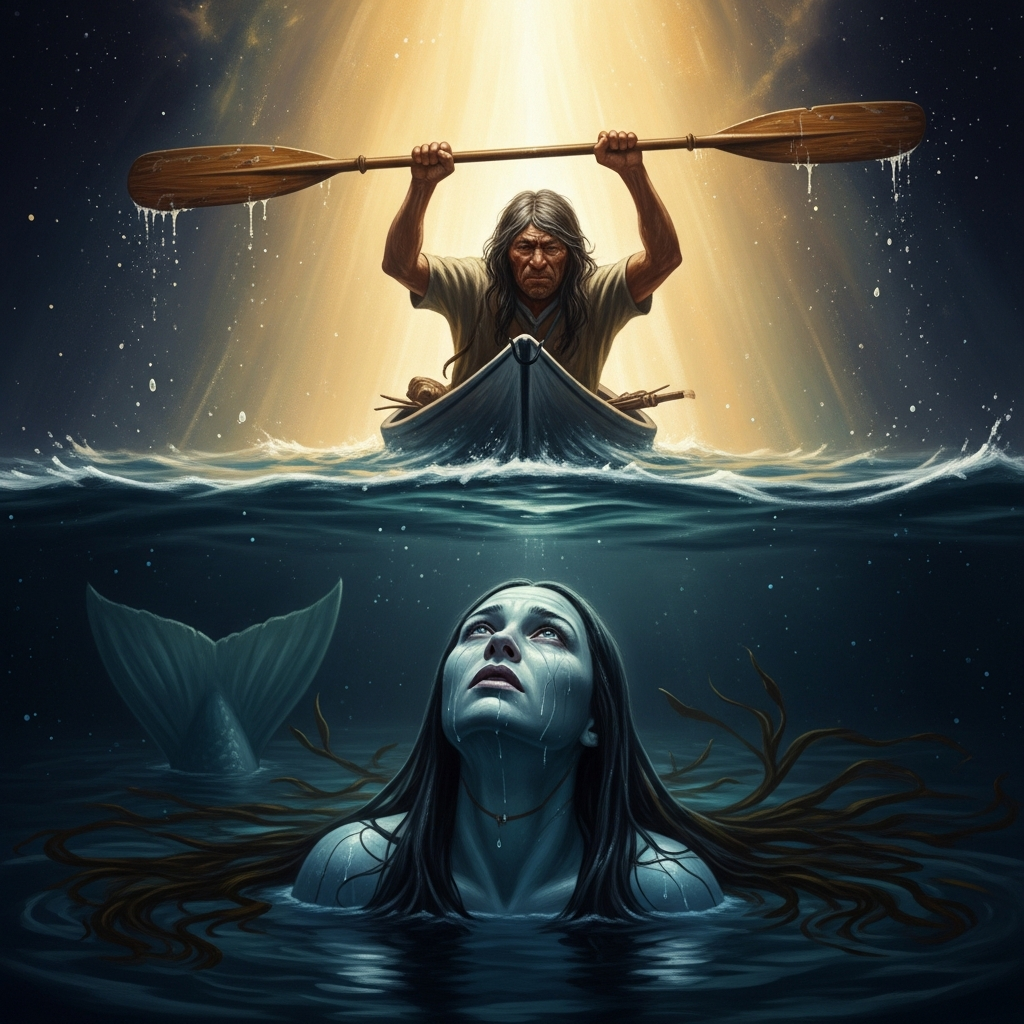
A young woman thrown from a boat into the Arctic sea has her fingers cut away joint by joint — and each joint sinks into the deep and transforms into the seals and walruses and whales that the Inuit depend on for survival, making their food supply the body of a betrayed goddess.
- When
- mythic time — the origin of the sea animals
- Where
- The Arctic Ocean — the moment where the human world ends and the sea world begins
No one agrees on why her father throws her in.
Every community in the Arctic that tells the Sedna story tells it differently, and the differences cluster around this question of culpability. In some versions she has dishonored her family by refusing to marry a suitable man and marrying a stranger who turns out to be a spirit in disguise. In some versions her father threw her in to save the community during a storm — the sea was demanding a sacrifice. In some versions she did nothing wrong at all, and this is the version that carries the most weight of tragedy.
What every version agrees on: she is in a kayak or umiak, in open Arctic water, and she is thrown overboard, and she tries to climb back in, and the people in the boat cut her fingers away.
Joint by joint. The fingers are cut at each knuckle while she grips the gunwale.
The first joints sink and become the ringed seals — the most common, the most available, the seal whose blubber and hide and meat form the foundation of Inuit survival.
The second joints sink and become the bearded seals, the large ones, the seals whose hides are thick enough for boat covers.
The third joints — the last of her grip on the living world — become the walruses and the beluga whales and, in the deepest water, the great whales.
She sinks. She does not die. She settles at the bottom of the Arctic Ocean, in the cold dark of the deepest places, and the sea animals that came from her body circle around her. She is their mother. She controls their release to the human hunters above.
The hunters’ success depends on her goodwill.
She is not reliably willing. The Sedna myth encodes a truth that the Inuit live: the Arctic is not generous by default. The sea does not give its animals freely. The successful hunt is the exception, not the norm, and the failure — the season when the seals do not come, the winter when the whales turn away from the coast — can mean starvation.
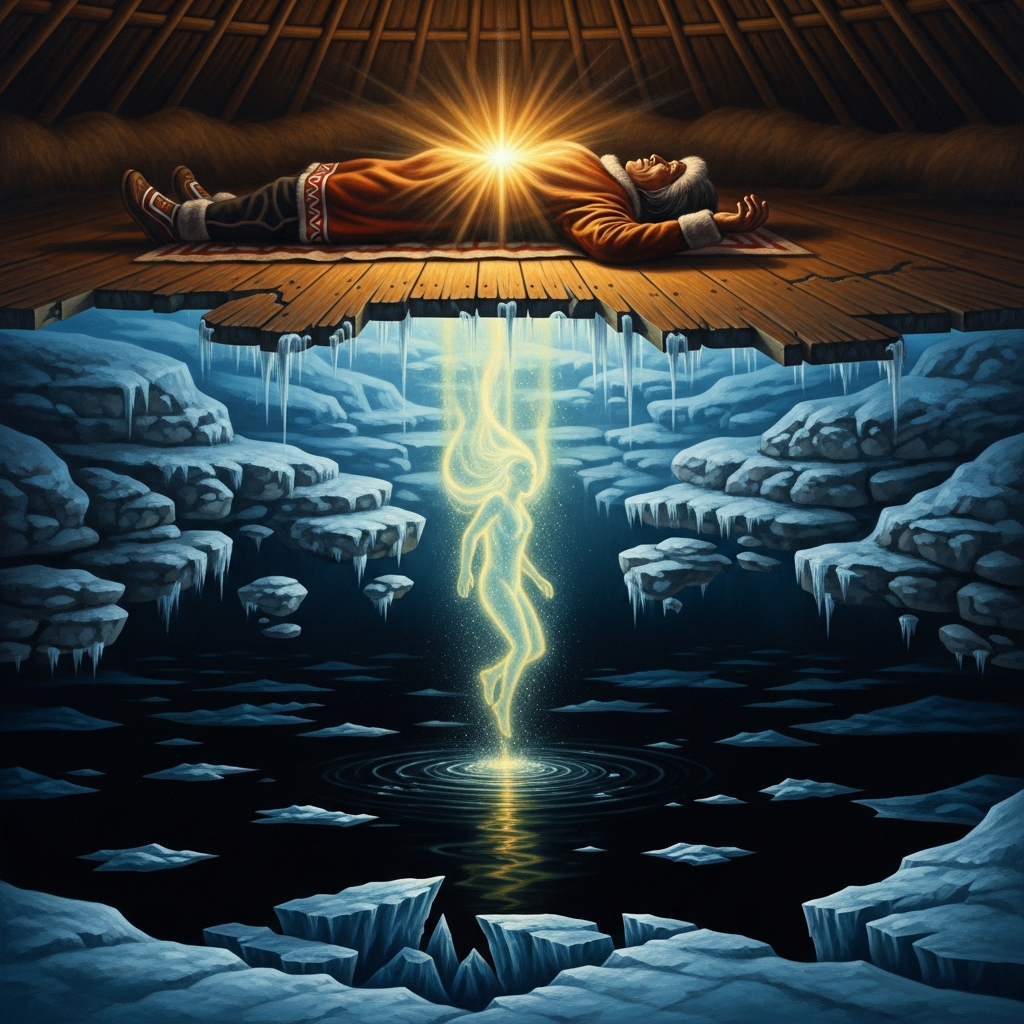
When the animals are withheld, the angakkuq descends.
The technique is specific and demanding: the angakkuq sends his consciousness down through the ocean floor — through layers of water that are progressively darker, colder, more oppressively pressurized — until he finds Sedna in her deep-sea home. Her hair is a tangle. This is key to the diagnosis. Human violations of the sacred rules — wasted meat, improper handling of animal remains, menstrual women approaching hunting equipment, the hundred small protocols that constitute respectful relationship with the sea animals — create tangles in Sedna’s hair. The tangles are visible to the angakkuq as he descends. The worse the violations, the more matted and complex the tangle.
He combs it out.
He brings a comb. Not a physical comb — his physical body is in the snowhouse, in trance. But he brings the spiritual form of a comb, the intention of careful untangling, and he sits beside Sedna in the deep cold and works through her hair with patient attention. He apologizes for each violation he encounters. He does not make excuses. He tells her what the community has done wrong and commits to correction.
She responds to this. Not warmly — she is not a warm being, living in deep water at minus two Celsius — but fairly. She releases the seals when the apology is genuine and the commitment to better behavior is clearly meant. She withholds when the apology is performative.
She is not an entirely tragic figure.
The Inuit relationship with Sedna is complicated, as all relationships with powerful people who have been treated badly are complicated. She has power. She is the source of the food supply. She is enormous, ancient, and impossible to deceive. The angakkuq who descends to her must bring genuine humility — she has heard every self-serving apology and can tell the difference.
But the Inuit are not merely guilty before her. They are also her people, in a sense. They came from the shore where she was thrown overboard. They eat the animals that are her body. They live on the border between the world she was thrown into and the world she was thrown from.
There is a love in this relationship that has survived the betrayal. The combing of her hair is an act of tenderness as much as an act of negotiation. The angakkuq sits with her in the dark at the bottom of the world and tends to her — and she, who has been alone in the cold since the beginning, accepts this tending.
The seals surface at the breathing holes.
The whales come close to the coast.
Her hair is smooth for another season.
Echoes Across Traditions
Entities
- Sedna (Nunavut: Kannaaluk; Alaska: Arnapkapfaaluk)
- the man who deceived her into marriage
- her father who throws her from the kayak
- the seals, walruses, whales (her finger joints)
- the angakkuq who combs her hair
Sources
- Rasmussen, Knud, *Report of the Fifth Thule Expedition 1921-1924* (Copenhagen, 1929)
- Laugrand, Frédéric and Oosterens, Jarich, *The Sea Woman* (Alaska, 2008)
- Merkur, Daniel, *Powers Which We Do Not Know* (Idaho, 1991)