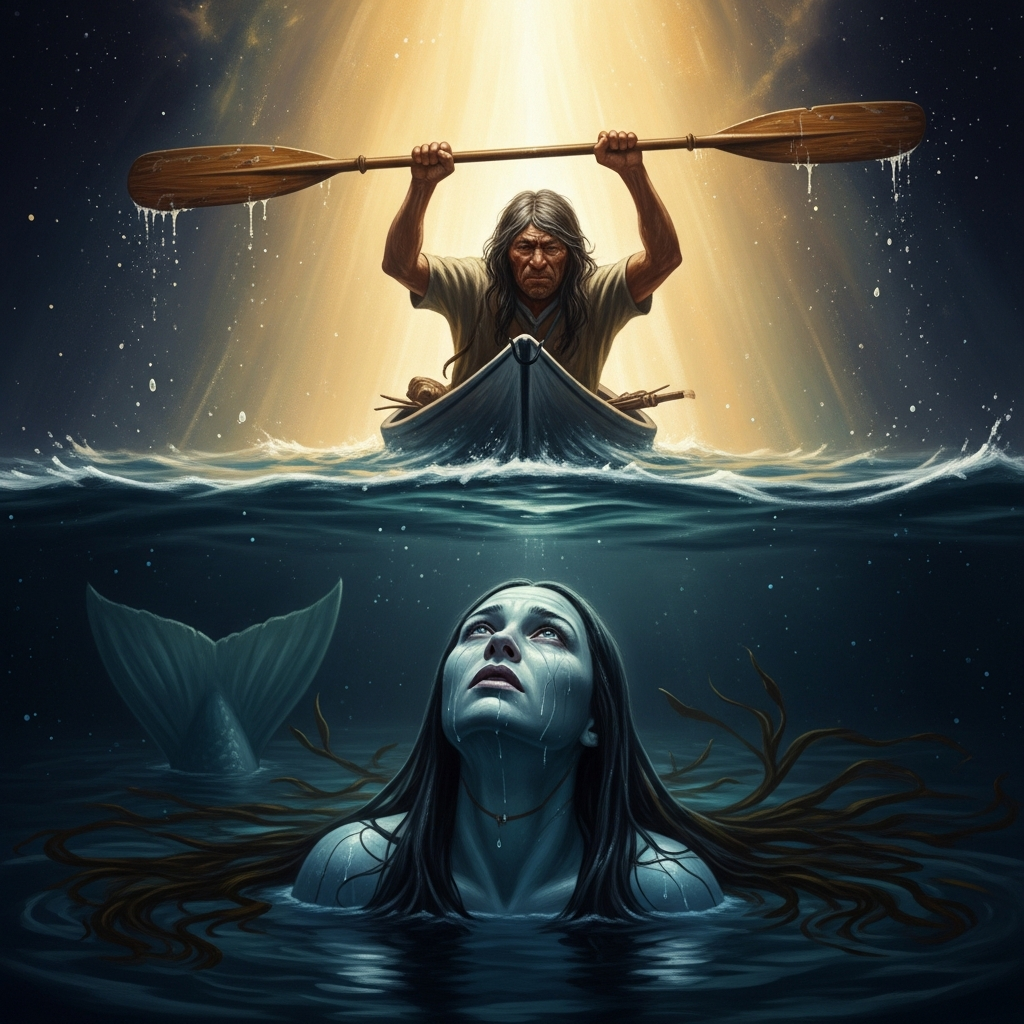
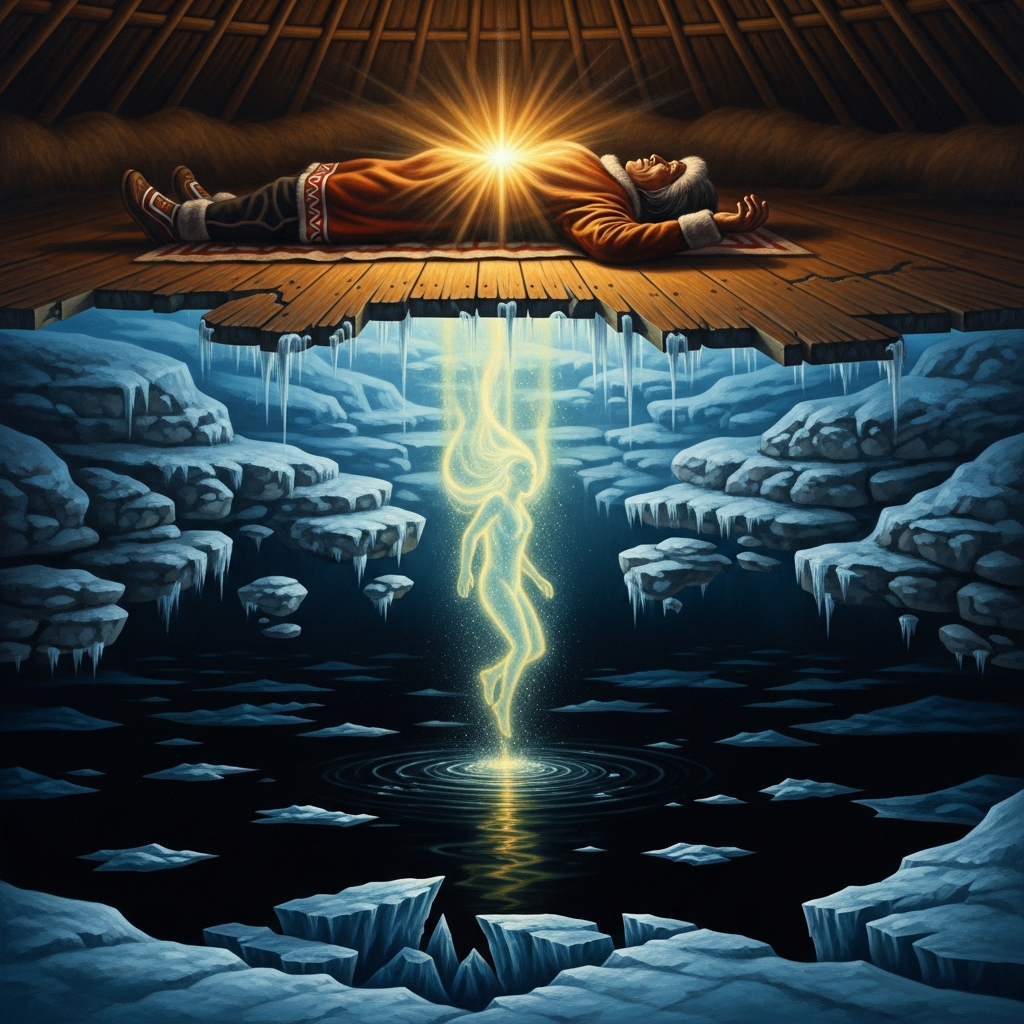
The Polar Bear Who Took Off His Fur
traditional time — the time when the worlds of humans and animals were not fully separate · The Arctic ice — the polar bear's territory, which overlaps with the Inuit hunter's territory in the most contested and sacred way
Contents
An Inuit story of the man who follows a polar bear home and discovers that inside the fur there is a person — the bear who is a person in disguise, and the person who is a bear at heart, and the hunt that is always also an encounter between kinds.
- When
- traditional time — the time when the worlds of humans and animals were not fully separate
- Where
- The Arctic ice — the polar bear's territory, which overlaps with the Inuit hunter's territory in the most contested and sacred way
The bear walks on the far side of the pressure ridge.
The hunter has been following its tracks for three days, moving carefully in a silence he has practiced his whole life — no unnecessary sound, breath slow, movement only when the wind is right. He is not gaining on the bear. The bear is aware of him. This is normal: polar bears are aware of everything in their territory. What is unusual is that the bear is not running.
It is walking at a pace that he can just follow.
He begins to understand, on the second day, that he is not hunting the bear. The bear is leading him somewhere.
On the third night, the bear stops at what looks like an ordinary pressure ridge — the kind where sea ice has buckled and stacked, creating a labyrinth of blue-white slabs fifteen feet high. The bear sits down facing a specific gap between the slabs. Then it does something the hunter has never seen: it reaches back with one paw and removes its fur.
Underneath the fur there is a man.
He is an older man, broad-shouldered, with the particular look of someone who has spent his life in cold weather. He shakes himself. He looks at the hunter without alarm. He says, in Inuktitut — the hunter’s own language — that he has been expecting him.
The man-who-is-a-bear leads him through the gap in the pressure ridge and into a passage that goes down. This is the moment in every version of this story where the rational mind says: this is not what I am seeing. The hunter has been raised in an animist cosmology where the boundary between human and animal is genuinely permeable, where the angakkuq transforms, where the spirit world is adjacent to the physical. He is shaken but not unbelieving.
The house below the ice is warm. There are other bears — other bear-people, a family, children who are somewhere between cub and child depending on the light. The man-who-is-a-bear introduces his wife, his sons. The wife offers food — it is seal, prepared the way the hunter’s own family prepares it.
He stays for what feels like three days but will turn out to have been one night.
The man-who-is-a-bear tells him why he was led here.
There has been a violation of protocol. Not by this hunter specifically, but by his community: the head of a bear killed two seasons ago was not disposed of correctly. The bear’s spirit has been unable to return to the bear-people’s country because the skull is in the wrong place, held by the wrong people, not returned to the sea as the protocol requires.
The bear-man is not angry. He is practical. The skull needs to be returned. The seal-oil offering that should have been made should still be made, late as it is. These things can be corrected. He explains how. He explains why — because the bear people and the human people have an agreement that is very old, older than anyone’s memory, and the agreement only holds if both sides honor it.
The hunter is being told this because he will be believed. He is a reliable witness. The community will make the correction when he returns.
The bear-man puts his fur back on.
He is a polar bear again immediately, without transition — the man is gone and the bear is there. He walks the hunter back to the surface through a passage the hunter cannot find again later. He stands at the surface for a moment. He looks at the hunter.
He dives into the sea.
The hunter returns to camp.
He goes directly to the angakkuq and tells him everything. The angakkuq listens without interruption, which is itself notable — the angakkuq is not a patient man — and at the end he says: yes. This is what we have been waiting to understand.
The skull is found in the storage cache of a family who has kept it as a trophy. The family is not shamed — they did not know the protocol fully. The skull is returned to the sea at the next high tide with the proper words and the oil offering. The angakkuq performs the ceremony of apology.
The following season’s polar bear hunting is good.
The hunter, for the rest of his life, is the person in his community who carries the knowledge of what bears actually are: people in furs, inhabiting a parallel version of the same territory, bound to the humans by an agreement that requires maintenance. When he hunts bears, he hunts with that knowledge. He thanks the bear he kills. He follows the protocol.
He sometimes feels, in the moment after a kill, that the bear is looking at him from somewhere behind its eyes and is satisfied with how the thing was done.
Echoes Across Traditions
Entities
- the polar bear (Nanuq)
- the hunter who follows the bear
- the bear's family in their house under the ice
- the bear-person's wife
- the angakkuq who teaches the hunter what he saw
Sources
- Rasmussen, Knud, *Across Arctic America* (New York, 1927)
- Merkur, Daniel, *Powers Which We Do Not Know* (Idaho, 1991)
- Ipellie, Alootook, *Arctic Dreams and Nightmares* (Theytus, 1993)