The Northern Lights Are the Souls Playing Football
traditional time — the ongoing relationship between living and dead under the Arctic sky · Labrador coast, Arctic Canada — where the aurora is most brilliant and the land of the dead most visible
Contents
The Inuit of the Labrador coast have a precise understanding of the aurora borealis: it is the souls of the dead playing games in the sky with a walrus skull, and whistling back at them is both a greeting to the ancestors and an invitation to come closer.
- When
- traditional time — the ongoing relationship between living and dead under the Arctic sky
- Where
- Labrador coast, Arctic Canada — where the aurora is most brilliant and the land of the dead most visible
The lights come up green tonight, which is the best color.
They appear first at the northern horizon as a pale curtain, then strengthen into the moving bands that the Inuit of the Labrador coast have been watching from their camps since before their ancestors’ memory. The children know what to do: you whistle.
A soft whistle, not commanding — an invitation. You are acknowledging that you can see them. You are saying: I am here, I know you are there, I am glad to see you.
The lights come closer.
The dead are not far.
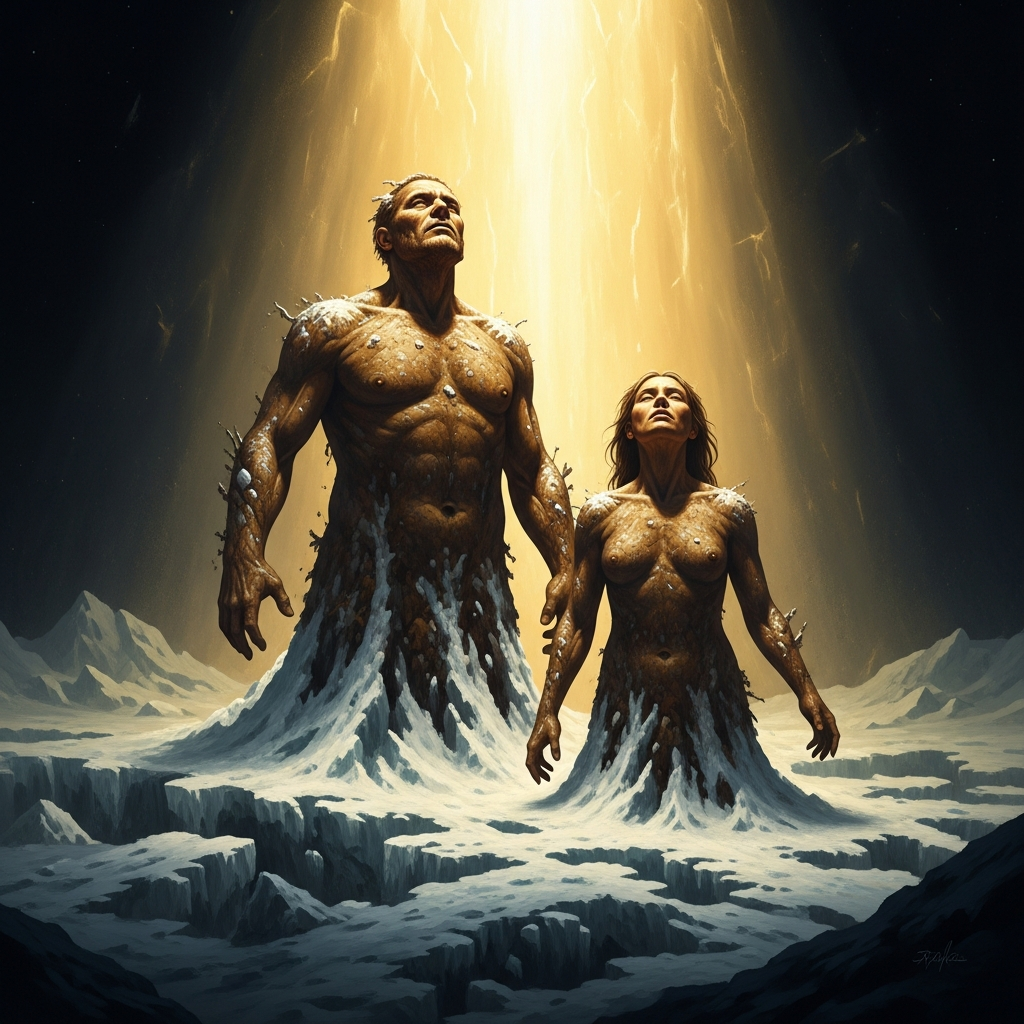
This is a foundational Inuit principle that runs through the afterlife cosmology of every Arctic community, though the details vary: the dead are not gone, they are in a place that is adjacent to the living world and accessible under certain conditions. For the Labrador coast people, the sky is the primary location of the dead’s country, and the aurora is the most visible and joyful evidence of what happens there.
The dead play games. This is specific and consistent across the tradition. They are not suffering. They are not being judged. They are not in a state of waiting for something else. They are doing what the Inuit do when work is done and the night is long: they play.
The game is a version of football — a kicking game played with something round. The walrus skull is the ball. The colors the aurora makes when it moves are the movement of the game: the greens and whites when the action is in the center of the field, the reds when someone has scored or made a brilliant play, the deep blues when the game pauses and the players rest.
When you whistle, you are not summoning the dead — you are acknowledging them. The lights come closer because the dead are responding to a greeting. They swing down from the sky in a long arc, and if the night is very clear and very still, you can sometimes hear something that is not quite a sound coming from the direction of the moving lights — the Inuit say it is laughter.
The angakkuq knows the players by name.
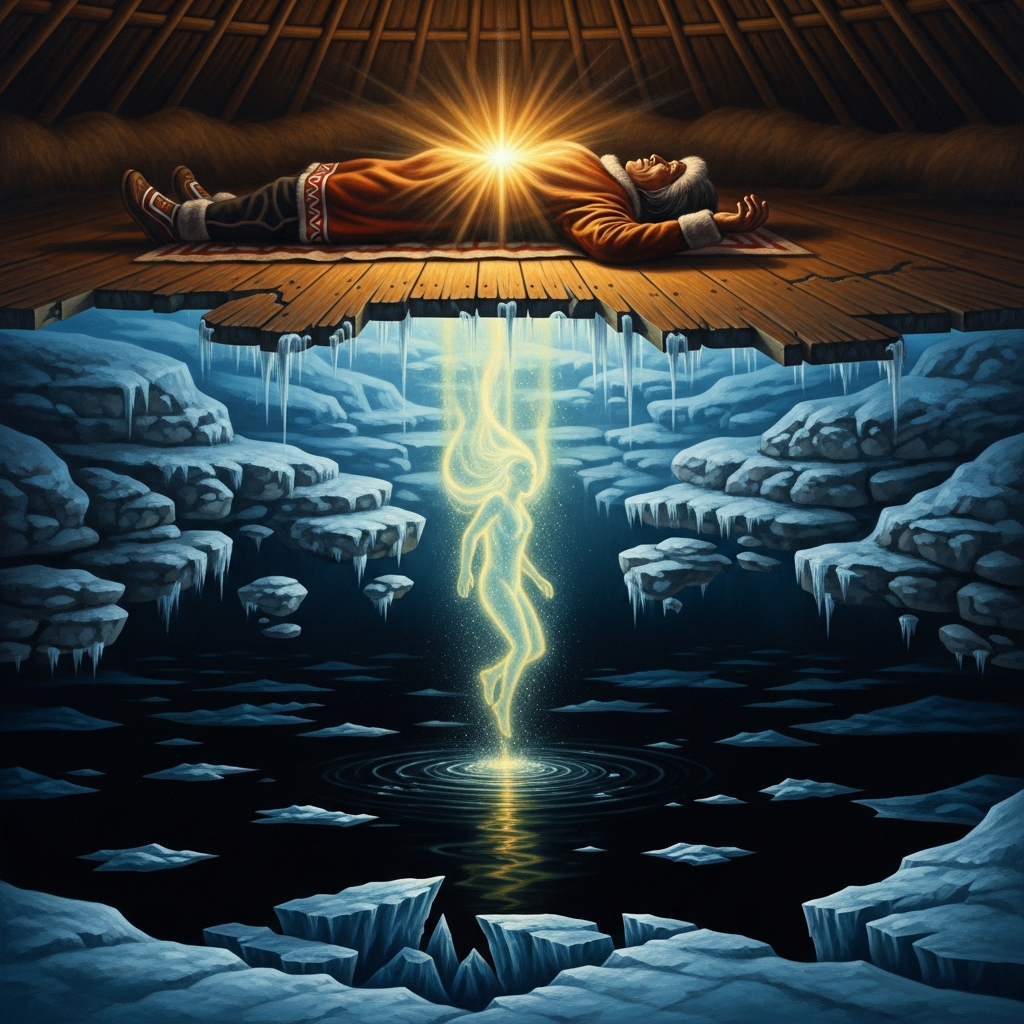
This is the specific knowledge that distinguishes the shaman’s relationship to the aurora from the ordinary person’s relationship. The angakkuq, in deep trance, can look at a specific section of the aurora and read who is there — which ancestor, which recently dead community member, which spirit that has been in the sky for generations. He can carry messages. He can bring back information.
A woman who died three winters ago in difficult circumstances — a birth that went wrong, a loss that her family has not been able to resolve — is in the sky tonight. The angakkuq, at the family’s request, sends a greeting to her specifically. Not a whistle but a directed thought, the specific call that goes to one person in a crowd: he names her.
The aurora shifts. A ribbon of green that has been at the northern edge moves south and then sweeps in a long loop that brings it directly overhead, directly above the snowhouse where her family is watching through the smoke-hole they have opened for this purpose.
The family says: she came.
Whether what moves the aurora is the dead woman’s response or the chance motion of charged particles in the magnetosphere is a question that belongs to a different cosmological framework. In the Inuit framework, the aurora is the dead at play, and the dead respond when called, and the family’s grief is eased by the green ribbon overhead that is as close to a visit as the living can receive.
The children whistle again.
The dead come closer, curious about the small warm beings below the smoke-holes, curious about the living world they remember, moving their lights across the enormous dark sky in patterns that look, if you watch long enough, exactly like people playing.
Echoes Across Traditions
Entities
- the souls of the dead (in aurora form)
- the walrus skull they play with
- the living Inuit who watch and whistle
- the angakkuq who knows the dead by name
- the sky as the land of the dead
Sources
- Merkur, Daniel, *Powers Which We Do Not Know: The Gods and Spirits of the Inuit* (Idaho, 1991)
- Laugrand, Frédéric and Oosterens, Jarich, *The Sea Woman* (Alaska, 2008)
- MacDonald, John, *The Arctic Sky: Inuit Astronomy, Star Lore and Legend* (Royal Ontario Museum, 1998)