Chi: The God You Carry With You
From before birth to after death — the chi accompanies the person through every moment · Inside every Igbo person — the chi has no external location, it is coextensive with the person it inhabits
Contents
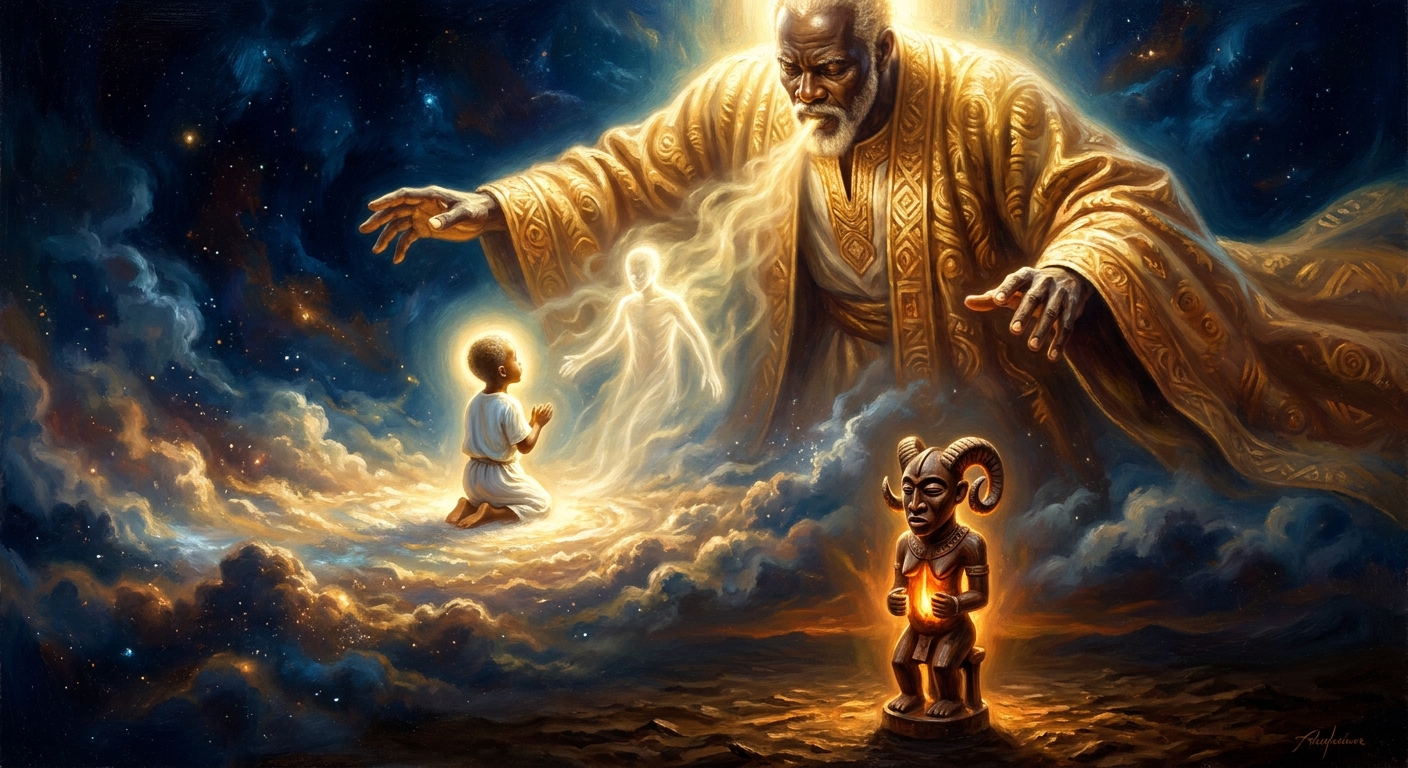
Every Igbo person has a *chi* — a personal divine double, assigned before birth, that determines the broad shape of a person's destiny while leaving room for individual will to negotiate within that shape.
- When
- From before birth to after death — the chi accompanies the person through every moment
- Where
- Inside every Igbo person — the chi has no external location, it is coextensive with the person it inhabits
Before you are born, you have a conversation with Chukwu.
In this conversation — which you will not remember — you choose, or are given, the broad shape of your life: whether you will be prosperous or poor, whether you will have many children or few, whether your death will come early or late, whether your accomplishments will be celebrated or forgotten. This assignment is your chi: the personal divine presence that Chukwu attaches to you at the moment before you enter the world.
Then you are born, and you forget the conversation.
The chi stays. It inhabits you — not as a separate entity that you carry alongside you the way you carry a child on your back, but as something more intimate than that, something more like a second self, a spiritual density inside the self, the divine counterpart to your human personality. It cannot be separated from you without consequences. It is not external to you in any meaningful sense. And yet it is not entirely you — it is the part of you that was assigned by Chukwu, the part that determines what is possible.
The most famous statement about chi in the Igbo tradition is: Onye kwe, chi ya ekwe — when a person agrees, his chi agrees.
Chinua Achebe, who is the most penetrating analyst of Igbo religious concepts in any language, wrestles with this sentence at length in his essay “Chi in Igbo Cosmology.” On the surface it seems to say that a person’s chi simply follows their will — that destiny is what you make it. But Achebe notes that it can also be read in the opposite direction: if a person agrees, then their chi agrees, which implies that the chi’s agreement is what makes the thing actually happen. The person’s will is necessary but not sufficient. The chi’s cooperation is also required.
This is not a minor theological puzzle. It is the central tension in the Igbo understanding of human life.
Are you living out a script that was written before your birth? Or are you writing as you go? The answer seems to be: both, within constraints whose edges are not visible to you. The chi sets the range of the possible. Within that range, your choices are real choices, with real consequences, and the wrong choices can waste a good chi’s potential while the right choices can make even a difficult chi yield a good life.
The proverb the Igbo use is: A person who refuses to get up early will not find any good thing in the market. The chi does not do the getting up. The person does. But the chi determines what is available in the market when you get there.
A bad chi is a serious diagnosis.
When a person’s life is persistently unfortunate — not just bad luck but the grinding, inexplicable pattern of failure despite effort and virtue — the Igbo recognize this as a chi problem. The person may have been assigned, before birth, a chi that was not adequate to the life they arrived in. Or the person may have made choices that degraded a good chi. Or the person may have been born at an inauspicious time, with an inauspicious name, in circumstances that have created a bad arrangement between their human self and their divine double.
The response to a bad chi diagnosis is not resignation. It is ritual recalibration.
Diviners identify what is wrong with the chi relationship and prescribe specific corrective ceremonies. A new name may be given — because the name is a direct invocation of the chi’s relationship with the person, and the wrong name creates interference. Specific sacrifices at specific shrines may be required. The person’s patterns of behavior may need to change so that they are not working against their chi’s nature.
The chi can be worked with. It cannot be replaced, and it cannot be overridden by force of will alone. But a skilled diviner, working with the person and the chi together, can negotiate a better arrangement.
The chi departs at death.
Or rather: at death the chi withdraws from its partnership with the human personality and returns to Chukwu for reassignment. The person’s consciousness — the self that the chi animated — disperses into the ancestor world, becoming one of the ndichie, the elder ancestors. The chi is available to be sent out again with another person, perhaps a grandchild, which is why Igbo families look at newborns for the signs of reincarnated ancestors: a gesture, a characteristic behavior, a birthmark in the location of an old wound.
The chi going out and coming back, out and coming back — this is the rhythm of the divine life circulating through the human world.
You carry a god with you.
You will not remember the conversation you had with Chukwu before birth, but the chi remembers. The chi is the memory of that conversation, embodied in you, the divine shape you were given before you became the human self that has opinions about it.
The human self has opinions about everything.
The chi is silent. It is the shape that all the opinions move inside of.
Echoes Across Traditions
Entities
- Chi
- Chukwu
- The individual person
Sources
- Achebe, Chinua, 'Chi in Igbo Cosmology,' in *Morning Yet on Creation Day* (Heinemann, 1975)
- Uchendu, Victor C., *The Igbo of Southeast Nigeria* (Holt, Rinehart and Winston, 1965)
- Metuh, Emefie Ikenga, *God and Man in African Religion* (Chapman, 1981)
- Chukwu, D.C.O., *The Igbo World and its Art* (Ethnographica, 1984)