Amadioha: Thunder as Justice
Historical and mythic — Amadioha is invoked in specific situations, not merely worshipped in general · The sky above Igboland — his shrines are on hilltops and in sacred groves across southeastern Nigeria
Contents
The Igbo thunder god strikes not at random but as the arm of divine justice — he is the executioner of the cosmic moral order, called upon to judge oaths, punish liars, and vindicate the wrongly accused.
- When
- Historical and mythic — Amadioha is invoked in specific situations, not merely worshipped in general
- Where
- The sky above Igboland — his shrines are on hilltops and in sacred groves across southeastern Nigeria
The accused stands before the shrine.
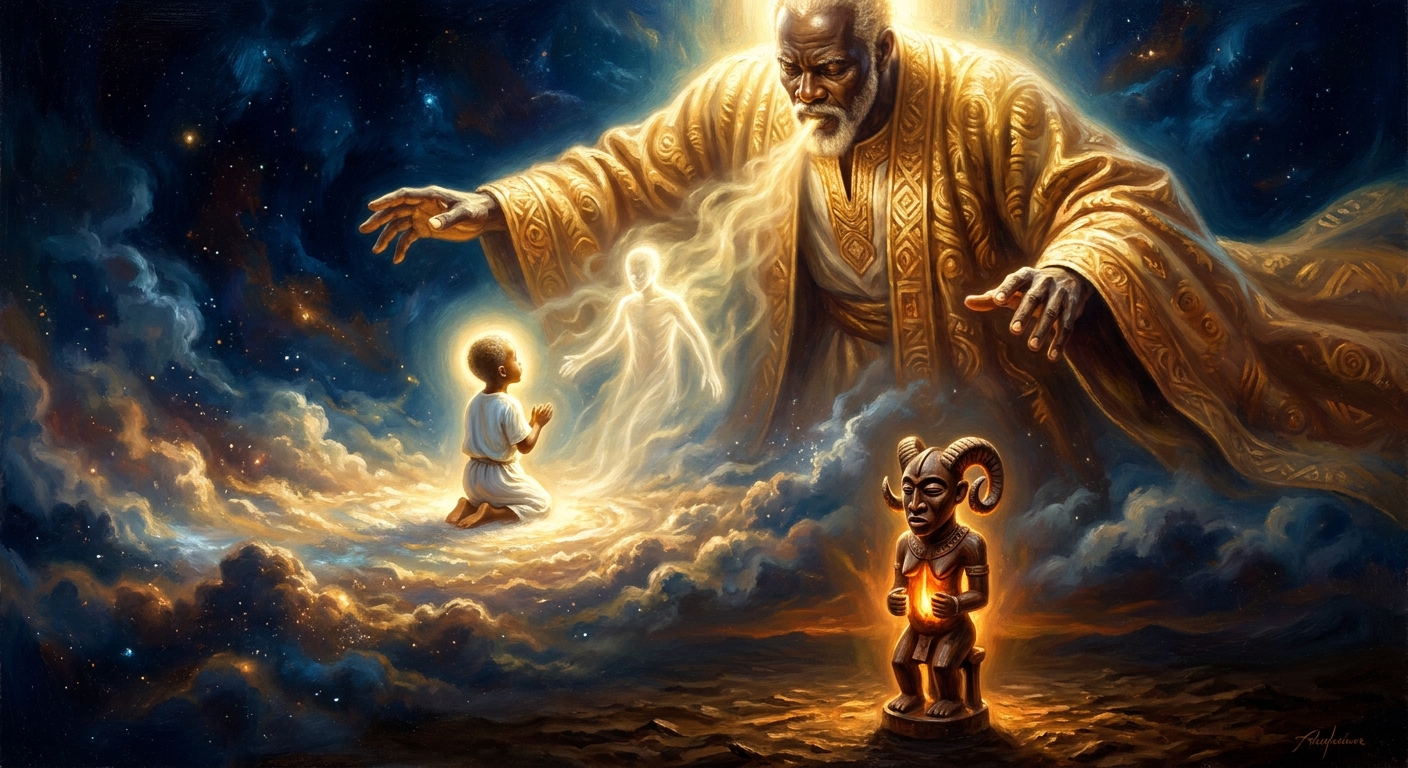
The shrine of Amadioha is usually outdoors, on a hill or at the base of a large tree, marked by a white-painted stone and sometimes by the skull of a ram. The priest stands between the accused and the stone. The community — the people who have brought the accusation, the family of the accuser, the elders who will observe the oath — forms a half-circle.
The accused picks up a piece of wood or a stone or some other object that the priest has prepared. He speaks the oath: I did not commit this act. If I am lying, let Amadioha kill me and my house.
Then he waits.
If he is telling the truth, nothing happens, and the accusation fails. If he is lying, Amadioha will come for him. It may not be today or this week. But the thunder god does not forget, and the community does not forget, and when the lying man sickens or his house catches fire or his child dies — the community knows why, and the community remembers who called for it.
Amadioha is the visible arm of a moral universe.
The Igbo believe that the universe has a moral structure — that it is not neutral ground on which humans happen to behave well or badly, but that the cosmic order itself requires justice, that injustice creates an imbalance that the universe tends to correct. Amadioha is the corrective mechanism made personal. He is not random lightning striking random trees. He is the divine judgment working itself out through the medium of the storm.
His targets are specific. He strikes oath-breakers. He strikes those who kill unjustly within the community. He strikes those who desecrate Ala, the earth goddess, because the two great moral powers of Igbo religion — earth and sky, female and male — operate in tandem: Ala defines what is right, and Amadioha enforces it.
He is also available for protection.
A person who has been wrongly accused, who cannot prove their innocence through normal means, can make the oath of Amadioha and thereby put the matter in divine hands. This is both a claim of innocence and a terrifying act of trust. If the accuser has been lying, the oath-taker has just publicly put their faith in a cosmic process they cannot control. If the accused has been telling the truth, they have just done the bravest thing a person can do: said to the universe, I am right, and I am willing to bet my life and my family’s safety on it.
His color is white.
Everything about Amadioha is white — the white ram that is his sacrifice, the white clay applied to the bodies of those who approach his shrine, the white stone that marks his presence. White in Igbo symbolism is the color of spiritual power, the color of the ancestors, the color of things that are not from this world even though they operate in it. White is what Igbo priests wear. White is what a person in spiritual crisis is rubbed with.
Amadioha’s whiteness means he is not merely a natural force. Lightning is not white in the Igbo understanding — lightning is red and violent and uncontrolled. Amadioha is controlled lightning, aimed lightning, the lightning that goes where it needs to go. His whiteness is the whiteness of moral precision.
The white ram offered to him is killed at the shrine and its blood poured on the sacred stone. The sacrificer must be clean: no recent sex, no contact with death, no outstanding debts unpaid. Amadioha, who is himself morally precise, requires moral precision in those who approach him.
There is a story told about Amadioha and a wealthy man.
The wealthy man had falsely accused a poor man of stealing, and the poor man had been publicly shamed and had lost his market trading privileges because of the accusation. The poor man came to Amadioha’s shrine with nothing to offer — he had nothing, the false accusation had taken it — and made the oath on his own behalf: the wealthy man lied; let truth be made clear.
Three months later the wealthy man died of something that should not have killed him — a small wound that became infected in a hot week, unremarkable except for its timing. The community remembered the poor man’s visit to the shrine. They understood.
The poor man was restored to the market. His accusation was publicly declared false. He received a portion of the wealthy man’s property as restitution.
Amadioha did not attend the settlement meeting.
He had already done his work.
The thunder that had fallen in the wealthy man’s body three months earlier was the same thunder that strikes the sky in the rainy season: sudden, final, impersonal in its precision.
Justice does not need to be personal. It needs only to be accurate.
Echoes Across Traditions
Entities
- Amadioha
- Ala (earth goddess)
- The white ram
- The oracle priests
Sources
- Achebe, Chinua, *Things Fall Apart* (Heinemann, 1958)
- Achebe, Chinua, *Arrow of God* (Heinemann, 1964)
- Isichei, Elizabeth, *A History of the Igbo People* (Macmillan, 1976)
- Metuh, Emefie Ikenga, *God and Man in African Religion* (Chapman, 1981)