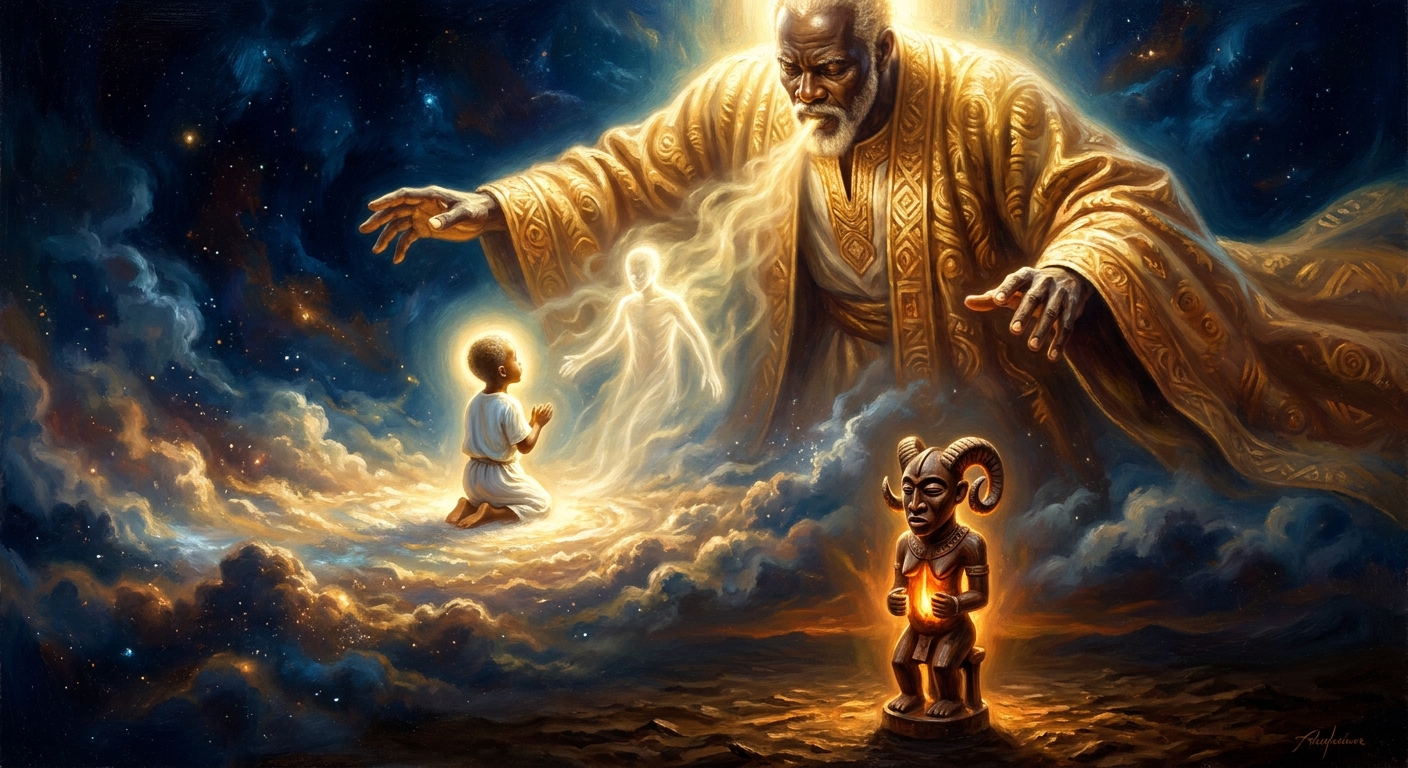
Ala Holds the Dead in Her Womb
From the beginning of Igbo time — Ala is the earth itself, not a historical deity · The earth itself — specifically the Igbo homeland of southeastern Nigeria, the red laterite soil of the Niger delta hinterland
Contents
The earth goddess Ala is simultaneously the mother of the living, the keeper of moral law, and the womb to which the dead return — the most powerful deity in the Igbo world, whose law even the thunder god must respect.
- When
- From the beginning of Igbo time — Ala is the earth itself, not a historical deity
- Where
- The earth itself — specifically the Igbo homeland of southeastern Nigeria, the red laterite soil of the Niger delta hinterland
She is beneath you now.
Every step you take on Igbo soil, you walk on Ala. She is not merely the physical substance of the earth — the red clay, the loam, the rock beneath the soil — though she is that too. She is the moral force that the earth embodies: the law that is not written down anywhere because it does not need to be written, because it is the ground itself.
Ala holds the dead.
When a person dies and is buried in Igbo country, they enter Ala’s womb. The earth does not consume them in the merely chemical sense. She receives them, the way a mother receives a child who has come home. The dead are in her. They are not gone; they are held. When the rains fall and the crops grow, it is in part because Ala is channeling the vitality of her held dead upward through the soil. The fertility of the earth is the generosity of the dead, mediated by the goddess.
This is why the crime of burying someone outside the community — the punishment inflicted on people who died badly, who died in ways that contaminated them — is so serious. To be excluded from the earth of the ancestors is to be excluded from Ala’s holding, to become a wandering thing rather than a returned thing.
Ala’s law is called omenala.
Omenala is usually translated as custom or tradition, but the translation loses something. Omenala means what happens in the land, where land is Ala herself. The customs of the community are not arbitrary historical accretions. They are the law of the goddess expressed through community practice. When the elders say this is how we do things, they are not appealing to mere convention. They are speaking for the earth.
The crimes that violate omenala directly are called nso-ala — taboos of Ala, desecrations of the earth. These include murder within the community, incest, the birth of twins (in older practice, which has largely changed), adultery by a pregnant woman, using violent language in Ala’s sacred spaces, and cutting certain trees that are her body.
When nso-ala is committed, the community enters a state of contamination. Ala has been offended. Her offense is not merely personal displeasure — she is the ground you stand on, the earth that grows your food, the womb that holds your dead. Her displeasure is environmental catastrophe: failed crops, disease, misfortune that extends across the entire community rather than staying with the individual offender.
Purification is therefore a community matter, not merely a private one. The individual who committed the offense must be expelled or treated. The community must perform the ceremonies that restore their relationship with the earth. Until this is done, everyone is at risk.
The Mbari houses are built for her.
Every few years, in certain Igbo communities, the goddess requires the construction of a Mbari — a large mud house filled with painted clay sculptures, a vast three-dimensional offering of artistic labor. The sculptures represent everything in the world: Ala herself, seated with a child in her lap and weapons in her hands; Amadioha the thunder god; the colonial officer; the hospital nurse; the market woman; the animal of the forest; the spirit of the river.
The building of the Mbari takes months and involves selected artists who live in a state of ritual seclusion while they work. They cannot go to their families. They cannot eat certain foods. They work in a state of sacred concentration, because what they are making is not art in the secular sense — it is an offering of form, of human creativity, to the goddess who is the source of form.
When the Mbari is complete, a ceremony opens it to the public. Then it is left to the elements. Ala does not want her Mbari preserved. She wants the labor, not the product. The houses return to earth — which is to say they return to Ala — over the following years, as the clay softens in the rains and the figures blur and dissolve back into the ground from which they were made.
The offering was the making. The return is the completion.
Thunder defers to earth.
Amadioha, the thunder god, is powerful — the lord of the sky, the divine executioner who strikes down the guilty with lightning. But in Igbo cosmology, Amadioha’s authority operates within the framework of Ala’s law. He punishes what she declares punishable. He does not punish at his own discretion. The sky god’s power is real, but it is downstream of the earth goddess’s moral authority.
This is unusual in world religion, where the sky god almost always sits at the top of the divine hierarchy. The Igbo arrangement — in which the moral authority belongs to the earth, not the sky — reflects an agricultural people’s deep knowledge that the ground is more fundamental than the weather. Weather changes year to year, season to season, storm to storm. The ground remains. The ground is there before the storm and after it. The ground is where the grain grows and where the dead go and where you build your house and from which you will not be separated for as long as you live.
She is beneath you now.
She has always been beneath you.
Her law is the law you are already living inside of, whether you know it or not.
Echoes Across Traditions
Entities
- Ala
- Amadioha (thunder god)
- Chukwu
- The Mbari
Sources
- Cole, Herbert M. and Chike C. Aniakor, *Igbo Arts: Community and Cosmos* (Museum of Cultural History, UCLA, 1984)
- Achebe, Chinua, *Arrow of God* (Heinemann, 1964) — cultural context for Igbo religion
- Ottenberg, Simon, *Double Descent in an African Society* (University of Washington Press, 1968)
- Ilogu, Edmund, *Christianity and Ibo Culture* (Brill, 1974)