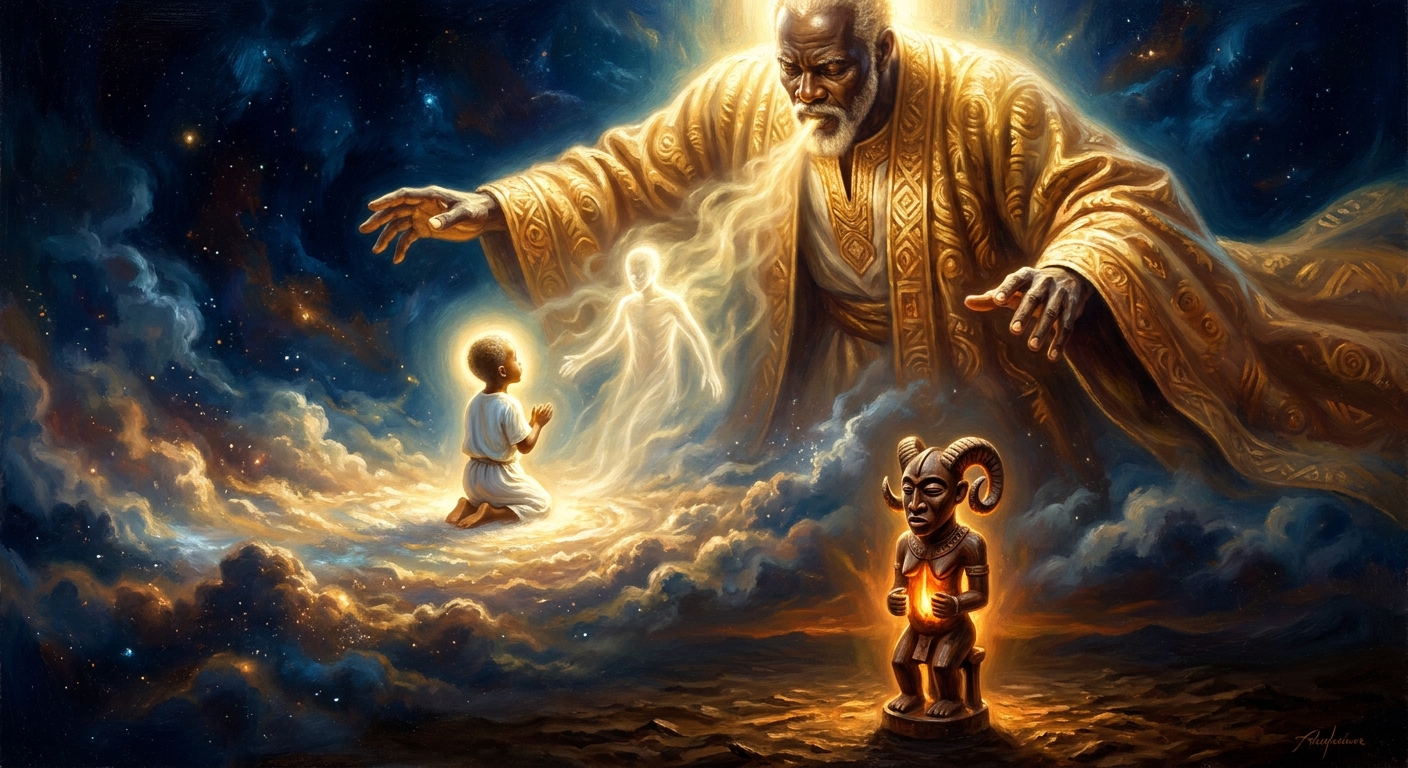
Chukwu: The Great God Too Big to See
Before time and continuously — Chukwu is not a historical figure but an ongoing reality · Everywhere and nowhere — Chukwu has no specific home, unlike the Arusi who inhabit specific rivers, trees, and hills
Contents
The supreme creator of the Igbo people is so immense that no statue can represent him, no temple can contain him — he is approached only through the lesser spirits called Arusi, the way a commoner approaches a king through intermediaries.
- When
- Before time and continuously — Chukwu is not a historical figure but an ongoing reality
- Where
- Everywhere and nowhere — Chukwu has no specific home, unlike the Arusi who inhabit specific rivers, trees, and hills
He has no face.
Every other divine being in the Igbo world has a representation: the river goddess has her white clay and her python; the thunder god has his ram and his red; the earth goddess has her python and her sacred groves. Artists have been making their faces for centuries, carving the specific gesture of each divine personality into wood and clay and ivory.
Chukwu has no representation. There is no mask for him, no carved figure, no way to say here, this is what he looks like. The question of what Chukwu looks like does not arise, because Chukwu is not the kind of thing that has a look. He is the condition in which all things with looks exist.
Chi-ukwu: the great Chi, the supreme spiritual force. The name tells you everything about how the Igbo understand him and nothing about what he looks like. He is not described by his appearance but by his magnitude.
You do not pray to Chukwu directly.
This is the practical consequence of his immensity. A farmer whose crops are failing, a woman whose child is sick, a man whose cattle are dying — these people have immediate needs, and Chukwu, who made the universe, is not the right address for immediate needs. The right address is the Arusi: the lesser divine beings who inhabit specific rivers and hills and trees and ancestral lineages, who are local in the way Chukwu is not local, who can be approached, argued with, satisfied, and thanked.
The relationship between Chukwu and the Arusi is often described using the analogy of political hierarchy. Chukwu is like a great king — so great that ordinary citizens do not have direct access. The Arusi are like the king’s ministers, his chiefs, his titled officials, who manage the practical governance of the kingdom and can be approached by ordinary people. When you bring your petition to the minister, you are, in a sense, bringing it to the king — but the transaction is mediated by someone whose scale is commensurate with yours.
This is not a corruption of monotheism into polytheism. It is a sophisticated theological position: the acknowledgment that the infinite cannot be directly transacted with by the finite, and that the system of intermediaries is not a second-best arrangement but the proper way for finite beings to relate to an infinite ground.
Chukwu creates through Chineke.
Chineke is another name for the same being, or possibly a distinct aspect of the same being — the translations vary, the Igbo scholars debate this — but where Chukwu emphasizes magnitude, Chineke emphasizes creative agency: chi na eke, the chi that creates. When the Igbo speak of the creator who made the world and continues to make it, they often use Chineke. When they speak of the supreme divine reality that undergirds all existence, they often use Chukwu.
The distinction matters because the Igbo do not think of creation as a completed act. Chineke is not a god who made the world and then rested. Chineke makes it continuously — makes each person’s chi (personal spirit) at birth, makes the grain that grows in the field, makes the child that forms in the womb. The universe is not coasting on an original creative act; it is being actively held in existence by Chineke’s ongoing creativity.
This is why Chukwu/Chineke cannot be approached through a single, fixed ritual: he is not in one place because he is in every place, doing the same thing in every place, which is making things exist.
The Arochukwu oracle was Chukwu’s voice on earth.
In eastern Nigeria, at a place called Arochukwu, there was for centuries a great oracle — the Ibini Ukpabi — that was known throughout the Igbo world as the voice of Chukwu himself. People came from hundreds of miles away to put their most serious questions to this oracle: disputes that could not be resolved locally, illnesses that could not be diagnosed, accusations that required divine adjudication.
The oracle operated through a series of chambers, with priests as intermediaries, and delivered its judgments in a voice that witnesses described as unlike any human voice — deeper, stranger, seeming to come from everywhere at once. The judgments were final. The oracle’s word was Chukwu’s word.
The British destroyed the Arochukwu oracle in 1901-1902, during the military campaign that ended the independent political structure of Igbo country. They did not understand what they were destroying. They thought they were dismantling a fraud. The Igbo understood it as the silencing of the only place where Chukwu had condescended to make himself audible.
But Chukwu does not require a specific location.
He has no face, no residence, no single point of access. He is the great Chi, too large for any container.
He is still making things exist.
Echoes Across Traditions
Entities
- Chukwu
- Chineke
- Arusi (lesser deities)
- Chi
Sources
- Achebe, Chinua, *Things Fall Apart* (Heinemann, 1958) — cultural context
- Metuh, Emefie Ikenga, *God and Man in African Religion: A Case Study of the Igbo of Nigeria* (Chapman, 1981)
- Isichei, Elizabeth, *A History of the Igbo People* (Macmillan, 1976)
- Onwu, Nlenanya, *Igbo Religious Tradition in Change* (Pastoral Institute, 1985)