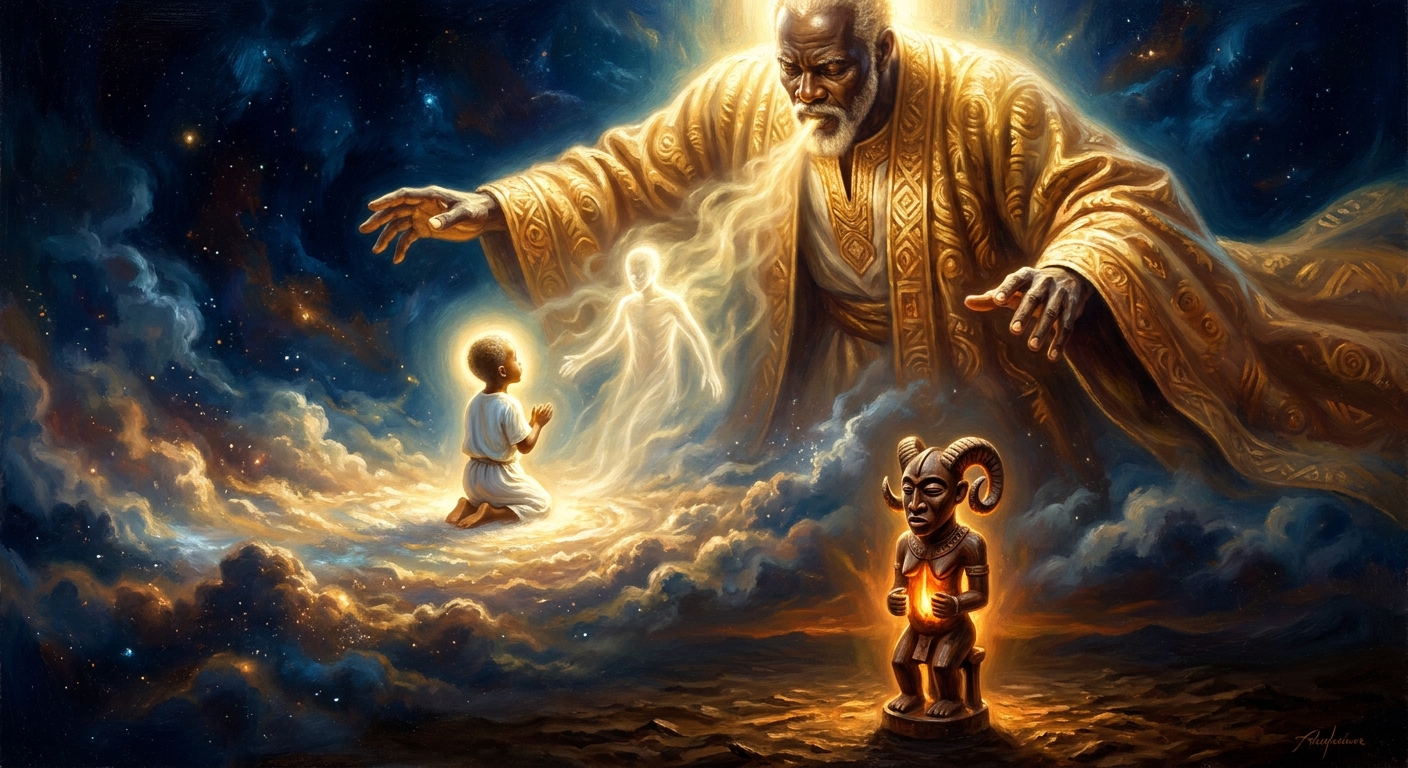
Ikenga: The Right Hand of Achievement
When a man comes of age — Ikenga is received at adulthood and retired at death · Inside the home — Ikenga is kept in the man's personal space, not in public shrines
Contents
The Ikenga is a carved wooden shrine-figure representing a man's personal power of achievement — it is the god of his right hand, the divine energy of his will and work, kept privately and fed with sacrifice.
- When
- When a man comes of age — Ikenga is received at adulthood and retired at death
- Where
- Inside the home — Ikenga is kept in the man's personal space, not in public shrines
He carves it himself, sometimes.
Or he commissions it from a skilled carver, pays with yams and palm wine, receives it in a ceremony that marks his transition from youth to adult man. Either way, the Ikenga arrives as something that is both made and sacred — an object worked from wood by human hands that is simultaneously the home of a divine force.
The Ikenga is recognizable by its form: a seated male figure with two horns projecting from his head, a machete raised in his right hand, sometimes a trophy head in his left. The horns are the horns of the ram — the most assertive of animals, the animal that does not retreat but goes forward, that addresses every obstacle by attacking it directly. The raised machete is the right hand itself, the hand of action, the hand that clears the farm and builds the house and defends the family. The trophy head is the achievement already accomplished, the evidence that the force is real.
The form is always the same in its essentials. The specific details vary by region and by the carver’s interpretation of the man’s character. A successful farmer might have an Ikenga with agricultural symbols. A warrior might have one whose machete is especially elaborate. The Ikenga is both a type and a portrait.
Ikenga means, approximately, the power of the right hand.
Ike is the Igbo word for power, force, energy — the kind of thing that makes a thing happen. Aka nni, the right hand, is the hand of achievement, the hand that does work, the hand that swears oaths and seals contracts and strikes enemies. The Ikenga is the divine personification of the man’s own power, made external and available for relationship.
This is not magic in the vulgar sense. The Ikenga does not give a man power he does not have. It receives and focuses and amplifies power that is already his. A lazy man’s Ikenga cannot make him successful; the divine energy has no will to work through. A hardworking man who feeds his Ikenga regularly and addresses it with specific prayers about his specific projects — this man is, in the Igbo understanding, more fully activating his own potential than he would be without the relationship.
The Ikenga is fed with sacrifice. Kola nut, palm wine, the blood of a cock at the new year. The feeding is not a bribe. It is a maintenance of the relationship between the man and the divine energy of his own achievement. To neglect the Ikenga is to neglect one’s own power — to let the divine aspect of the self go hungry and dim.
When things go wrong, the Ikenga is consulted first.
A man whose farming has failed, whose trading ventures have collapsed, who has lost a court case he should have won — this man speaks to his Ikenga before he goes to the diviner. He speaks to it honestly. He asks: have I neglected you? Have I broken a promise I made while holding you? Have I worked in a way that went against your nature?
The Ikenga does not answer in words. The man knows his own heart. The consultation is a structured form of self-examination, a ceremony that forces the man to review his actions while in relationship with the divine representation of his own standards.
Sometimes the consultation reveals the answer without any divination at all. The man remembers the promise he broke, the shortcut he took, the sacrificial obligation he deferred too long. He addresses it. The energy clears.
When the consultation does not resolve it, the diviner is called. The diviner looks at the relationship between the man’s chi (his personal divine double, received from Chukwu before birth) and his Ikenga (his personal divine double of achievement, received at adulthood from the community). Sometimes these two forces are working at cross-purposes. A man with a chi suited to scholarship who is trying to achieve as a warrior will find his Ikenga and his chi in conflict. The diviners can work with this.
At a man’s death, the Ikenga is broken.
The breaking is ceremonial and final: the Ikenga is cut or smashed, returned to the wood it was made from, the divine force released. The man and his Ikenga achieved together and are dissolved together. The son who inherits the compound does not inherit the father’s Ikenga. He makes his own, or receives his own, appropriate to his own power and his own projects.
The Ikenga is the most personal thing a man owns — more personal than his title, more personal than his yam barn, more personal than his compound. His title can be transferred. His barn can be divided. His compound can be shared.
The Ikenga is his alone, from the day he receives it to the day it is broken.
It is his right hand, made holy.
Echoes Across Traditions
Entities
- Ikenga
- Chi
- The individual man
Sources
- Cole, Herbert M., *Ikenga: The Cult of the Right Hand* (in Igbo Arts: Community and Cosmos, 1984)
- Achebe, Chinua, *Things Fall Apart* and *No Longer at Ease* — cultural context for Ikenga
- Basden, G.T., *Niger Ibos* (Seeley, Service & Co., 1938)
- Boston, J.S., *Ikenga Figures among the North-West Igbo and the Igala* (Ethnographica, 1977)