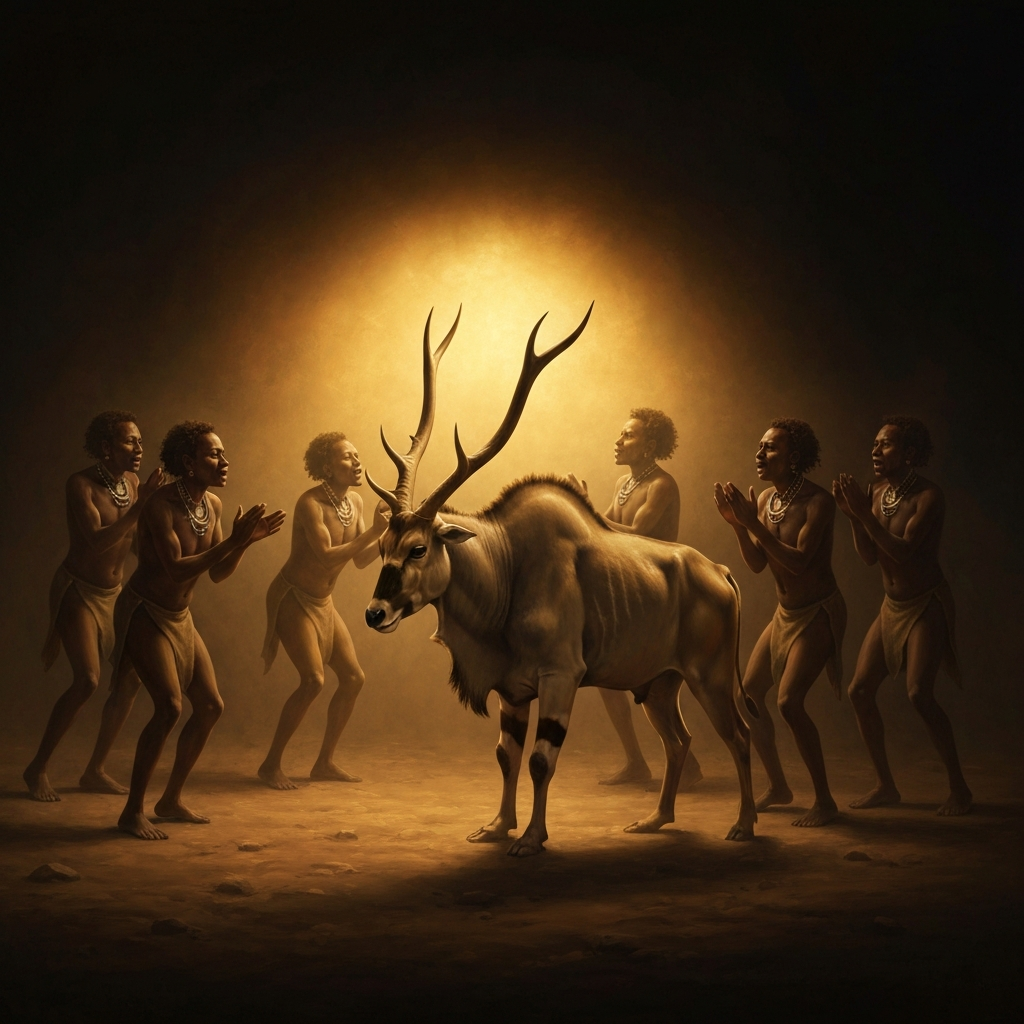
The Eland: Most Sacred of All Animals
From the first dances — and continuously, in every San community that maintains the ceremonies · The Kalahari Desert and southern African savanna — wherever San communities gather to dance
Contents
The eland is the animal that carries divinity — its fat is medicine, its blood marks major life transitions, and entering the trance dance means transforming toward the eland's body, becoming the border between worlds.
- When
- From the first dances — and continuously, in every San community that maintains the ceremonies
- Where
- The Kalahari Desert and southern African savanna — wherever San communities gather to dance
The eland is heavy with power.
N/om — the San word for the healing force, the potency that fills the air during a successful trance dance, the energy that flows through the healer’s body and into the sick person — is most concentrated in the eland. It lives in the eland’s fat, in the blood behind the eland’s eyes, in the specific clicking sound of the eland’s tendons when it runs. When a healer goes into trance, part of what they are doing is becoming-eland: feeling the animal’s energy enter their body, their spine arching backward in the way that eland hold their heads when they run, the world turning the colors that the eland sees.
Kaggen made the eland. This is the foundation of the eland’s sacredness. But the eland did not stay sacred merely by being made by a god — it stayed sacred because the San have maintained, over thousands of years, the ceremonial practices that keep the relationship between humans and eland alive and reciprocal.
At a girl’s first menstruation, the eland dances.
The most important ceremony in San life is the girl’s puberty rite, sometimes called the Eland Bull Dance. When a girl has her first menstrual period, the community gathers. The adult women, led by the senior women who know the ceremony, gather around the girl in her seclusion. They dance. The male dancers outside the seclusion hut dance the eland: they hold their arms in the posture of the eland’s horns, they make their movements heavy and deliberate in the way the eland moves, they enter the state of feeling-eland that is the beginning of the trance experience.
The girl at the center of this ceremony is becoming sexually capable of reproduction — she is entering the condition that allows the community to continue. The eland at the center of the ceremony is the animal that mediates between the human world and the divine world. The girl and the eland are in the same transitional state: both are at the threshold of their full power, both are vulnerable in their potency.
The ceremony seals something: the girl enters womanhood in the presence of the eland’s blessing, and the eland’s potency is called up to protect and empower the new woman.
The healer enters the eland’s body.
During the trance dance — the healing ceremony that San communities perform when sickness is present or when the community needs spiritual maintenance — the senior healers enter altered states of consciousness by dancing for hours, hyperventilating through the dance, reaching the state of trance that the San call !kia, which is described as a kind of death and return.
In this state, the healer’s consciousness leaves the body and moves through the world in spirit form. They encounter the spirits of the dead (who are often causing the illness by pulling their living relatives toward them). They encounter the great spirits of the landscape. They encounter the eland.
The eland in the spirit world is enormous, luminous, radiating n/om — the healing potency — from its fat and blood. The healer approaches it, enters its energy field, absorbs the potency, and brings it back in their hands and chest and spine to lay on the sick person.
The healing is the transfer of eland-energy from the spirit world to the human body.
This is why, after a trance dance, the healers are exhausted and the sick person often improves. The energy has moved.
The art records the dances.
San rock art, painted on shelter walls over tens of thousands of years, is densest in scenes of the trance dance. The human figures with eland antelope heads are not fantasies or metaphors. They are accurate records of what trance-dancers see when they enter the eland’s body: the self becoming the other, the border between human and animal dissolving, the healing potency flowing across that dissolved border.
These images are the oldest continuous theological record in human history.
They show what the San have always known: the eland is where the power is. The dance is how you get there.
The animal is still running somewhere out on the savanna, its tendons clicking, its fat dense with n/om, the gate between the worlds clicking open and shut with every stride.
Echoes Across Traditions
Entities
- The Eland
- Kaggen
- The Healers
- The young women at initiation
Sources
- Lewis-Williams, J. David, *The Mind in the Cave* (Thames and Hudson, 2002)
- Biesele, Megan, *Women Like Meat: The Folklore and Foraging Ideology of the Kalahari Ju/'hoan* (Indiana University Press, 1993)
- Lee, Richard B., *The !Kung San: Men, Women and Work in a Foraging Society* (Cambridge University Press, 1979)
- Bleek, W.H.I. and L.C. Lloyd, *Specimens of Bushman Folklore* (George Allen, 1911)