Contents
The trickster-deity of the San people of southern Africa is a praying mantis who made the moon from an old shoe — the creator as the comedian, the divine as the absurd, the cosmic as the intimate.
- When
- The first time — the time before the moon existed
- Where
- The Karoo and Kalahari — the ancient San territories of southern Africa
The moon was a shoe.
Or rather: the moon was made from a shoe, which Kaggen the Mantis found in the grass and threw into the sky one afternoon when he needed light to see by at night. He threw it and it glowed — not brightly at first, but enough, which is exactly the kind of creation Kaggen engages in. Enough. Improvised. Surprising even to him.
Kaggen is small. He is an insect — the praying mantis, Mantodea, the creature that holds its forelegs in a posture that looks like prayer, that turns its alien head to look at you with eyes that seem more knowing than they should be. Among the San people of southern Africa, this insect is understood as a form — one of many forms — that the trickster-god takes when he moves through the world.
Kaggen is also sometimes a man, sometimes an eland antelope, sometimes a small person with extraordinary powers who can die and resurrect himself. He is not consistent. He is the divine as unstable, shifting, not quite predictable, available in unexpected places in unexpected forms.
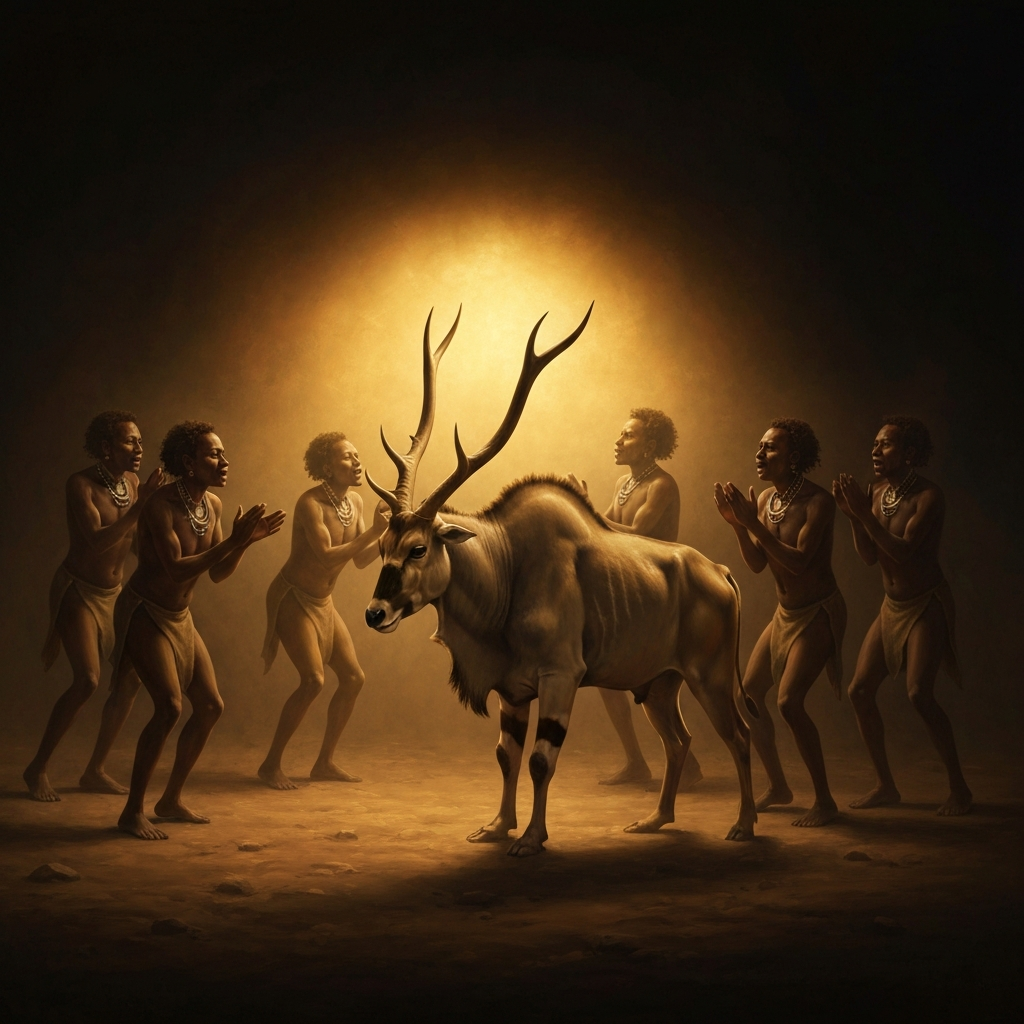
His greatest creation is the eland.
The eland is the largest antelope in Africa: deep-chested, capable of astonishing speeds despite its bulk, with a characteristic clicking sound when it runs from the tendons of its knees. Among the San, the eland is the most sacred animal — the focus of the most important ceremonies, the animal whose fat is the most powerful medicine, the animal that appears most frequently in San rock art.
Kaggen made the eland from his shoe buckle, or his hartebeest’s hair, or a piece of honeycomb, depending on which community is telling the story. He hid the eland in a cave and visited it daily, anointing it with honey, watching it grow. When the Ichneumon — Kaggen’s son-in-law, his skeptical younger companion — found the eland and killed it against Kaggen’s wishes, Kaggen wept. His grief was inconsolable.
But from the eland’s blood, the Ichneumon and his wife made the other eland. The species continued because grief and the practical work of continuation are not opposites.
Kaggen can be killed.
This is what distinguishes him from most creator gods and makes him the most interesting of them. He can be killed by animals, by enemies, by his own stupidity. He has been killed and has come back to life multiple times in the recorded stories. The resurrection is not triumphant — it does not prove his divine invincibility. It is more like the mantis that seems to be dead on the path and then suddenly moves. The life was there all along; it was just very still.
His family argues with him. His son-in-law disrespects him. His plans fail regularly. The moon he made from a shoe is adequate, not magnificent. The eland he created with such care was killed by a family member who did not appreciate what it was.
And yet: the moon is there. The eland are there. The things Kaggen made badly or accidentally or in spite of the forces working against him are still there, still providing light and still running across the savanna with the sound of their clicking tendons.
He lives in the San rock art.
For twenty thousand years, San artists have been painting on the walls of rock shelters across southern Africa. The paintings are not decorations. They are records of the trance-dance, the ceremony in which healers enter altered states of consciousness and travel in the spirit world that coexists with the ordinary world. The most common figures in the art — the human bodies with animal heads, the people with lines of power flowing from their bodies, the half-human half-antelope figures — are records of what the trance-dancers saw.
Kaggen appears in this art. His mantis form, his eland form, his human form. He is not merely a character in stories. He is a presence that the trained shamans of the San encounter in the trance state, the personality they navigate by in the spirit world, the being who has been available to his people since before the category of history exists.
The rock walls of the Drakensberg, the Karoo, the Kalahari are his autobiography. He left these images everywhere he went.
The shoe he threw into the sky glows above them every night.
Echoes Across Traditions
Entities
- Kaggen (the Mantis)
- The Eland
- The Ichneumon (his son-in-law)
- The Porcupine
Sources
- Bleek, W.H.I. and L.C. Lloyd, *Specimens of Bushman Folklore* (George Allen, 1911)
- Lewis-Williams, J. David, *The Mind in the Cave: Consciousness and the Origins of Art* (Thames and Hudson, 2002)
- Biesele, Megan, *Women Like Meat: The Folklore and Foraging Ideology of the Kalahari Ju/'hoan* (Indiana University Press, 1993)
- Lewis-Williams, David and Thomas Dowson, *Images of Power: Understanding San Rock Art* (Southern Book Publishers, 1989)