Zurvan: Before Good and Evil Were Born
Before the beginning — the pre-cosmic era of Zurvanite cosmology · The Infinite — the undefined space before the separation of light and darkness
Contents
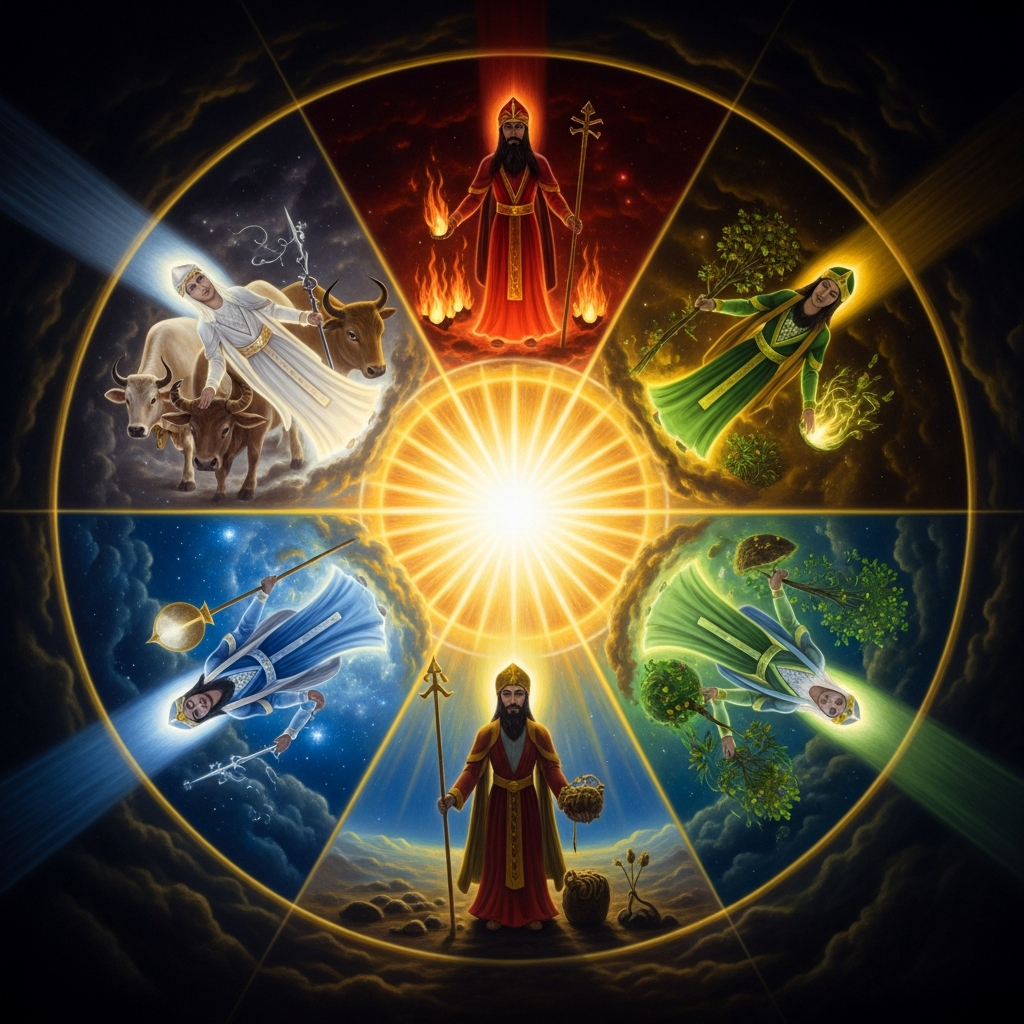
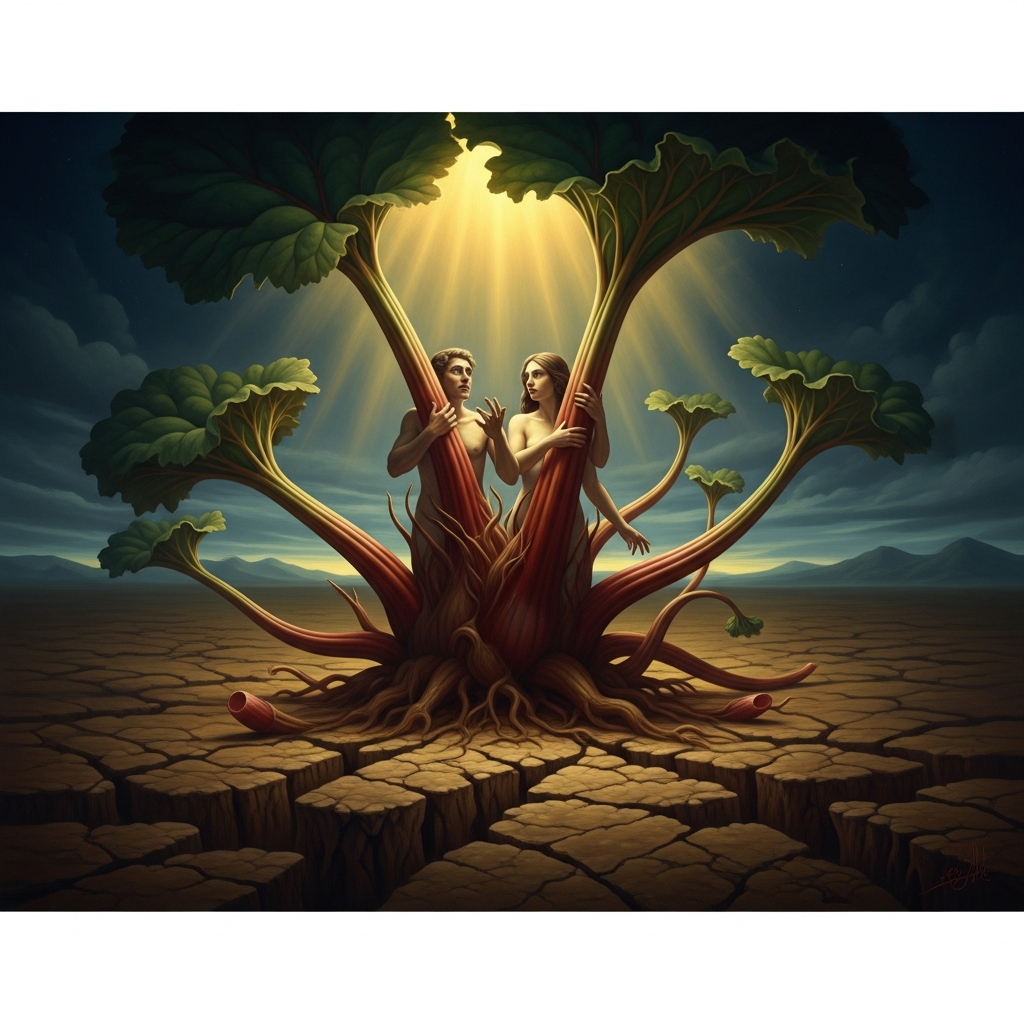
In the Zurvanite heresy, both Ahura Mazda and Angra Mainyu are born as twins from a single father — Zurvan, Infinite Time — who sacrificed for a thousand years to have a son and doubted once, and from his doubt the dark twin was born.
- When
- Before the beginning — the pre-cosmic era of Zurvanite cosmology
- Where
- The Infinite — the undefined space before the separation of light and darkness
For a thousand years, Zurvan offered sacrifice.
Zurvan is Infinite Time — the deity who stands above both light and darkness, above both truth and lie, the principle of temporal existence that contains both without being either. He wished for a son who would create the material world and order it. He sacrificed and prayed for a thousand years without interruption.
And then, in the nine hundred and ninety-ninth year, he doubted.
The doubt was this: What is the use of all my sacrifice? Will a son actually result from it? The thought lasted only a moment. He returned to his sacrifice. But the moment of doubt was enough.
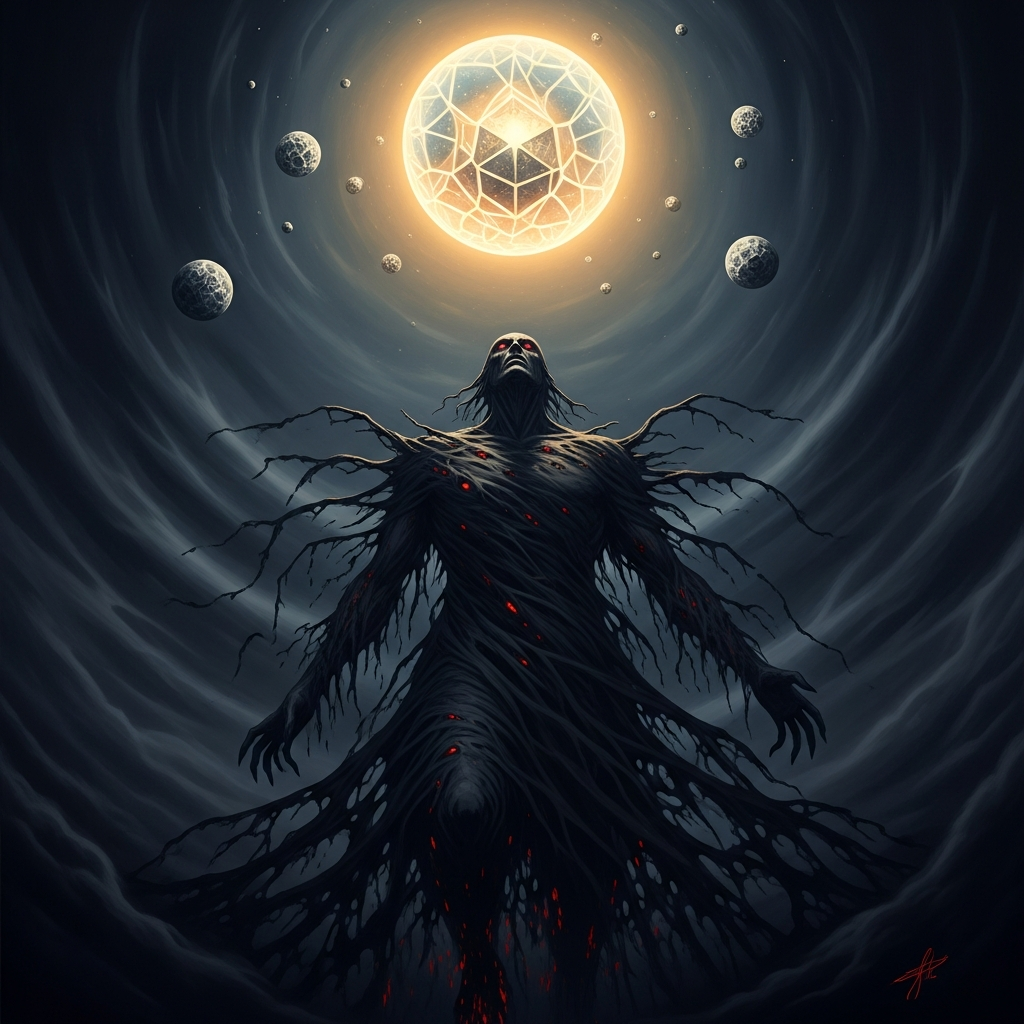
Because he sacrificed for a thousand years with a pure intent, a son was forming in the divine realm — Ohrmazd, the Wise Lord, who would be born bright and good and powerful. And because he doubted for one moment, a second being was also forming — Ahriman, the Hostile Spirit, born from the doubt itself. The two were conceived simultaneously: the thousand years produced the light, the moment of doubt produced the darkness.
Ahriman knew what was happening before he was born.
He tore through the womb of time ahead of his brother and presented himself to Zurvan first. Zurvan had promised: the first son to arrive will be given the dominion over creation. Ahriman arrived first. He claimed the promise.
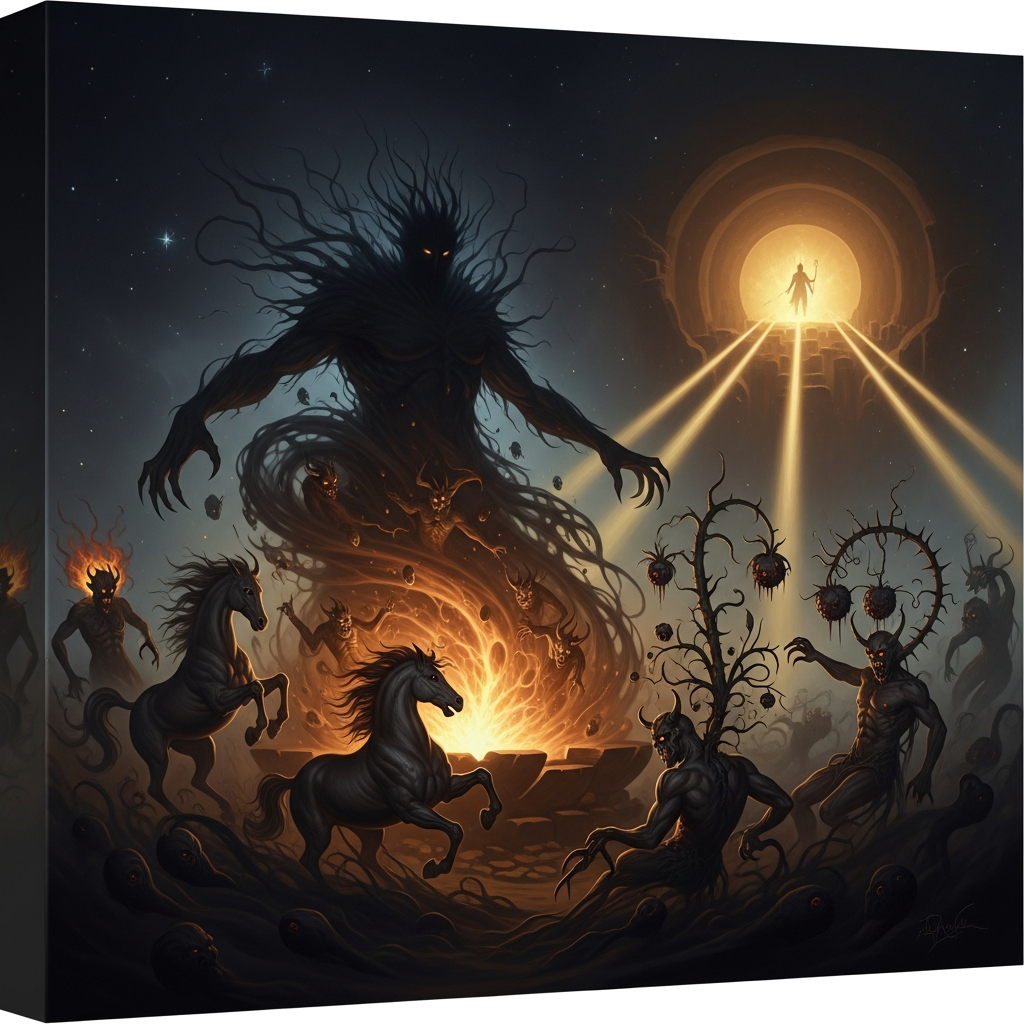
Zurvan was horrified — this dark, malicious being was clearly not the son he had intended — but the promise was made and he could not unmake it. He gave Ahriman the limited dominion: dominion over the material world for a bounded period of time. Then Ohrmazd arrived, bright and perfect, and Zurvan gave him the unlimited kingdom that would exist after Ahriman’s bounded time was over.
The orthodox Zoroastrian tradition rejected this story.
The rejection was emphatic and theologically well-grounded: if Ahura Mazda and Angra Mainyu are twins from a common parent, then the common parent is responsible for the existence of evil. Zurvanite theology, by resolving the problem of cosmic dualism through a prior unity, created a worse theological problem — a God-beyond-God who somehow contains evil in his nature, even if only as the shadow of a moment’s doubt.
But the story persisted.
It persisted because it answered something that the standard Zoroastrian theology left hanging: if Ahura Mazda and Angra Mainyu both simply exist, co-eternal, where do they come from? What makes them what they are? The orthodox answer — they simply are what they are, and the evil one simply chose evil — doesn’t satisfy everyone. The Zurvanite answer — evil emerged from a moment of doubt in a being who was otherwise good — gives evil an origin, and in giving it an origin, makes it contingent rather than necessary.
The doubt need not have happened.
If Zurvan had not doubted, only Ahura Mazda would have been born. The darkness would never have existed. This means the darkness is a cosmic accident — not designed, not inevitable, not the necessary counterpart of light, but the consequence of a single momentary failure of trust.
The Zoroastrian theologians who opposed Zurvanite thought found this more disturbing than the orthodox dualism, not less. An accidental evil is, in some ways, harder to endure than a principled one: at least a principled evil has a logic, a position, an argument that can be refuted. An accidental evil is just what doubt produces.
The story of Zurvan survived.
It is in a letter of Theodore bar Konai from the eighth century. It is in Eznik of Kolb’s fourth-century Armenian treatise. It is in the memories of priests who knew it was not orthodox and told it anyway because the question it raised — what is the source of evil? — would not be silenced by saying: there is no source, it simply exists.
Doubt is the source.
The question is: whose?
Echoes Across Traditions
Entities
- Zurvan
- Ahura Mazda
- Angra Mainyu

Sources
- R.C. Zaehner, *Zurvan: A Zoroastrian Dilemma* (Oxford, 1955)
- Mary Boyce, *A History of Zoroastrianism*, Vol. I (Brill, 1975)
- Shaul Shaked, 'The Notions mēnōg and gētīg,' *Acta Orientalia* (1971)
- Prods Oktor Skjærvø, *The Spirit of Zoroastrianism* (Yale, 2011)