Angra Mainyu: The Lie That Chose Itself
The end of the first three thousand years — the primordial assault on creation · The boundary between Endless Light and Endless Darkness — the membrane of the material creation
Contents
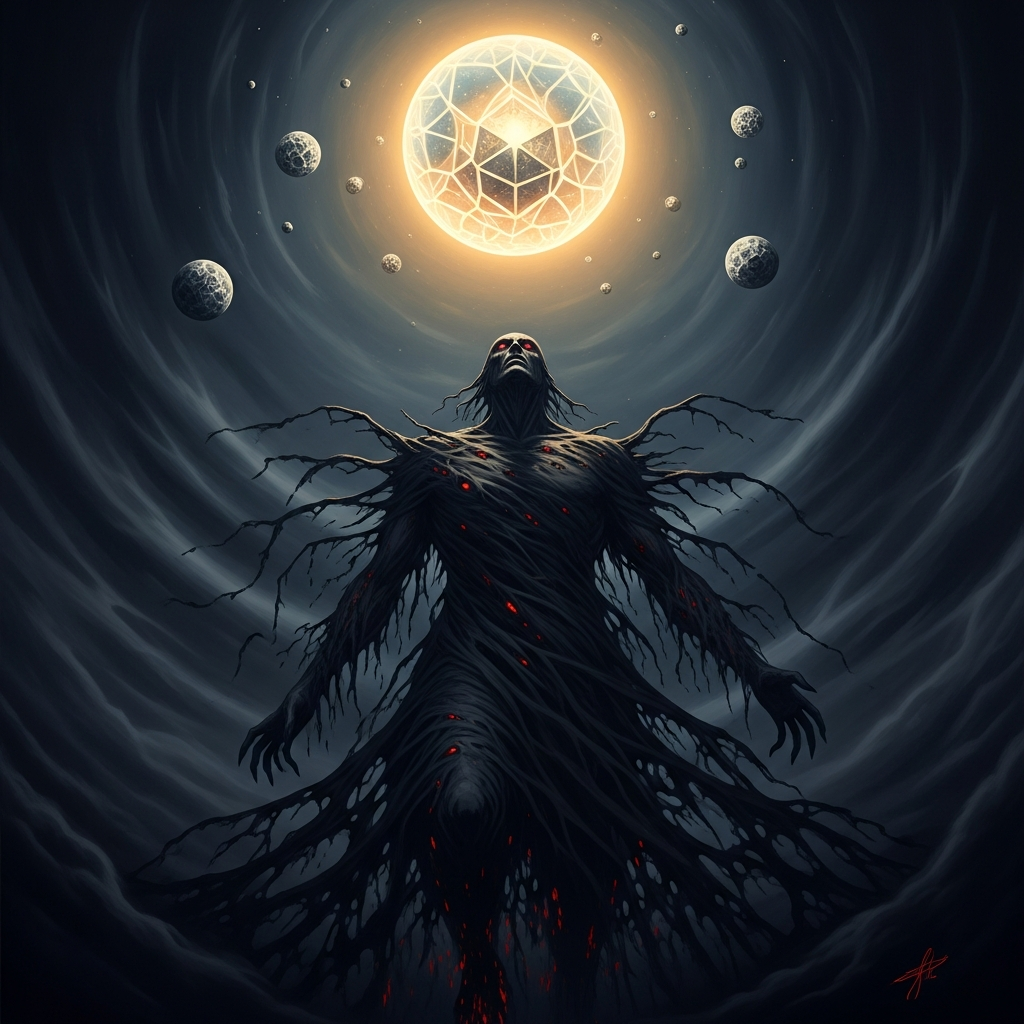
When the Hostile Spirit wakes from his ancient stupor, he does not hesitate — he assaults the perfect creation of Ahura Mazda with a darkness that is not merely absence but active, intelligent malice.
- When
- The end of the first three thousand years — the primordial assault on creation
- Where
- The boundary between Endless Light and Endless Darkness — the membrane of the material creation
He has been unconscious for three thousand years.
This is the condition the Bundahishn describes with clinical precision: when Ahura Mazda spoke the Ahunwar prayer, the force of its righteousness overwhelmed the Hostile Spirit so completely that he sank into the abyss and lay insensible while creation proceeded above him. Three thousand years pass. The sky crystallizes. The water settles. The earth spreads flat and perfect. Gayōmard, the first man, stands in his radiance. The primordial bull walks the unbroken plain. Everything is whole.
Angra Mainyu wakes.
The tradition preserves a moment before the assault — a moment that is theologically essential. The great Zoroastrian cosmogonic texts record that Ahura Mazda, knowing the attack is coming, offers a truce. He presents Angra Mainyu with a vision of what creation is and what it will become — shows him the Frashokereti, the final renovation, the moment when evil is defeated and all creation returns to perfection. He offers Angra Mainyu the possibility of recognizing the outcome and standing down.
Angra Mainyu sees the vision clearly.
And refuses.
This is the moment the tradition insists on above all others: Angra Mainyu chooses the lie with full knowledge that it will fail. His evil is not ignorance, not deception, not a comprehensible desire for something good-gone-wrong. It is the pure choice of opposition for its own sake. He says, in effect: I know I will lose, and I prefer to lose while fighting than to exist in a world ordered by your righteousness. The choice is absurd, is self-defeating, is the very definition of Druj — the cosmic Lie — because a lie is something that destroys the one who tells it even as it pretends to serve their interest.
He dives upward through the Endless Darkness toward the membrane of creation.
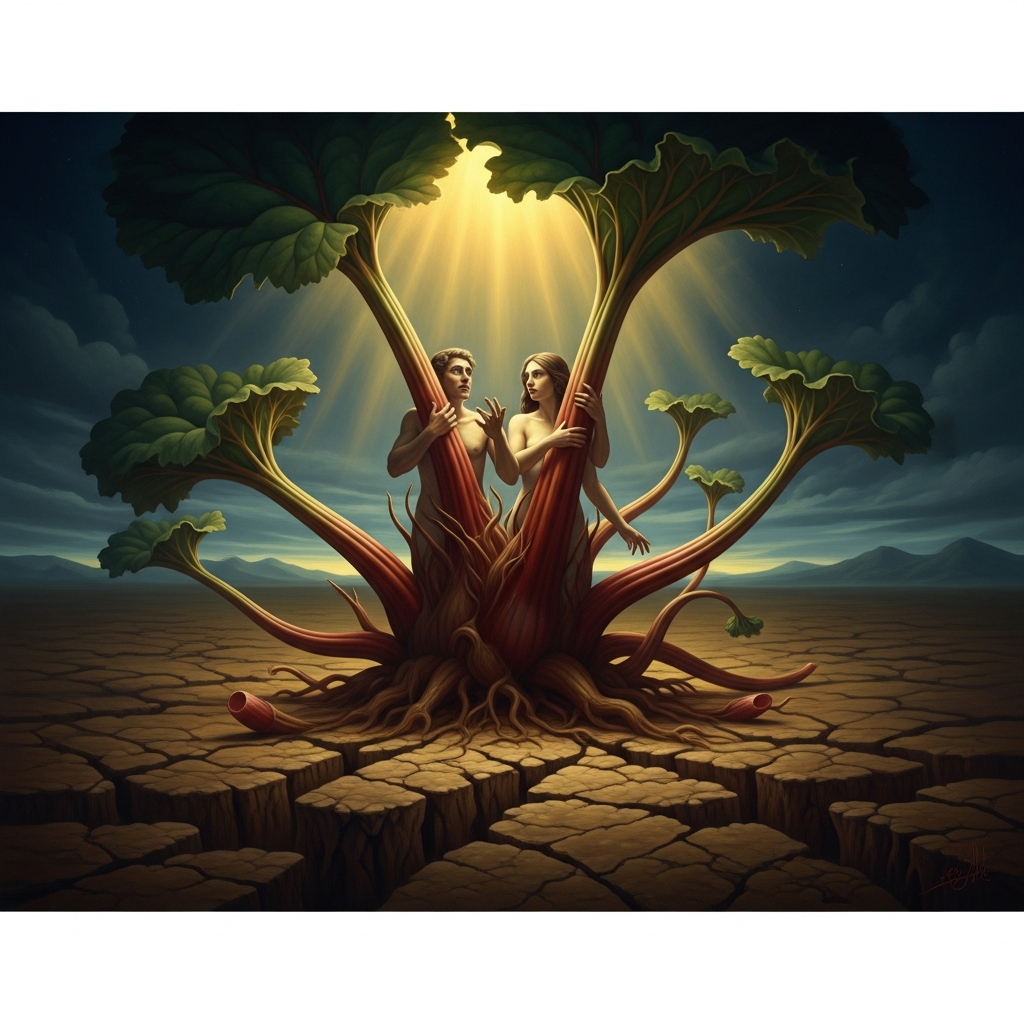
The assault is catastrophic and precise. He does not attack randomly. He tears through the crystalline sky and leaves a wound in it. He poisons the perfect water. He breaks the flat earth into the ridges and valleys and deserts that are geological memory of the assault. He finds the primordial bull and kills it — but from the bull’s death, as Ahura Mazda had foreseen, all plants and useful animals will eventually spring. He finds Gayōmard and poisons him — but from Gayōmard’s death, as Ahura Mazda had foreseen, the first human couple will eventually grow.
With him, Angra Mainyu brings a vast army.
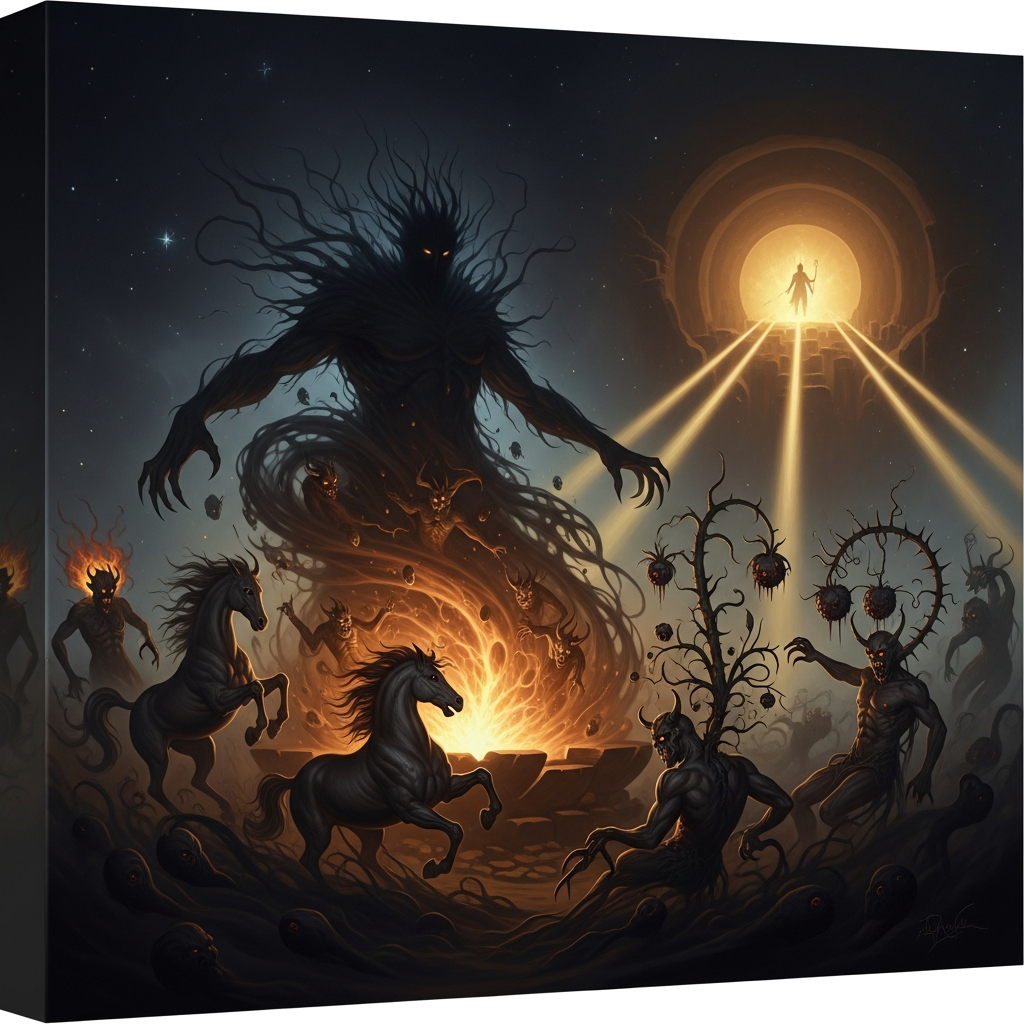
They are the daevas — the old spirit-beings of the steppe-religion that Zarathustra rejected, reframed now as the soldiers of the principle of Lie. Some daevas specialize in specific corruptions: Aeshma embodies the violence of the cattle-raider, the berserker fury that was endemic to the Bronze Age plateau. Nasu is pollution, the corruption that spreads from a corpse. Aka Manah is bad thought, the specific inversion of Vohu Manah, Good Mind. They fall on creation like a plague, and where they touch, something that was whole breaks.
But Ahura Mazda has prepared.
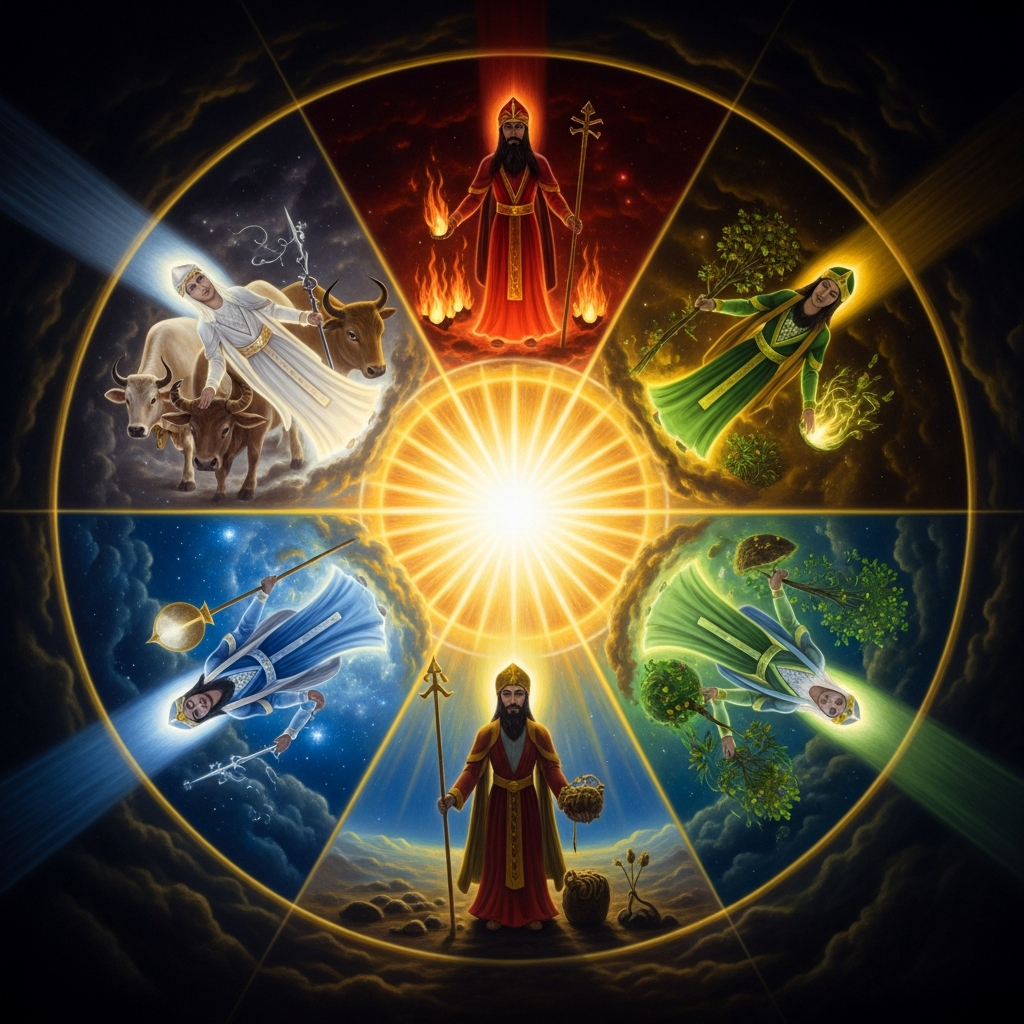
He has his own army: the yazatas, the worshipful ones, and the Amesha Spentas, the Bounteous Immortals. And he has his strategy, which the Bundahishn explains in terms that have always seemed startling: he does not try to eject Angra Mainyu from creation immediately, because he knows the cosmic time is limited and that within the limited time the defeat of evil is certain. The material world, which Angra Mainyu has invaded and wounded, is now also the trap — the finite arena in which the infinite malice of the Hostile Spirit will eventually exhaust itself.
The mixed world — creation-after-the-assault, the world of light and darkness intermingled, of good plants and poisonous plants, of useful animals and predators, of human beings capable of truth and lie — is not a tragedy. It is a plan.
Angra Mainyu does not know this. He surveys the damage he has done and calls it victory.
He is, as he always was, deceiving himself.
The Gathas of Zarathustra describe the cosmic situation with a poet’s compression: In the beginning the two primal Spirits, who are the well-renowned twins, were known as the one good and the other evil in thought, word, and deed. Between these two, the wise chose correctly; not so the fool. The two spirits — Spenta Mainyu and Angra Mainyu — were present at the root of existence, and one chose truth and one chose lie. The lie knows it is the lie. That is why its defeat is inevitable. A principle that must deceive even itself in order to persist cannot outlast a principle that is simply, without concealment, what it is.
In the meantime, the world is a battleground.
And every human being who ever draws breath is choosing which side they are on.
Echoes Across Traditions
Entities
- Angra Mainyu
- Ahura Mazda
- Druj
- Daevas
- Gayōmard

Sources
- *Bundahishn*, chapters 1–4, translated by Behramgore Anklesaria
- *Greater Bundahishn*, translated by Fazlollah Pakzad (Tehran, 2005)
- Shaul Shaked, 'The Notions mēnōg and gētīg in the Pahlavi Texts,' *Acta Orientalia* (1971)
- Almut Hintze, *Zamyad Yasht* (Reichert, 1994)