Mašyā and Mašyānag: The First Lie
The first days of human existence — after the forty-year growth of the primordial rhubarb plant · The primordial plain where the rhubarb plant grew from Gayōmard's seed
Contents
The first man and woman emerge from a rhubarb plant, are commanded to speak only truth, and within minutes attribute the creation of the world to Angra Mainyu — committing the original sin of Zoroastrianism in a single breath.
- When
- The first days of human existence — after the forty-year growth of the primordial rhubarb plant
- Where
- The primordial plain where the rhubarb plant grew from Gayōmard's seed
They stand at last, looking at each other.
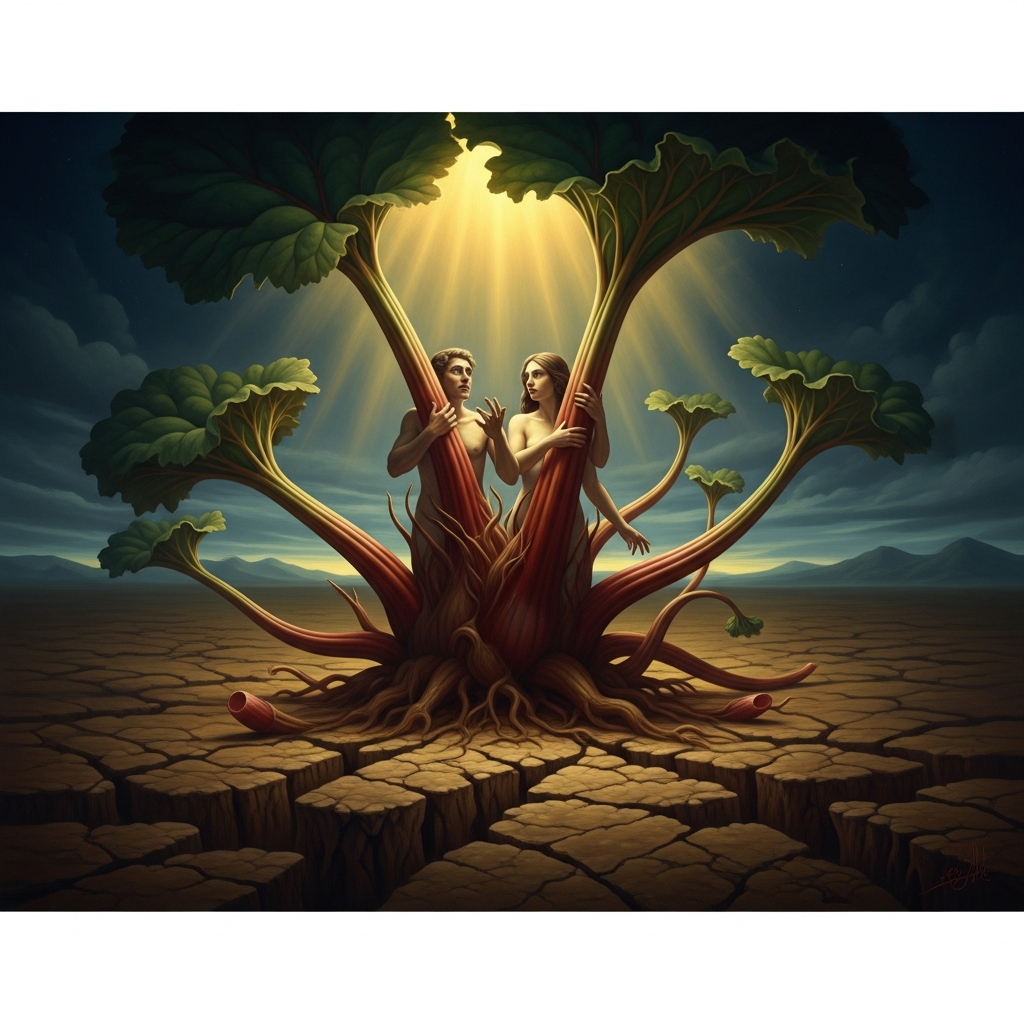
The rhubarb plant that grew from Gayōmard’s spilled seed has spent forty years drawing minerals from the earth and light from the sky and water from the ground, building in its vegetable patience the forms of a man and a woman. Now the plant has parted — slowly, over the last few days, the stem that joined them at the shoulder has thinned and separated — and Mašyā and Mašyānag stand upright on the plain.
They are pale as milk and bright as new metal. They have their grandfather’s luminosity in them, the divine breath that Ahura Mazda breathed into Gayōmard, but it is cut now with the mineral darkness of the earth, with the memory of forty years buried in soil. They are a little less bright than he was. They are human.
Ahura Mazda addresses them in their first moment of independent existence.
His instruction is not a long list of commandments. It is a single directive, stated with the clarity of everything that matters: Do not sin. Do not depart from righteous practice. Be pure in thought, word, and deed. And then a supplement: When you are asked who created you and all good things in the world, say: it was Ahura Mazda.
They understand. They agree.
They have been standing for perhaps an hour when Angra Mainyu finds them.
The Bundahishn does not explain how he reaches them so quickly, but the logic is clear: Angra Mainyu has been poisoning and polluting the new world since his assault, and the emergence of human beings — the creatures made in Ahura Mazda’s image to actively cooperate in the defeat of evil — is precisely the event he most needs to corrupt at the source. He does not appear to them in his own form. The tradition does not record exactly how he approaches them. What it records is the result.
Mašyā turns to Mašyānag.
It was Angra Mainyu, he says, who first made the water and the earth and the plants and the animals and the stars and the moon and the sun.
The words are barely out before the horror of them is evident. Mašyānag does not correct him. The lie lands in the world and echoes: the first human utterance after the instruction to speak only truth is the exact opposite of truth. The first thing the first man says about the created world is wrong.
The consequences are immediate, though they accumulate rather than strike.
The Bundahishn records what they lose in sequence. For thirty days they have no food — they are sustained by the divine light still in their bodies, fasting not as a spiritual discipline but as a punishment for the lie. When they finally eat, they find the milk of an ewe and drink it. This is good; this is allowed. But it diminishes the divine light in them slightly — the act of eating the physical world, which should be a sacred act of alignment with Ahura Mazda’s material creation, is now tinged with the corruption that the lie introduced.
Later they eat meat. Each time they eat, the light dims a little more.
The loss of light is not total — the tradition is careful about this. They retain enough of the divine fire to make choices, to practice righteousness, to align with Asha. The loss is enough to make the choice harder. This is the Zoroastrian understanding of original sin: not a catastrophic deprivation of human nature but a complication of it, a static on the signal, a dimming of the vision that makes truth harder to see clearly but not impossible to seek.
They have children. The first children they have, they eat — driven by a love so intense it becomes destruction, the demonic parody of parental devotion. Ahura Mazda diminishes their desire for their children to one part in a hundred of what it would naturally be, so that the species can persist. This detail too is recorded without judgment: the cosmic order makes accommodations for the damaged nature of its creatures.
From their eventual surviving children come the seven races of humanity. The tradition is specific: the human world is seeded by one couple, starting over after the initial catastrophe of the lie, working with the diminished light that is all they have.
They live for a hundred years and then die.
The death is not punishment; it was always part of the plan. Mortality was in Gayōmard’s name, was in the meaning of Mašyā — the mortal one. The lie did not introduce death. It introduced confusion about who is responsible for life.
Every prayer in the Zoroastrian tradition that begins by naming Ahura Mazda as creator is a correction of the first lie. Every dawn ritual that attributes good things to the Wise Lord and evil things to the Hostile Spirit is Mašyā and Mašyānag’s descendants saying, over and over, what should have been said in the first hour: It was Ahura Mazda. It was not the other one.
The correction never becomes unnecessary.
Echoes Across Traditions
Entities
- Mašyā
- Mašyānag
- Ahura Mazda
- Angra Mainyu
- Gayōmard

Sources
- *Bundahishn* 14.1–40, translated by Behramgore Anklesaria
- R.C. Zaehner, *The Dawn and Twilight of Zoroastrianism* (Weidenfeld & Nicolson, 1961)
- Mary Boyce, *A History of Zoroastrianism*, Vol. I (Brill, 1975)
- Prods Oktor Skjærvø, *The Spirit of Zoroastrianism* (Yale, 2011)