Gayōmard: The Primordial Man
The first three thousand years of material creation — the era before the attack of Angra Mainyu and the thirty years after · The perfect flat earth before mountains existed — the primordial plain of creation
Contents
Gayōmard, the first mortal being, stands radiant on the perfect earth for thirty years — and when Angra Mainyu's poison finally reaches him, his dying body seeds the ground with the minerals that will become all of humanity.
- When
- The first three thousand years of material creation — the era before the attack of Angra Mainyu and the thirty years after
- Where
- The perfect flat earth before mountains existed — the primordial plain of creation
He stands on the plain like a column of light.
The Bundahishn says Gayōmard is as bright as the sun and as tall as a man needs to be — which is to say: perfectly proportioned, without the excess of height that marks the daevas, without the smallness that marks creatures of the earth. He is made by Ahura Mazda from the clay of the earth, and the Wise Lord breathes his own fire-breath into him, which is why Gayōmard stands not merely alive but luminous, as though the light that created the world is gathered into a body and given legs.
His name means, in the old Iranian, something close to Mortal Life or Living Mortal — the oxymoron at the heart of the human condition. He is made to live, and he is made to die. He knows the first before the assault of Angra Mainyu, and the second after it.
For the first thirty years of his existence, the world is intact.
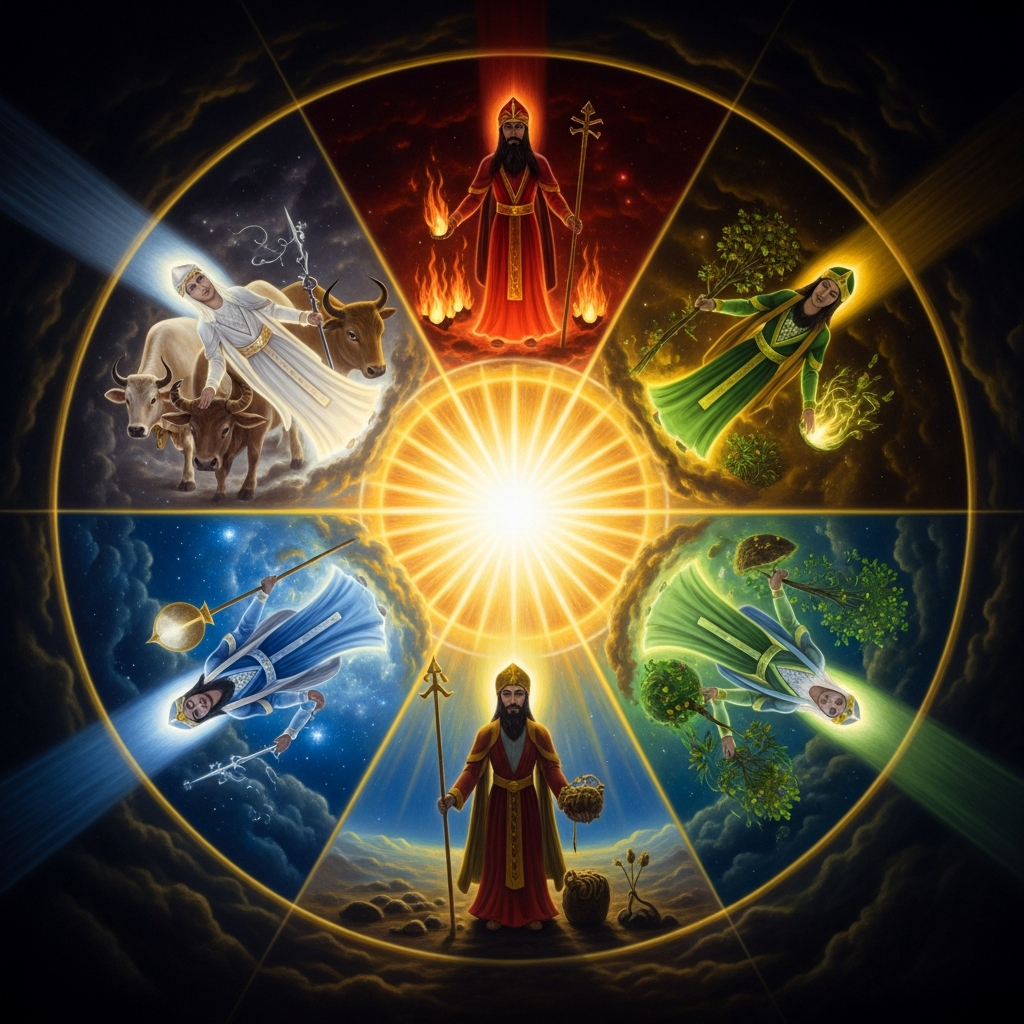
This is the period the texts describe with a kind of nostalgic precision: Gayōmard walks a flat earth that has no mountains, because mountains are wounds Angra Mainyu will later cut into the earth’s surface. He drinks from waters that are pure because they have not yet been poisoned. He walks among animals — the primordial bull is his companion, and the two of them together represent the totality of the biological world in its original, uncontaminated form. He knows the names of all the yazatas. He knows the structure of the cosmic order. He is not naive, because he is not ignorant — Ahura Mazda has made him knowing.
He is, however, mortal.
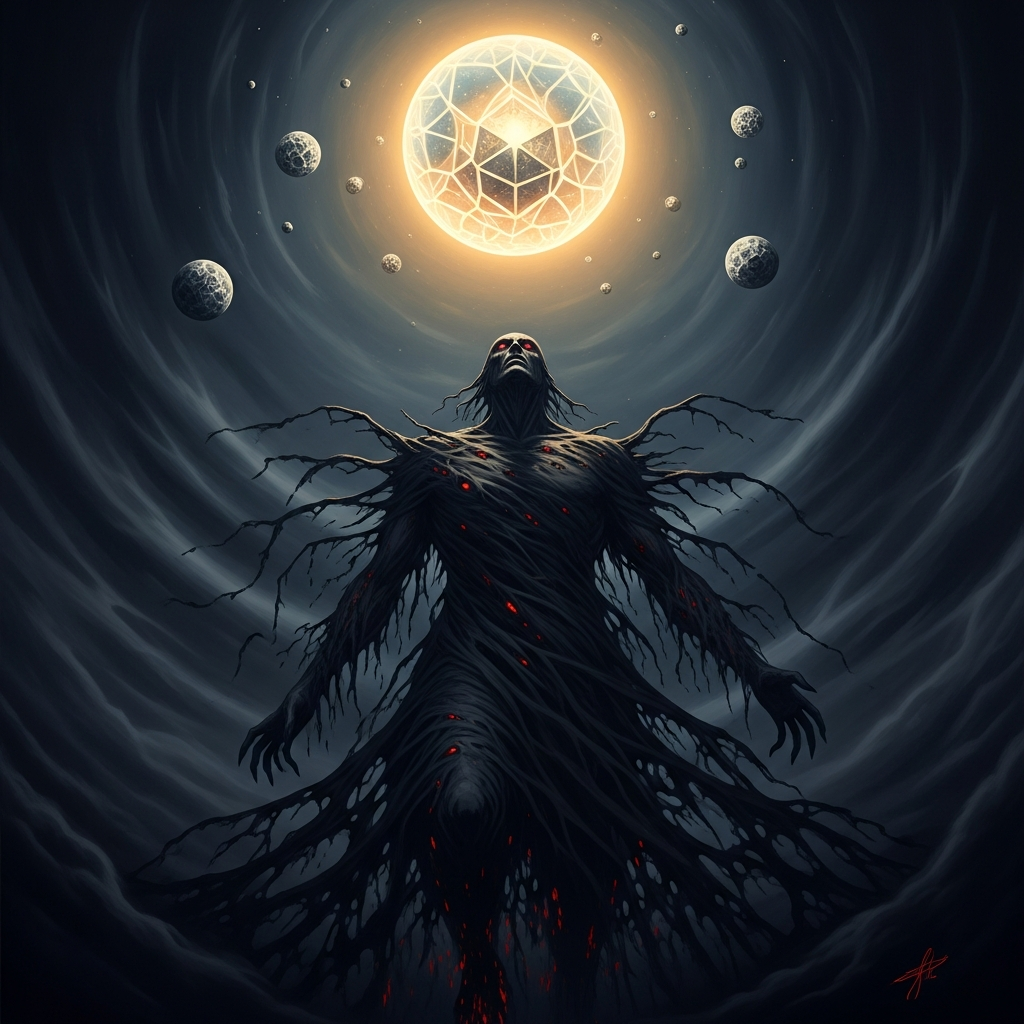
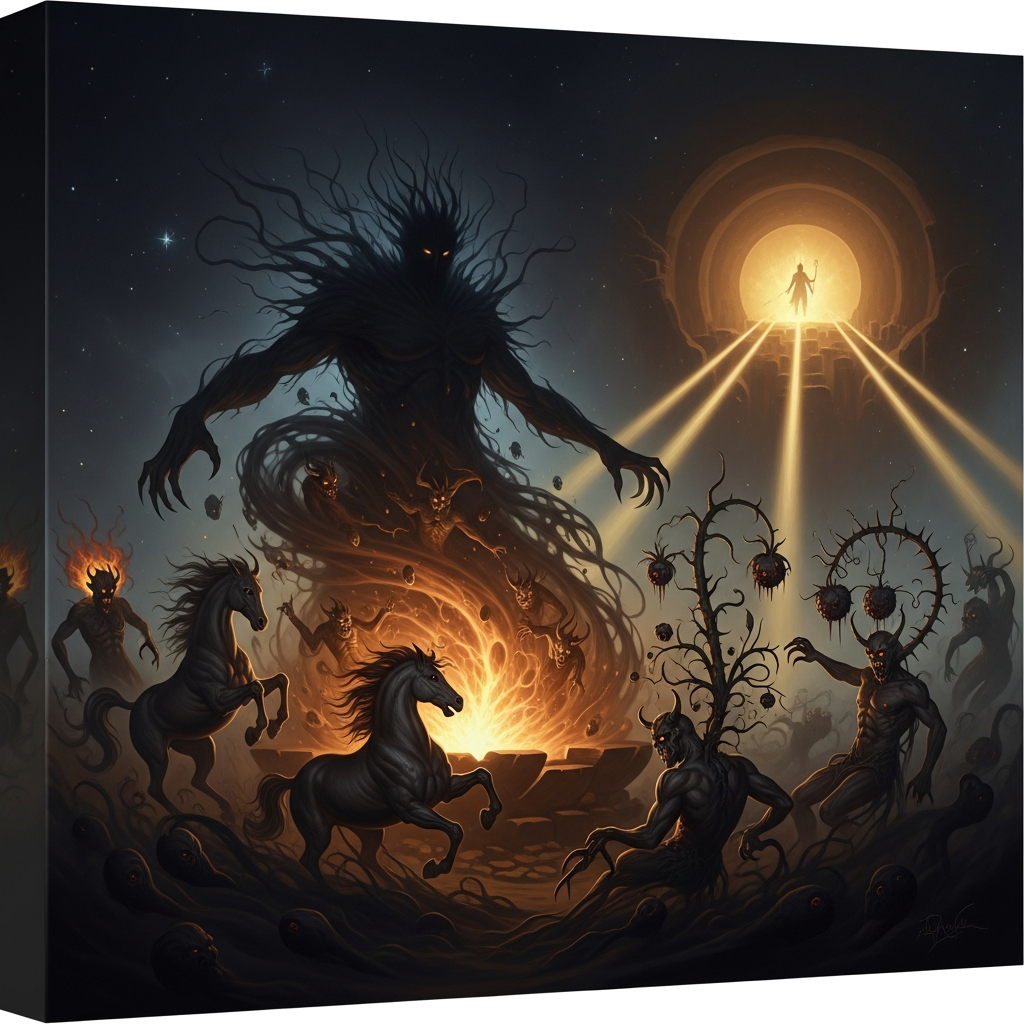
When Angra Mainyu’s attack comes, it comes for everything at once. The sky is pierced. The earth is broken. The water is poisoned. The primordial bull is killed and from its death Ahura Mazda salvages the seeds of all useful plants and animals — a resurrection in advance of the destruction. Then the sickness that Angra Mainyu sends into the world finds Gayōmard.
He fights it for thirty years more.
This detail matters: he does not die immediately. For thirty years after Angra Mainyu’s assault has corrupted the world, Gayōmard continues to live and to practice righteousness on the broken earth. He is, in these years, the prototype of every human being who will live after him — surrounded by the corruption of the hostile spirit, breathing air that carries the seeds of disease, drinking water that has been touched by the Lie, and choosing, every day, to align himself with Asha rather than with Druj.
He dies facing south, which is the direction of light.
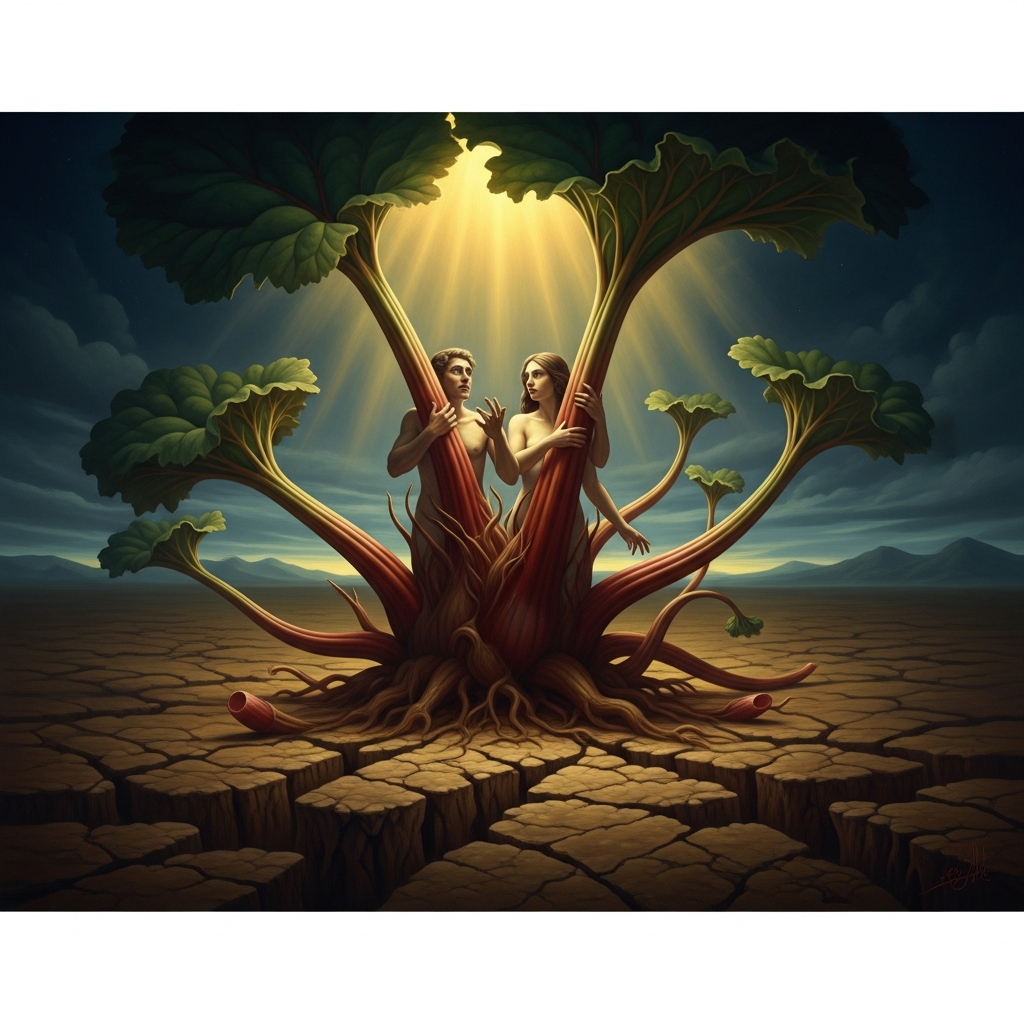
What the earth receives from Gayōmard is not merely a corpse. The Bundahishn records that from his body seven metals spring into being in the earth — the seven sacred metals that smiths will later work and prize. From his seed, which falls onto the earth as he dies, a rhubarb plant grows. It grows for forty years, tended by the divine beings, and when it is finally ready — when the forty years are complete — it divides.
From the rhubarb plant emerge two figures, joined at the shoulders, growing apart like branches from a single trunk: Mašyā and Mašyānag, the first human man and the first human woman. They grow into their separation over days. They are at first indistinguishable from each other, then gradually differentiating, then finally separate and upright, looking at each other across the short distance of their first breath.
They have inherited everything from Gayōmard: his luminosity is in them, dimmer now, mixed with the earth that made them, but present. They have also inherited the world as he left it — broken by the assault of Angra Mainyu, but tended by the divine beings, still capable of sustaining life. They have inherited the choice that defined his last sixty years: whether to align with Asha or with Druj, with truth or with the lie.
The first words they speak, Ahura Mazda instructs them, should be an affirmation of the Wise Lord’s goodness.
The first words they actually speak are different.
But that is their story, not his.
Gayōmard’s story ends in a rhubarb plant that will not complete its growing for forty years — the longest gestation in mythology, the most patient act of biological faith. He dies and waits, having done what he was made to do: inhabit the mortal life with the intensity that creates, from its ending, the continuation.
Echoes Across Traditions
Entities
- Gayōmard
- Ahura Mazda
- Angra Mainyu
- Mašyā
- Mašyānag

Sources
- *Bundahishn* 3.1–22, translated by Behramgore Anklesaria
- Mary Boyce, *A History of Zoroastrianism*, Vol. I (Brill, 1975)
- A.V. Williams Jackson, *Zoroastrian Studies* (Columbia University Press, 1928)
- Philippe Gignoux, 'Gayōmart,' *Encyclopædia Iranica* (1985)