Contents
Above the heavens of the jade emperor and the immortals, in three separate pure realms, dwell the Three Pure Ones — the primordial manifestations of the Tao itself, too fundamental to be worshiped through petition and too vast to be reached by any ladder of cultivation.
- When
- Before time — the Three Pure Ones exist prior to the creation of the universe
- Where
- The Three Pure Realms above the thirty-three heavens — the highest levels of the Taoist cosmos
Above the jade palace of the jade emperor, above the thirty-three heavens where the immortals live, above the realm where the celestial bureaucracy administers the universe — above all of this are three pure realms, and in each one a Heavenly Worthy who is not quite a god.
They are called the Three Pure Ones — Sanqing — and they are the highest expression of the divine in Taoist theology, the point at which the tradition’s abstraction and its personification meet in a sustained tension that neither resolves into the other.
The first is Yuanshi Tianzun — the Heavenly Worthy of Primordial Beginning. He occupies the realm called Jade Clarity. He has no origin. He has always existed. Before the universe, before the chaos that preceded the universe, before the concept of before — he was there. He does not create; creation happens in relation to him the way light happens in relation to the sun, not through intention but through nature. His realm is the highest level of being, and the beings who exist in it are not gods in any functional sense but principles of existence that are too foundational to perform.
The second is Lingbao Tianzun — the Heavenly Worthy of Numinous Treasure. He occupies the realm of Upper Clarity. He transmits the scriptures — the sacred texts that descend from the first level through the second and arrive eventually in the third and ultimately in the human world. He is the principle of transmission: the Tao cannot be known directly, but it can be transmitted, and transmission requires a medium, and the medium is this second level. The numinous treasure of the scriptures passes through him the way light passes through a lens.
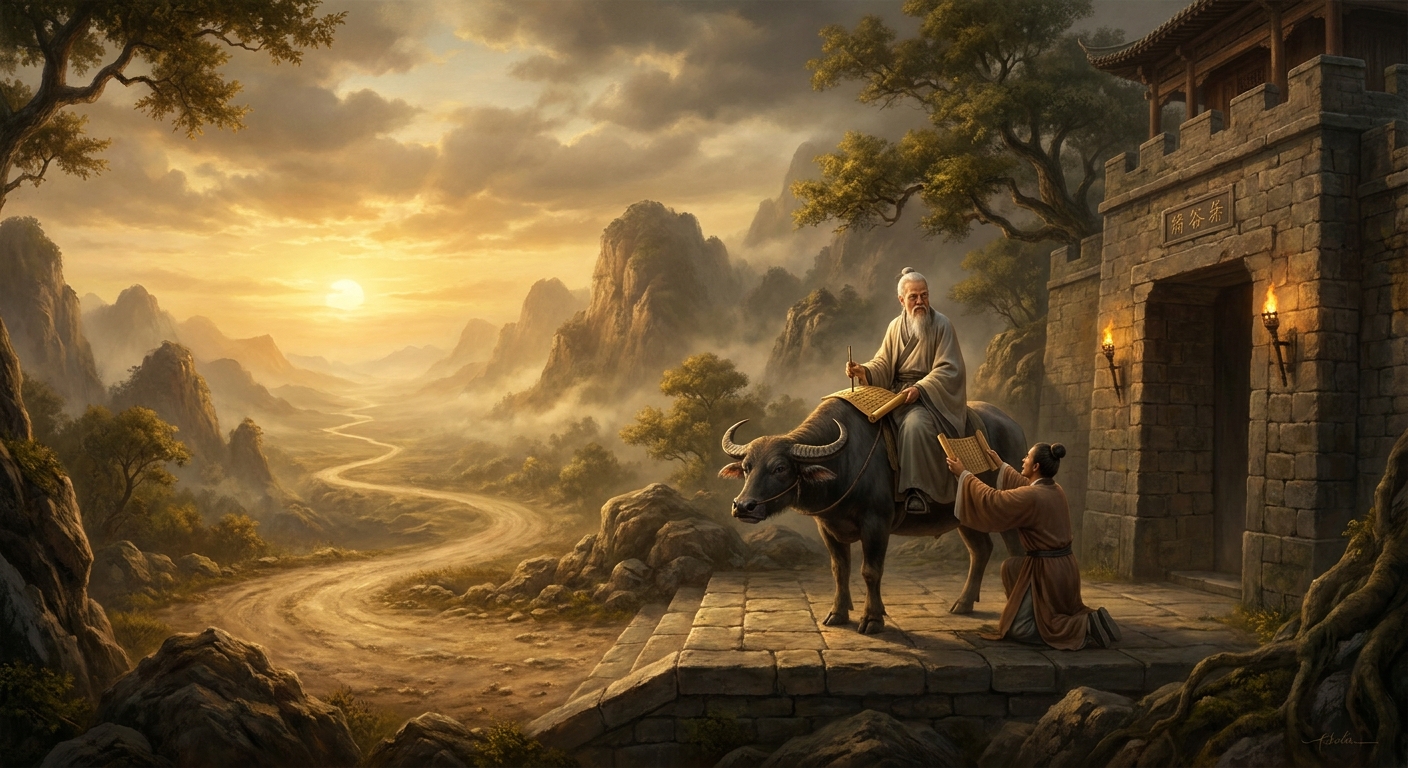
The third is Daode Tianzun — the Heavenly Worthy of the Way and Its Power. He occupies the realm of Great Clarity. He is Laozi’s highest identity — not the librarian of Zhou, not the teacher at the Hangu Pass, but the eternal principle that the librarian and the teacher were temporary expressions of. He is the Tao in its aspect as moral teaching, the Way in its aspect as accessible guidance, the principle that has been descending toward the human world for the longest time.
Below the Three Pure Ones, the Jade Emperor. Below the Jade Emperor, the celestial bureaucracy. Below the celestial bureaucracy, the earth gods and the kitchen gods and the household spirits. The hierarchy descends from the abstract to the particular, from the eternal to the temporal, from the Three Pure Ones who exist before the universe to the kitchen god who reports on whether you argued with your spouse last Tuesday.
Both ends of this hierarchy are real. The kitchen god is as real as Yuanshi Tianzun. The difference is not in the reality but in the scope: the kitchen god governs one household’s kitchen, Yuanshi Tianzun governs the preconditions of existence. You can petition the kitchen god because you and the kitchen god are in the same relationship that the celestial bureaucracy models: subject and official. You cannot petition the Three Pure Ones because there is no language in which the petition could be addressed and no action they could take in response that would be distinguishable from the functioning of the Tao itself.
They exist at the top of the cosmos as the answer to the question that Laozi raised at the Hangu Pass: what is the Tao? The Three Pure Ones are as close as the tradition comes to answering — three faces of what cannot be faced directly, three names for what Laozi said at the beginning cannot be named, three presences at the summit of the cosmic mountain that stand there not to be approached but to be acknowledged as the thing that everything below is an expression of.
Echoes Across Traditions
Entities
- Yuanshi Tianzun (Heavenly Worthy of Primordial Beginning)
- Lingbao Tianzun (Heavenly Worthy of Numinous Treasure)
- Daode Tianzun (Heavenly Worthy of the Way and its Power)
- Laozi
Sources
- Taoist Canon (道藏), various texts on the Three Pure Realms
- Kristofer Schipper, *The Taoist Body* (UC Press, 1993)
- Livia Kohn, *Daoism and Chinese Culture* (Three Pines Press, 2001)
- Eva Wong, *Taoism: An Essential Guide* (Shambhala, 1997)