Lièzǐ Who Rides the Wind
c. 5th-4th century BCE — traditional period of Lièzǐ, predating Zhuāngzǐ · The state of Zheng in central China
Contents
The sage Lièzǐ can ride the wind for fifteen days at a stretch, moving effortlessly through the air — but his teacher Huzi shows him that his effortlessness still depends on the wind, and true freedom requires no vehicle at all.
- When
- c. 5th-4th century BCE — traditional period of Lièzǐ, predating Zhuāngzǐ
- Where
- The state of Zheng in central China
He rides the wind for fifteen days and returns.
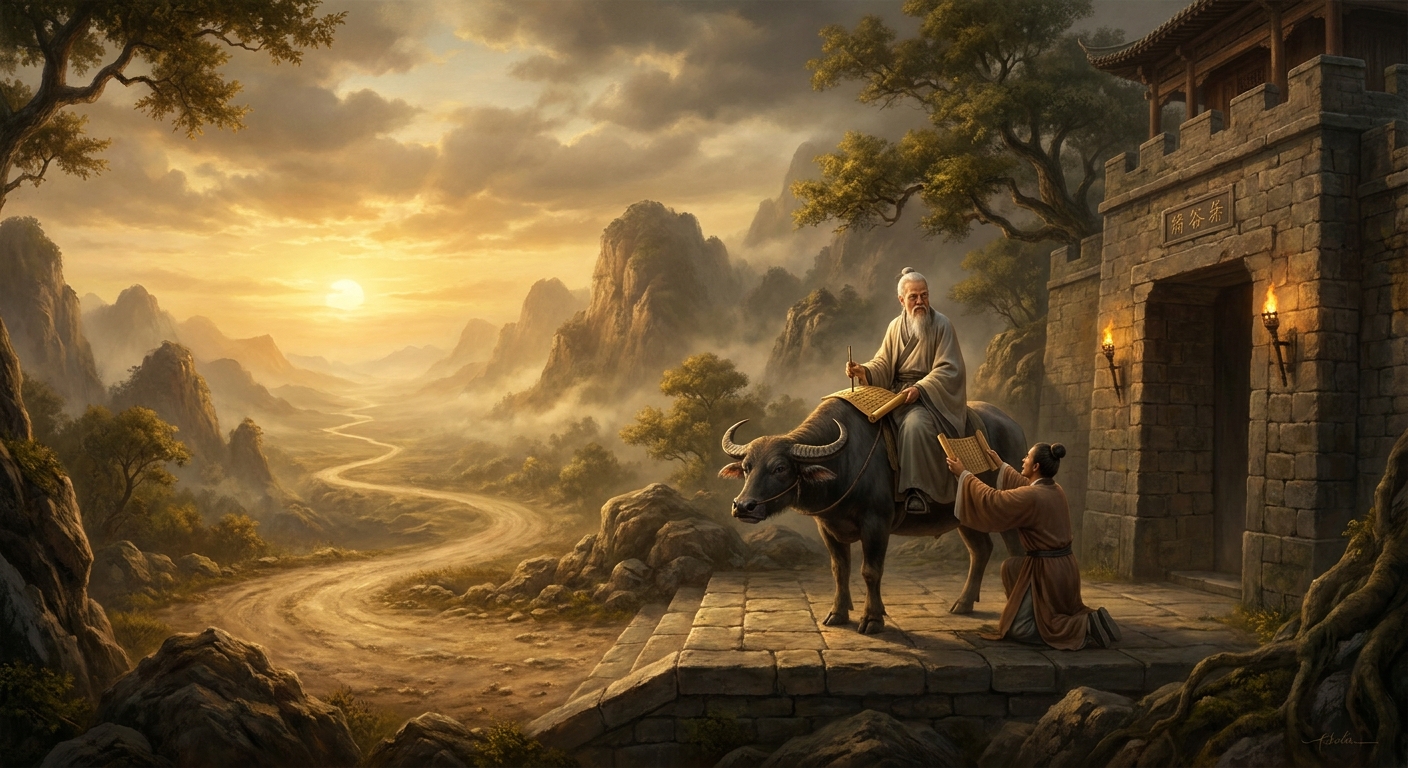
The departure is not dramatic — he rises, when the wind is right, with the ease of a man stepping into a boat he has used many times, and the wind takes him. He covers the distances of a fifteen-day journey in the space of a day, moving through the air above the roads he would otherwise walk, seeing the landscape from the altitude that birds see it and the occasional immortal. He returns rested. The wind does not tire him.
For two years after he masters this practice, he does not leave the house.
His wife asks about the food. He goes to the market. He meets a diviner named Jixian who has the ability to read the lifespans of living things in their faces. The diviner looks at Lièzǐ and predicts his death date with precision. Lièzǐ goes to his teacher Huzi, frightened.
Huzi says: show me the diviner.
The diviner comes. He examines Huzi and says: this man will die soon. His earth element is disrupted. Huzi shows him something — the texts call it a particular configuration of the life-force, a presentation of the body’s qi in a particular pattern — and sends the diviner away. He asks Lièzǐ: what did he see?
Lièzǐ reports the death prediction. Huzi says: I showed him the earth in its stillness — unmoving as a clod, life-force blocked. Come back tomorrow.
The next day the diviner comes again. He looks at Huzi and says: this man is recovering. Something has changed. I saw good signs. He leaves. Huzi: I showed him the sky above the ground — the movement of heaven’s energy, life ascending. The diviner saw recovery because recovery was what I presented.
This happens four times. Each time Huzi shows the diviner a different face — earth, sky, water, the void. On the fourth visit, the diviner cannot read him at all and flees. Huzi sends Lièzǐ after him: follow him, see what you can learn.
Lièzǐ follows, but the diviner disappears.
He returns to Huzi. And here the teaching lands. Lièzǐ has spent years cultivating the ability to ride the wind. He has achieved something remarkable. But his teacher has just demonstrated something beyond it: not the ability to move through one medium, but the ability to present any face at all — to have no fixed face, to be earth or sky or water or void as the situation requires, which means being none of them fundamentally. Lièzǐ’s wind-riding depends on the wind. Huzi’s teaching requires nothing external.
Zhuāngzǐ comments on Lièzǐ in the first chapter of the Zhuangzi: the man who rides the wind does well, but he still depends on the wind. The great Tao walker, Zhuāngzǐ implies, needs no vehicle because he is not going anywhere in particular — he is not going from point A to point B by clever means, he is the motion that is already present in everything.
Lièzǐ goes home. He spends three more years not leaving the house — not from fear this time, but from practice. He cooks for his wife. He tends the pigs. He stops distinguishing between the sacred cultivation and the domestic task. After three years of this, the Zhuangzi says, he has achieved something that the wind-riding was only an early symptom of: not the capacity to ride above things, but the capacity to be at home everywhere, which requires riding nothing at all.
Echoes Across Traditions
Entities
- Lièzǐ (Lie Yukou)
- Huzi (Lièzǐ's teacher)
- the diviner Jixian
- Zhuāngzǐ
Sources
- Liezi (列子), attributed to Lie Yukou, compiled c. 4th century BCE — 3rd century CE
- Zhuangzi (莊子), chapter 1 — 'Wandering Free and Easy,' mentions Liezi's wind-riding
- A.C. Graham, trans., *The Book of Lieh-tzu* (Columbia, 1960)
- Eva Wong, *Taoism: An Essential Guide* (Shambhala, 1997)