Itzamna: The Iguana Lord Who Invented Writing
c. 300-900 CE — Classic Maya Period; mythic origins preceding historical memory · The highest level of the Maya heavens; Izamal in the Yucatán, the city sacred to Itzamna
Contents
Itzamna, supreme lord of the Maya heavens, old man of the universe and husband of Ix Chel, invented writing, calendrics, and divination — the three technologies through which the Maya believed time could be read and the gods consulted.
- When
- c. 300-900 CE — Classic Maya Period; mythic origins preceding historical memory
- Where
- The highest level of the Maya heavens; Izamal in the Yucatán, the city sacred to Itzamna
His body is the sky.
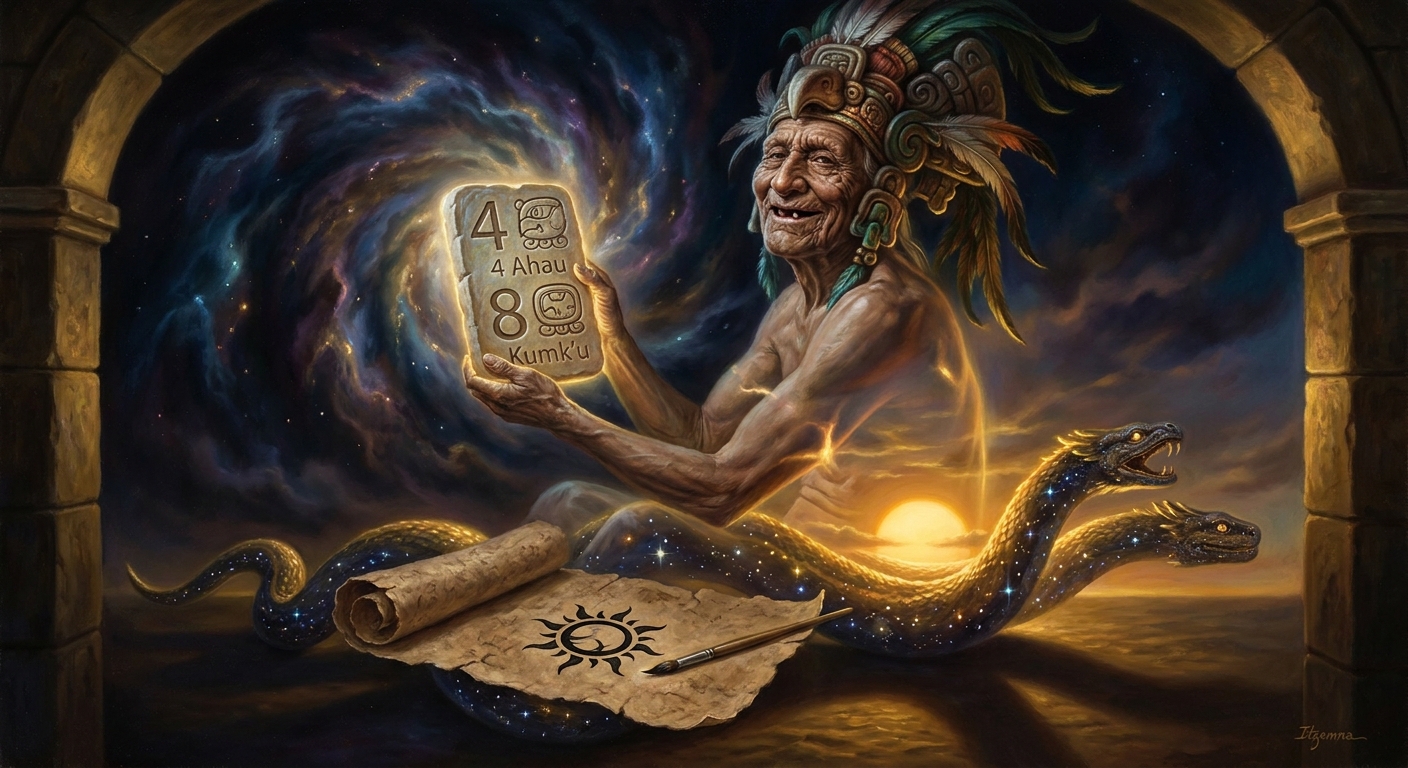
Itzamna — Iguana House, the dwelling place of the iguana, which is itself a form of the cosmic serpent — is old in a way that predates old age. He appears in Maya codices as a toothless ancient man, bent, with sagging cheeks and the hooked nose of extreme age, seated among the symbols of the uppermost heavens. He is not impressive in the visual sense that warrior gods are impressive. He is impressive the way the sky is impressive: by being everywhere, by being the condition within which everything else happens.
He invented writing.
The Maya glyphs — the only fully developed writing system in the pre-Columbian Americas, a combination of logograms and phonetic syllables capable of recording any spoken language — exist because Itzamna gave them. The story is not told in elaborate mythological form the way the Popol Vuh tells the story of the corn-people; it is simply understood and stated in the sources that survive: Itzamna was the first to give people the means to put language onto a surface that would hold it.
What this means, in practical terms, is almost impossible to overstate. The Maya calendar system — the interlocking 260-day tzolk’in and 365-day haab, the fifty-two-year Calendar Round, the Long Count that tracks time in cycles of millions of years — exists in its full precision because it was written down, accumulated across generations of observation, corrected and refined and compared. Without writing there is no calendar. Without the calendar there is no ability to plan agriculture, anticipate celestial events, coordinate ritual across city-states, or legitimize royal power by placing it within divine time.
Itzamna gave the Maya the ability to be precise about time.
He is also the inventor of divination.
The Maya divination systems — particularly the daykeeper practice that uses the 260-day calendar as a template for reading the qualities of time — trace to him. Each of the 260 days has a character, a deity, an association with particular qualities of fortune and risk. The daykeeper who reads a person’s birth date and advises them about the trajectory of their life is operating within a system Itzamna established.
His wife is Ix Chel, the moon goddess, the goddess of medicine and weaving and childbirth. Together they represent the complementary principles of the Maya universe: he is time and language, she is the body and its cycles. His time-tracking and her body-knowledge form the complete picture of what human beings need to navigate existence.
The city of Izamal in the Yucatán was his principal center — a city of golden pyramids and white plazas where the earliest Spanish colonial church was built directly on top of the temple platform, the conquistadors demonstrating their usual spatial theology. The pyramid remains, encased. The colonial church sits on it.
He lives in the highest level of the thirteen heavens.
Maya cosmology stacks the heavens in thirteen layers, each with its own qualities, and Itzamna occupies the uppermost. Below him, in descending order, are the other deities and the various celestial phenomena they govern. This is not a hierarchy of force — Itzamna does not rule the other gods through military domination — but a hierarchy of comprehension. He is highest because he sees the most. He is old because he has been watching longest.
The scribes in Classic Maya cities — the men who wrote on bark paper books and carved stone monuments and painted ceramic vessels with mythological narratives — were trained in the arts of Itzamna. They were among the most powerful people in Maya society, second only to kings and sometimes overlapping with them. The ability to read and write the glyphs was sacred knowledge, restricted and valuable, the key to communicating across the barrier of time.
When the Spanish arrived and Diego de Landa burned the books — the vast majority of Maya written knowledge, thousands of years of accumulated observation, gone in a series of bonfires at Maní in 1562 — what he was burning was the gift of Itzamna.
Three books survive.
In them, Itzamna sits at the top of the page, looking down, bent and ancient, his wrinkles deep, his eyes still sharp, still reading the time that falls beneath him like water.
Echoes Across Traditions
Entities


Sources
- Mary Miller and Karl Taube, *An Illustrated Dictionary of the Gods and Symbols of Ancient Mexico and the Maya* (Thames & Hudson, 1993)
- Michael D. Coe, *Breaking the Maya Code* (Thames & Hudson, 1992)
- Diego de Landa, *Relación de las Cosas de Yucatán* (c. 1566, translated by Alfred Tozzer, 1941)