The Eight Trigrams and the Grammar of Change
Traditional: trigrams from Fúxī c. 2800 BCE; hexagrams from King Wen c. 1046 BCE; Confucian commentaries c. 500 BCE · The Yellow River and the Zhou dynasty prison where King Wen composed his judgments
Contents
Three lines — each either broken or unbroken — combine into eight figures that map every possible state of the universe, and the sixty-four hexagrams they form together become the Book of Changes: China's three-thousand-year tool for thinking about transformation.
- When
- Traditional: trigrams from Fúxī c. 2800 BCE; hexagrams from King Wen c. 1046 BCE; Confucian commentaries c. 500 BCE
- Where
- The Yellow River and the Zhou dynasty prison where King Wen composed his judgments
There are only two states: unbroken and broken.
This is the foundation. A line is either whole or divided. Everything in the universe is one or the other, or more precisely, everything in the universe is a particular proportion and arrangement of the two. Yang — the unbroken line, the bright, the strong, the active. Yin — the broken line, the dark, the yielding, the receptive. Neither is better. Both are necessary. The dance between them is the universe.
Stack three lines. The eight possible combinations are: all yang, all yin, and six combinations in between. These are the eight trigrams. Fúxī receives them from the river tortoise and arranges them in a circle. The circle is a map: Heaven opposite Earth, Thunder opposite Wind, Water opposite Fire, Mountain opposite Lake. The opposites complete each other. The circle turns.
Stack two trigrams. Sixty-four hexagrams — all possible combinations. King Wen composes his hexagram judgments in the Zhou dynasty prison where his captor, the last Shang emperor, has confined him. He does not compose them to pass the time. He composes them because he is trying to understand his situation — the loyal minister unjustly imprisoned, the dynasty on the verge of collapse, the question of whether the pattern he is in contains the seed of its own resolution or only its own continuation.
He finds the pattern. He writes the judgment. The pattern says: Trapped in a narrow gorge, imprisoned within stone walls. For three years, no one comes. This is hexagram 47, Kun — oppression. He is reading about himself. He is using the structure of the cosmos to locate his own situation within it. When you know which of the sixty-four patterns you inhabit, you know something about what the pattern implies: what it has in common with every time this pattern has appeared, what the internal dynamics of the pattern suggest about movement, what kind of action the pattern supports and what kind it resists.
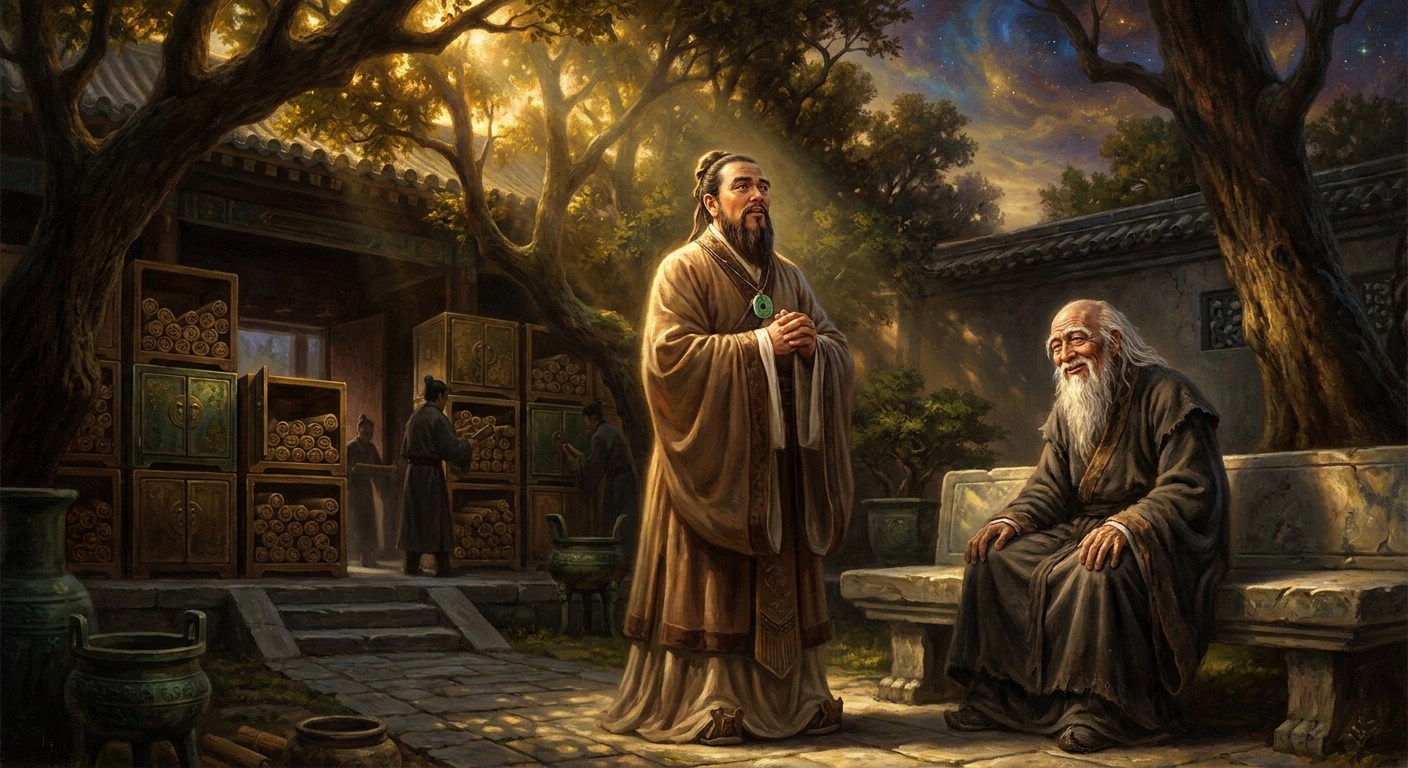
Confucius reads the I Ching in his old age with such intensity that he wears through three bindings of the bamboo slips. He writes the Ten Wings — the philosophical commentaries that give the text its depth. The Great Commentary, the Wenyan, the Explanation of the Trigrams. He writes: Change has a Supreme Ultimate. This produces the two forms. The two forms produce the four images. The four images produce the eight trigrams. He is locating the I Ching within the Confucian cosmos — making it not just a divination manual but a map of how reality generates itself.
The sixty-four hexagrams describe sixty-four conditions: creative force, receptive yielding, initial difficulty, youthful inexperience, waiting, conflict, the army, community, advance, treading carefully, peace, standstill, community of people, great possession, modesty, enthusiasm, following, work on the decayed, approach, contemplation, biting through, grace, splitting apart, return, innocence, great accumulation — and on through every state the human being can inhabit.
Leibniz encounters the I Ching in the seventeenth century and recognizes in its binary structure the same logic as his newly invented calculus notation. The sixty-four hexagrams arranged in the Fuxi sequence are isomorphic with binary numbers 0 through 63. The Chinese had found the mathematical structure of information two thousand years before the mathematics of information was formalized.
The river tortoise came up from the water. Fúxī drew the lines. King Wen wrote the judgments in his prison. Confucius wore through three bindings. Leibniz wrote his letters. The broken and unbroken lines kept their arrangement through every dynasty, every translation, every interpretation. The question they are always answering is the same question: what is the pattern I am in right now, and what does it tell me about what I should do? The answers are sixty-four. That has always been enough.
Echoes Across Traditions
Entities
- Fúxī (creator of the trigrams)
- King Wen of Zhou (creator of the hexagrams)
- Confucius (author of the commentaries)
- the I Ching
Sources
- Yijing (易經) / Book of Changes — the text itself
- Richard John Lynn, trans., *The Classic of Changes* (Columbia, 1994)
- Richard Wilhelm & Cary Baynes, trans., *The I Ching or Book of Changes* (Princeton, 1950)
- Kidder Smith et al., *Sung Dynasty Uses of the I Ching* (Princeton, 1990)