Lǎozǐ Rides West on a Buffalo
Traditional: c. 6th century BCE, during the decline of the Zhou dynasty · The Hangu Pass (函谷關) on the border of what is now Henan and Shaanxi Provinces
Contents
When the Zhou dynasty falls into corruption, the keeper of the imperial archives loads his books onto a green water buffalo, rides to the western pass, and is stopped by the gatekeeper — who asks him to write something down before he disappears.
- When
- Traditional: c. 6th century BCE, during the decline of the Zhou dynasty
- Where
- The Hangu Pass (函谷關) on the border of what is now Henan and Shaanxi Provinces
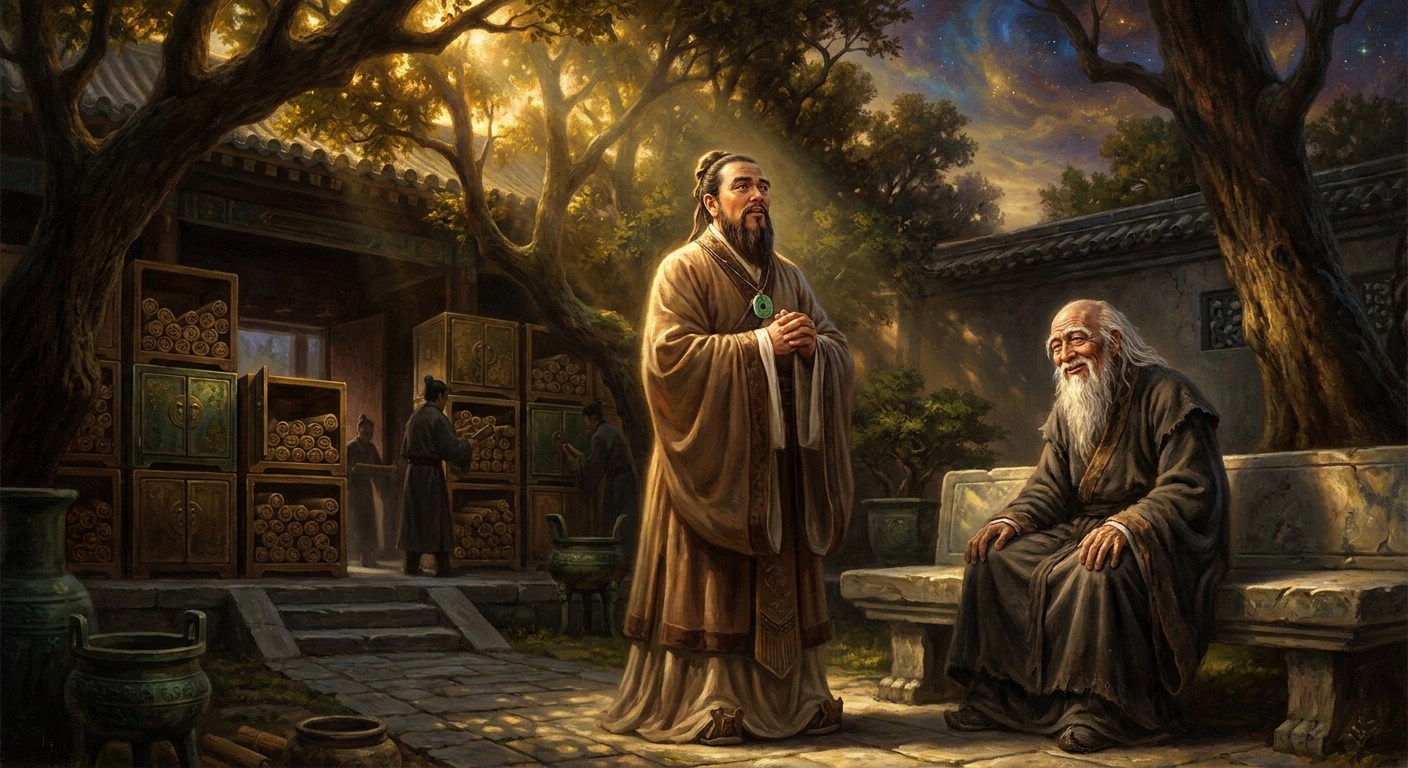
He has worked in the archives for a very long time.
The Shiji says he was a keeper of the archives of the Zhou dynasty — the librarian, the keeper of records, the man who knew where the texts were and what they said and which ones had been filed incorrectly and which ones were genuine. He was not a political figure. He was not a general. He was the person who understood the records and was therefore, by a certain definition, the person who understood the dynasty’s past.
He watches the dynasty rot. He has the archivist’s particular advantage in watching this process: he can see it in the documents, in the accumulation of bad decisions recorded in dry administrative language, in the discrepancy between what the court says it is doing and what the records show it has done. The Shiji says he simply grows weary of the decay. He decides to go west.
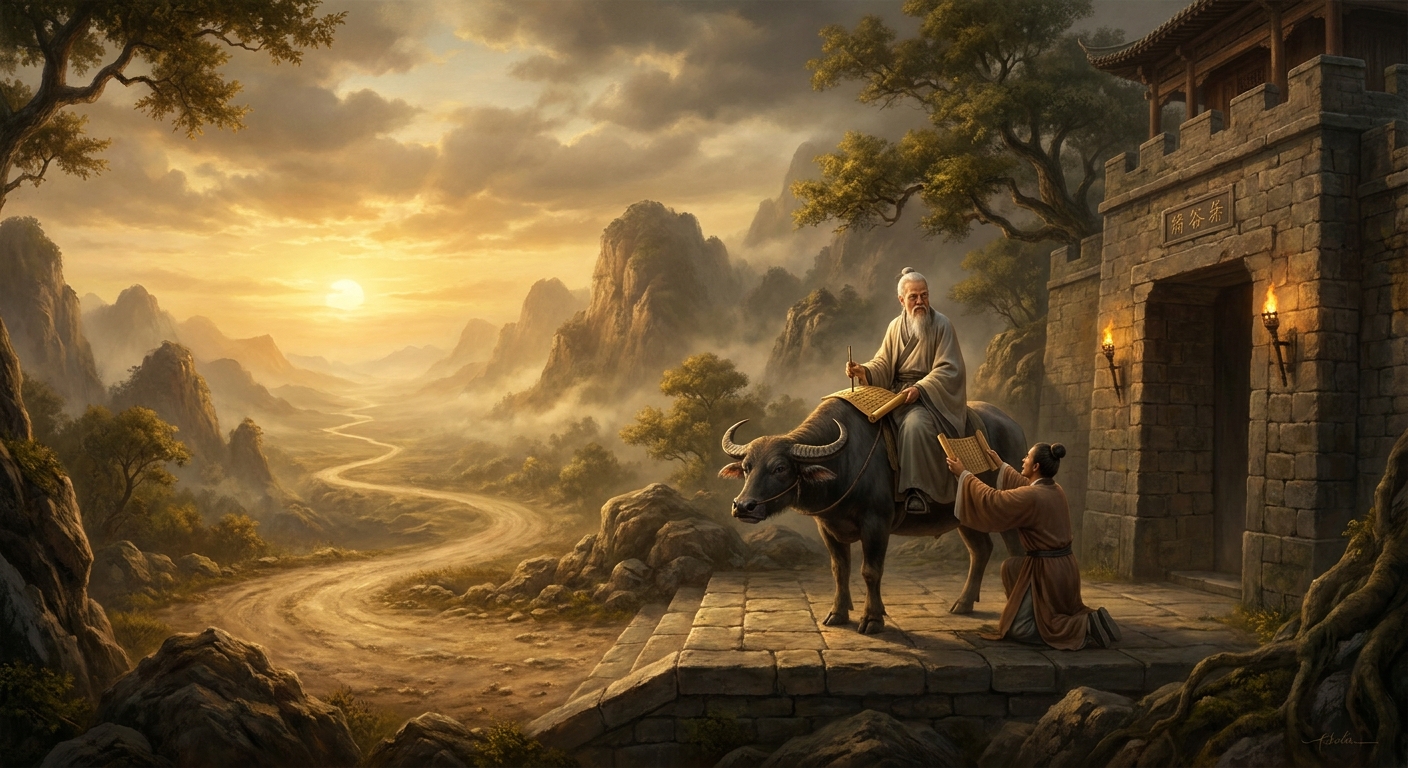
He loads his things on a green water buffalo. This detail appears in every account: not a horse, a buffalo, which is slower and stronger and less easily spooked and associated with farming and the earth rather than war and mobility. He is not escaping. He is departing, which is a different thing.
The pass at Hangu is the last gate between the Zhou kingdom and the west. The gatekeeper Yǐnxǐ — or the Pass Master, as some texts call him — is an unusual official: a man who studies the sky and the emanations of qi in the air and is paying close attention to the west. He has been watching, for days, a cloud of purple qi moving down the pass road from the east. Purple qi in the Chinese system is the sign of the sage — the visible luminosity that accumulates around genuine cultivation.
He stands at the gate when Laozi arrives.
He recognizes immediately what he is looking at. He tells Laozi: before you pass through and vanish, you must write something down for me. The Shiji records the request with this particular urgency: you are about to retire into obscurity. Force yourself to write something down.
Laozi dismounts from the buffalo.
He writes. It takes some time. He writes five thousand characters — eighty-one chapters, each very short, some only a few lines. He writes in the paradoxical mode that is the Tao’s natural language: The Tao that can be named is not the eternal Tao. The name that can be given is not the eternal name. He writes about water that overcomes stone by yielding. He writes about the usefulness of emptiness — the hub that makes the wheel, the hollow that makes the bowl, the space that makes the room useful. He writes about the ruler who governs by not governing, the sage who teaches without speaking, the way that is not a method.
He hands the text to Yǐnxǐ.
He remounts the buffalo. He rides west through the pass.
No credible account says where he goes. The mountain tradition says he went to India and became the Buddha. The Taoist tradition says he dissolved into the undifferentiated west, becoming one with the Tao. The skeptical tradition notes that no one knows, that he simply vanished, which is what the texts themselves suggest is the appropriate end for someone who has understood what he understood.
The Tao Te Ching remains. The gatekeeper’s request generated the most translated non-biblical text in human history. The eighty-one chapters have been used to justify pacifism, despotism, individual liberation, political quietism, military strategy, feminist theory, and ecological philosophy. Scholars argue about whether the passages mean what they appear to mean or something entirely opposite. The chapters do not resolve the argument. They were not designed to. The Tao that can be explained is not the eternal Tao.
The buffalo has long since reached whatever it was walking toward. The archive is closed. The gatekeeper’s question produced the answer that no one has finished with yet.
Echoes Across Traditions
Entities
- Lǎozǐ (Li Er)
- Yǐnxǐ (the gatekeeper)
- the Hangu Pass
- the green water buffalo
Sources
- Shiji (史記), Sima Qian, biography of Laozi
- Tao Te Ching (道德經) — the text itself, attributed to Laozi
- D.C. Lau, trans., *Tao Te Ching* (Penguin, 1963)
- Stephen Mitchell, trans., *Tao Te Ching* (Harper, 1988)
- A.C. Graham, *Disputers of the Tao* (Open Court, 1989)