The Long Count: What Happens When Time Runs Out
c. 400 BCE — first Long Count inscriptions; system used through the Classic Maya period; 3114 BCE — the mythological creation date · Palenque, Quiriguá, Copán, Tikal — major sites with Long Count inscriptions
Contents
The Maya Long Count calendar tracks time in cycles of millions of years from a creation date in 3114 BCE — not because the Maya thought time would end, but because they believed cosmic history must be precisely remembered and the great cycles must be ceremonially completed.
- When
- c. 400 BCE — first Long Count inscriptions; system used through the Classic Maya period; 3114 BCE — the mythological creation date
- Where
- Palenque, Quiriguá, Copán, Tikal — major sites with Long Count inscriptions
The Long Count begins on a day in 3114 BCE.
August 11, 3114 BCE in the proleptic Gregorian calendar — the day the current creation began, the day after the previous world order ended, the anchor point from which all subsequent Maya dates are measured as a count forward. On that day, in the Maya Long Count notation, the date is written 0.0.0.0.0 — five zeros, like an odometer at the start of a journey.
The odometer has five places.
The smallest unit is the k’in — one day. Twenty k’ins make one winal — twenty days. Eighteen winals make one tun — 360 days, approximately one year. Twenty tuns make one k’atun — approximately twenty years. Twenty k’atuns make one b’ak’tun — approximately four hundred years. The date is written b’ak’tun.k’atun.tun.winal.k’in, a five-place number that can express any day in human history with precision.
The current creation was expected to complete its 13th b’ak’tun on December 21, 2012.
This is the date that generated the 2012 apocalypse theory, and the theory was entirely wrong.
The Maya did not believe the world would end in 2012. The evidence for this is written on stone at multiple sites. At Palenque, the inscriptions in the Temple of Inscriptions place events more than 4,000 years in the future — millennia after the 13th b’ak’tun — within the Long Count framework, because the scribes expected the count to continue. At Quiriguá, Stela D records events at the creation date that are described in terms that suggest cycles continuing beyond 13 b’ak’tuns.
At the site of Cobá, an inscription reaches back to a date equivalent to 41 octillion years ago.
The Maya Long Count is not a countdown to apocalypse. It is a counting up — an accumulation of remembered time, stretching in both directions from the present, making the present comprehensible by showing how small it is within cosmic duration and how precisely placed it is within that duration.
When the 13th b’ak’tun ended in 2012, Maya communities in the Yucatán and Guatemala held ceremonies. The ceremonies were celebrations of completion — the same kind of ceremony you hold when an important cycle ends and a new one begins. The odometer rolled to 13.0.0.0.0, and then to 13.0.0.0.1, and time continued.
The intellectual achievement of the Long Count cannot be overstated.
The Maya scribes who designed it worked out, through centuries of astronomical observation without telescopes, the length of the solar year to within a fraction of a day. They calculated the orbital period of Venus to within minutes of accuracy. They predicted eclipses generations in advance. They did all of this with naked-eye observation, a positional number system that included zero (which Europe would not use until centuries after the fall of the Classic Maya cities), and the patience of people who understood that cosmic patterns are only visible over very long time spans.
The Long Count is the instrument that allowed all of this precision.
Without a unified count that situates individual observations within a larger framework, the patterns cannot be seen. A Venus observation on one date means nothing without knowing how many days separate it from the next Venus observation at the same point in its cycle. The Long Count provides the framework. The scribes kept the observations and the count simultaneously, building a database of celestial mechanics that their successors could draw on.
When the Spanish arrived and the Catholic Church condemned the books, they burned not just religious texts but the observational records of centuries. The three codices that survived contain enough to reveal the system. They do not contain all that was lost.
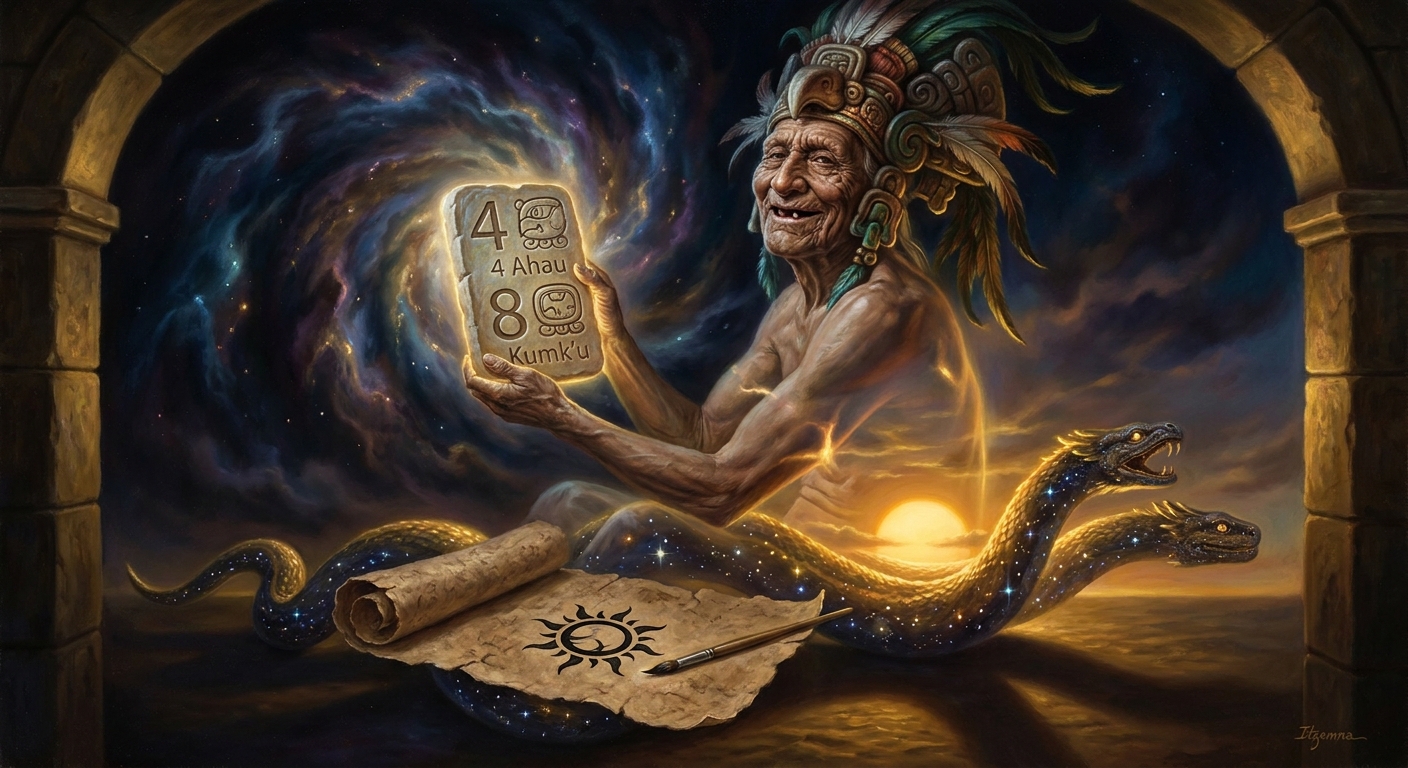
Time, in the Maya understanding, is not a backdrop for human events. It is the primary reality, the structure within which everything else is situated, the gift of Itzamna that allows the present to know where it stands.
The count continues.
Today is a Long Count date. The five-place number is still advancing, one k’in at a time, and the daykeepers still know which number it is.
Echoes Across Traditions
Entities
- the scribes of Palenque
- Pacal
- the inscribers at Quiriguá
Sources
- David Stuart, *The Order of Days: The Maya World and the Truth about 2012* (Harmony Books, 2011)
- Anthony F. Aveni, *Skywatchers of Ancient Mexico* (University of Texas Press, 1980)
- Simon Martin and Nikolai Grube, *Chronicle of the Maya Kings and Queens* (Thames & Hudson, 2000)