Ahura Mazda Speaks the First Word
Before time — the primordial era before the material world was created · The Endless Light — the infinite realm of Ahura Mazda before material creation
Contents
Before time begins, Ahura Mazda contemplates the infinite void and speaks the sacred word Ahuna Vairya — and in that utterance, the entire future of creation is both decided and set in motion.
- When
- Before time — the primordial era before the material world was created
- Where
- The Endless Light — the infinite realm of Ahura Mazda before material creation
Before the beginning, there is only light.
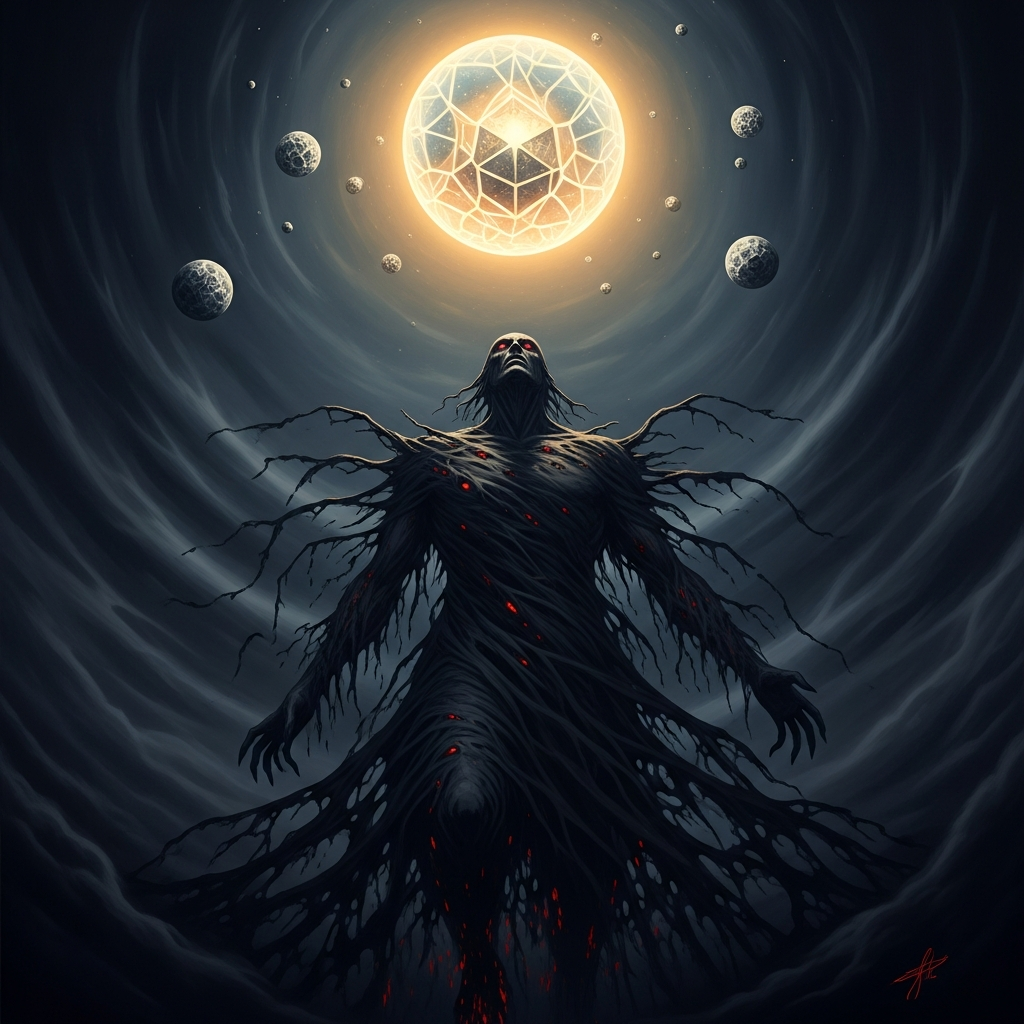
Not the light that illuminates something else — not the luminescence that falls on objects and makes them visible — but light that is itself the substance of reality, undivided and self-sufficient. Ahura Mazda, the Wise Lord, dwells in this boundless luminosity. He is omniscient: he knows everything that has happened and everything that will happen, because in his infinite present there is no distinction between those two categories. He knows that far below his realm of Endless Light, there exists an Endless Darkness — a counterprincipal, a cosmic shadow whose nature is not the absence of light but the active choice of darkness, the principle that will name itself Angra Mainyu, the Hostile Spirit.
He knows that Angra Mainyu does not yet know that he exists.
This is the situation Ahura Mazda contemplates in the stillness before time: that the darkness has not yet attacked, and that he must decide what to do about a conflict that has not yet begun.
The Bundahishn — the great Zoroastrian cosmogonic text composed from older oral traditions — records his decision in terms of pure strategy. Ahura Mazda knows that if he simply exists in his Light, the darkness will eventually discover him and attack. He also knows that he himself cannot descend into the Darkness, because Light and Darkness cannot intermingle — only the material world, when it is created, can be the arena in which they contest. So he decides to create the material world as the arena: to call into being a limited time, a bounded space, in which the conflict can be decided once and for all in favor of truth.
And so he speaks.
The word he speaks is the Ahuna Vairya — the Ahunwar, the most sacred of all Zoroastrian prayers, which later priests will recite in a single breath because its power is such that it must not be interrupted. The prayer begins: As the master is to be chosen, so is the judge to be chosen according to righteousness. In speaking it, Ahura Mazda does not merely describe a future arrangement; he constitutes it. He speaks the cosmic hierarchy into being. He speaks the victory over Angra Mainyu into being — not as an accomplished fact but as a certainty that is now lodged in the structure of time.
Below in the Darkness, Angra Mainyu hears it.
The effect on him is paralyzing. The prayer is so dense with divine energy, so saturated with the force of Asha — cosmic righteousness — that Angra Mainyu falls into a swoon that lasts for three thousand years. He lies stunned in the abyss while above him Ahura Mazda proceeds with creation.
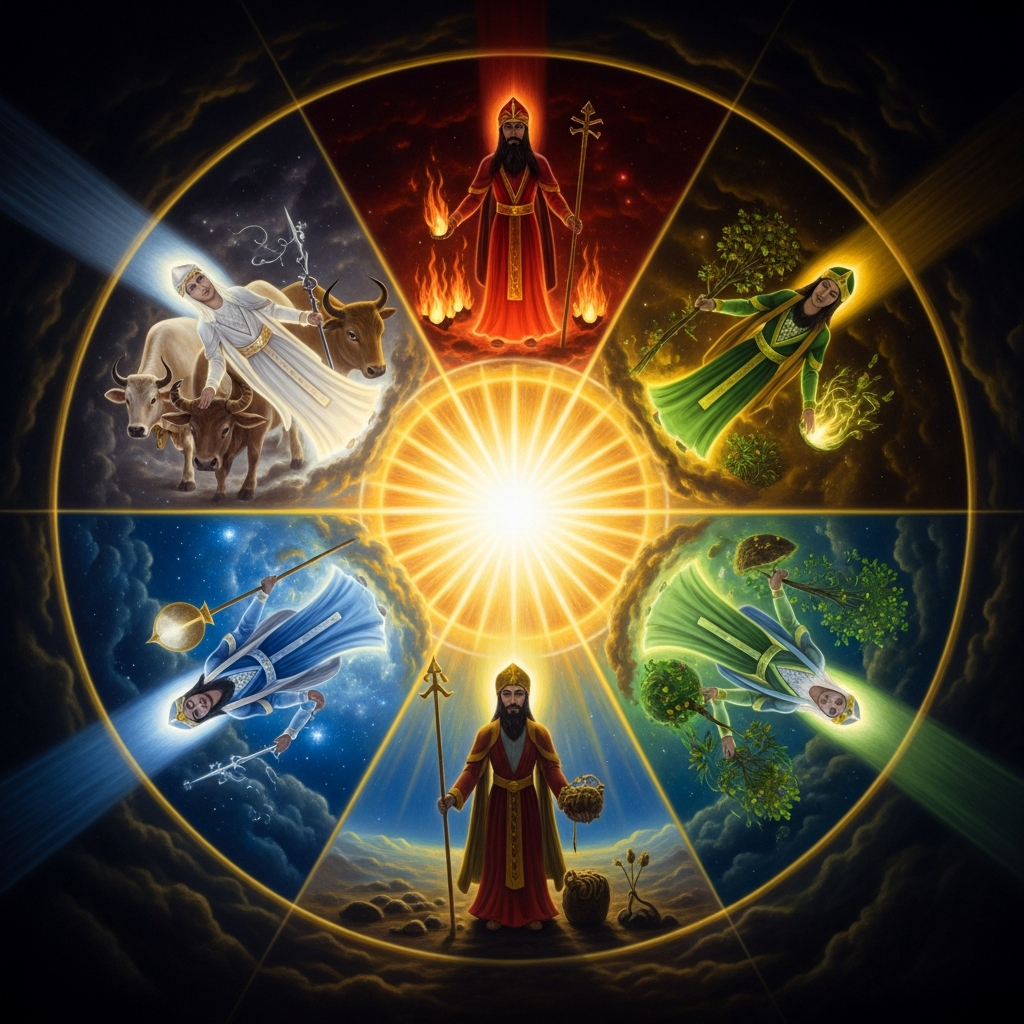
The Wise Lord creates first in the menog form — the spiritual, invisible mode — and then in the getig form, the material, visible mode. Six divine qualities emanate from him in sequence: Good Mind, Best Righteousness, Desirable Dominion, Bounteous Devotion, Wholeness, and Immortality. These are not angels exactly, not separate beings, but facets of the divine nature crystallized into distinct presences, each responsible for a dimension of creation. Through them the sky, the water, the earth, the plants, the animals, and finally the first human being — Gayōmard, the Mortal Life — take on their material forms.
Everything he makes, he makes perfect.
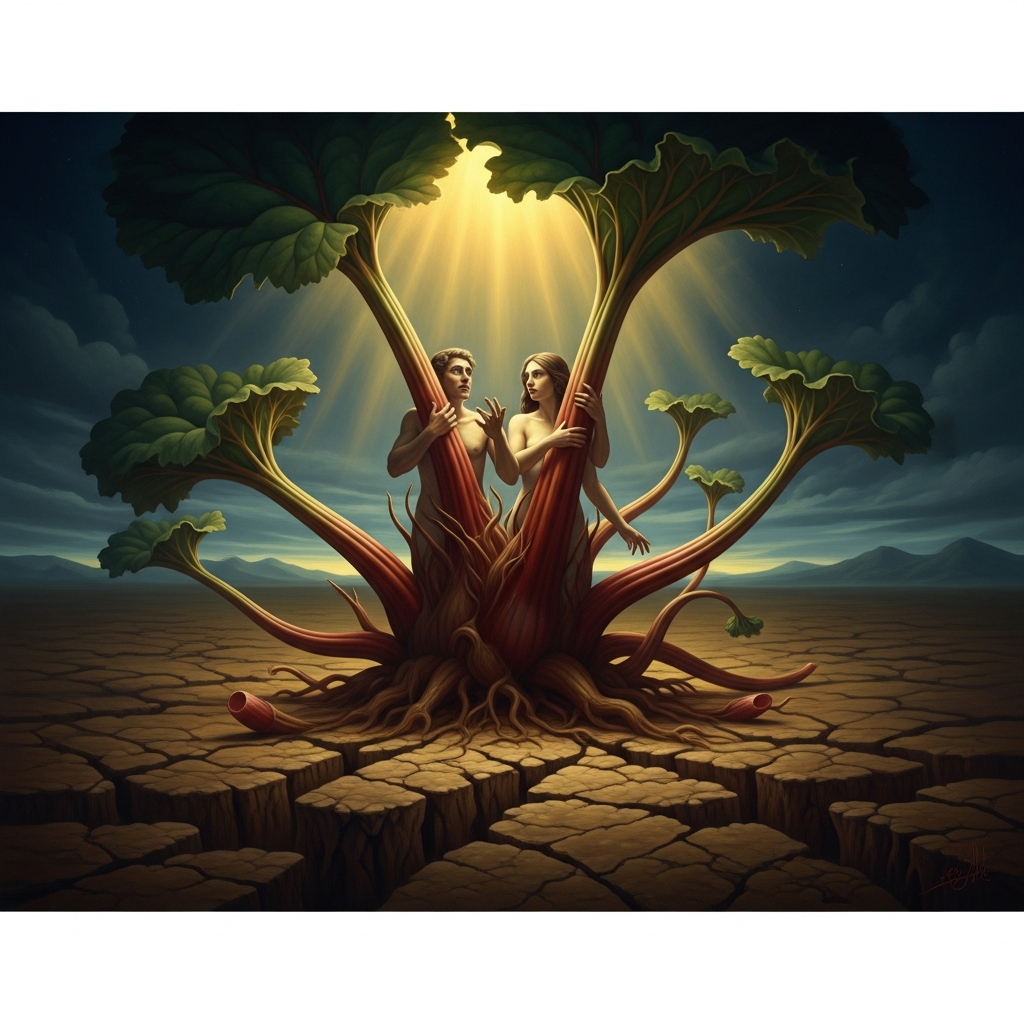
This is the detail the tradition insists on and will not let go of: the original creation is entirely good, entirely whole. There is no imperfection in the getig world that Ahura Mazda speaks into being. The sky is crystalline and perfect. The water is pure. The earth is flat and unbroken, without mountains or valleys, which are wounds that come later. The plants are healing. The animals are wise. Gayōmard, the primordial man, is radiant as the sun.
Ahura Mazda looks at what he has made.
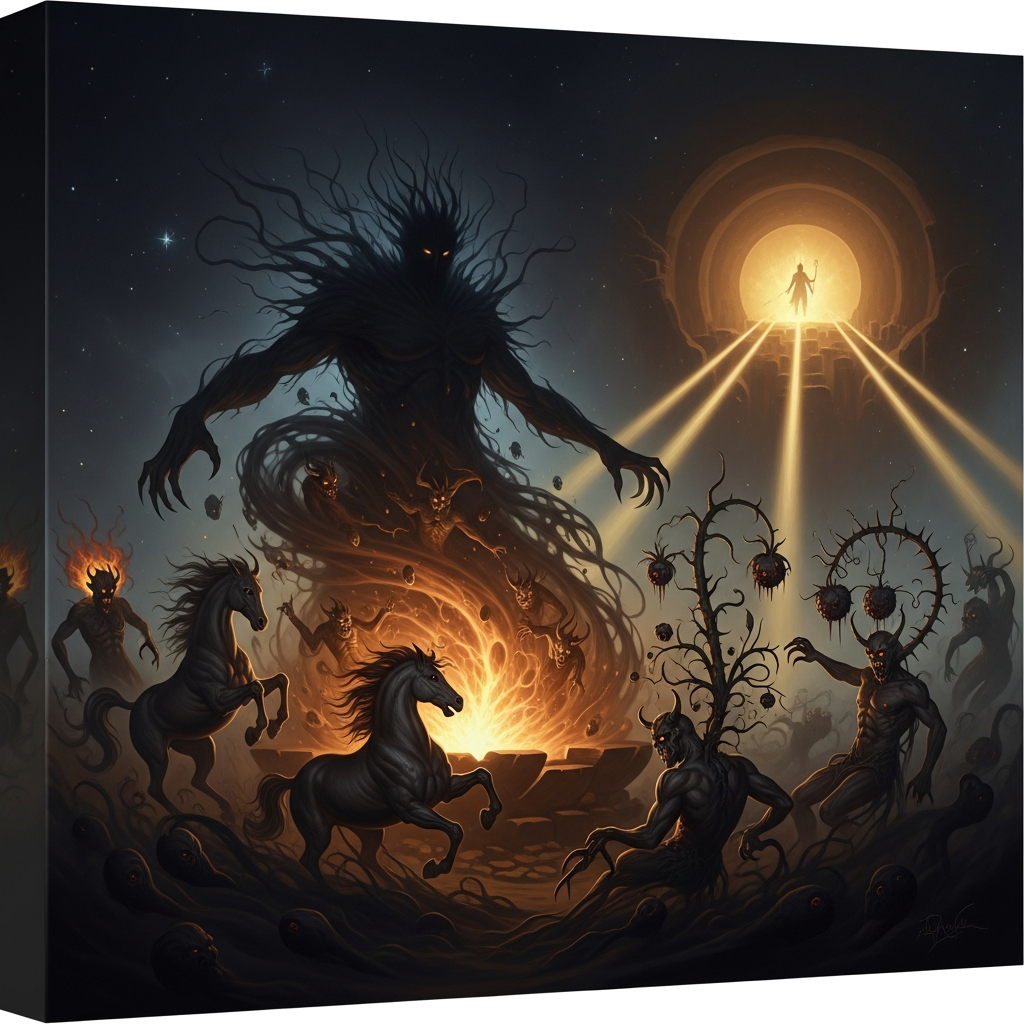
He knows what is coming — he has always known, because he is omniscient and the attack of Angra Mainyu is already in his knowledge. He knows the perfection he has created will be invaded, corrupted, disrupted. He knows that Gayōmard will die and that death will spread. He knows that the flat earth will be broken by Angra Mainyu’s assault into mountains and deserts and poisoned waters.
He creates it anyway.
This is the theological core that Zarathustra’s successors will spend two millennia unpacking: Ahura Mazda creates a world he knows will suffer, because the suffering is finite and the final renovation — the Frashokereti, when all creation is restored to its original perfection — is certain. The creation is not a mistake. It is a decision made with full knowledge of its cost, by a being who believes the cost is worth the outcome.
The first word has been spoken. Time has begun. The world exists.
And in the Darkness, Angra Mainyu stirs.
Echoes Across Traditions
Entities
- Ahura Mazda
- Angra Mainyu
- Spenta Mainyu
- Amesha Spentas

Sources
- *Bundahishn* (Book of Primal Creation), translated by Behramgore Anklesaria (Bombay, 1956)
- Mary Boyce, *Textual Sources for the Study of Zoroastrianism* (Manchester, 1984)
- Prods Oktor Skjærvø, *The Spirit of Zoroastrianism* (Yale, 2011)
- R.C. Zaehner, *Zurvan: A Zoroastrian Dilemma* (Oxford, 1955)