How Ahriman Made the Lie
The primordial era — the counter-creation that accompanies the assault on Ahura Mazda's world · The Endless Darkness — the abyss from which Angra Mainyu's counter-creation proceeds
Contents
In the theological account of Zoroastrian evil, Angra Mainyu does not merely corrupt — he counter-creates, producing for every good thing in Ahura Mazda's cosmos an evil twin whose nature is the systematic inversion of goodness.
- When
- The primordial era — the counter-creation that accompanies the assault on Ahura Mazda's world
- Where
- The Endless Darkness — the abyss from which Angra Mainyu's counter-creation proceeds
For every thing Ahura Mazda made, Angra Mainyu makes the opposite.
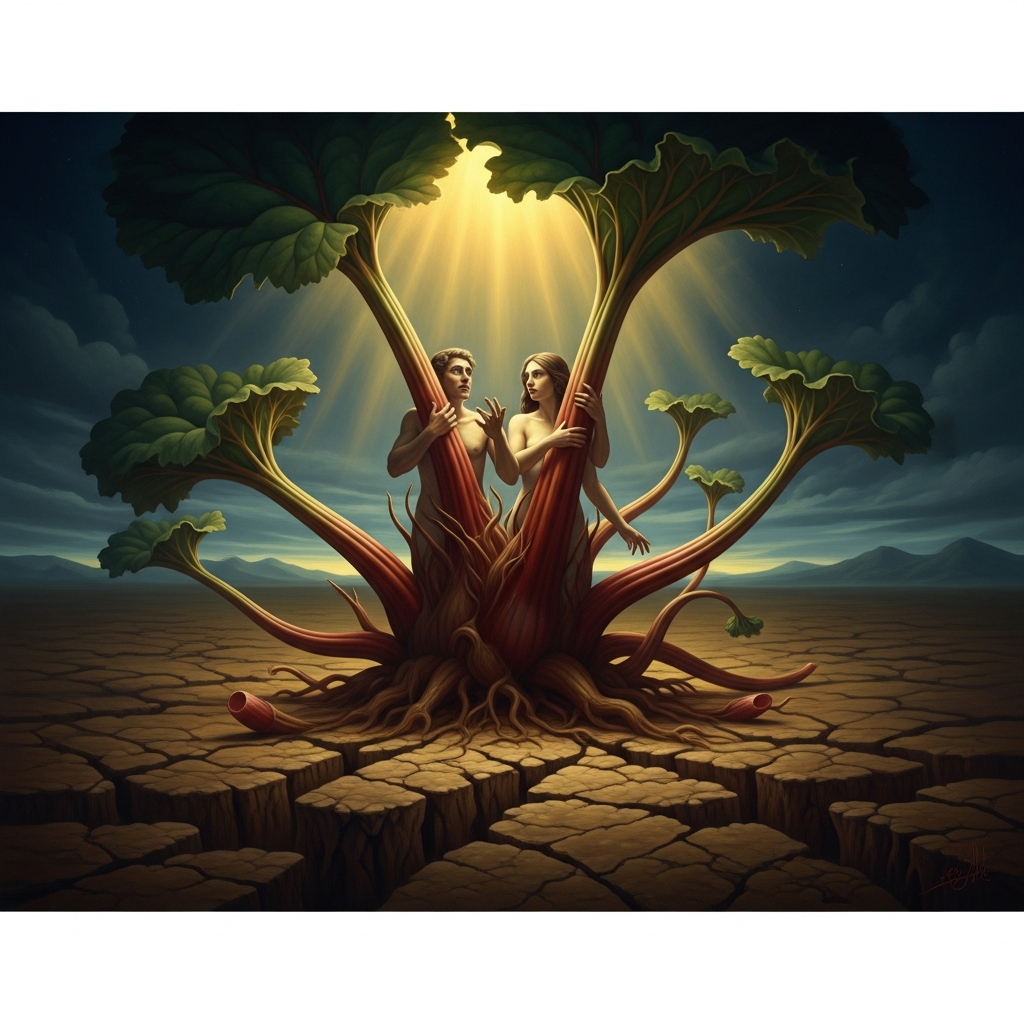
This is the structure the Bundahishn describes with theological precision: when the Wise Lord breathed life into Gayōmard, the Hostile Spirit breathed disease into the air around him. When Ahura Mazda made pure water, Angra Mainyu made saltwater and poisoned rivers. When Ahura Mazda made the cattle useful and docile, Angra Mainyu made the predators. When Ahura Mazda made wheat, Angra Mainyu made the plant that poisons.
The Avestan term is paiti-varsta — counter-working, counter-creation. Angra Mainyu does not create from nothing; he requires an original to invert. This is, the tradition insists, the proof of his derivative nature: the Lie is always subsequent to the Truth it corrupts. You cannot lie about nothing. You can only lie about something that is, first, real.
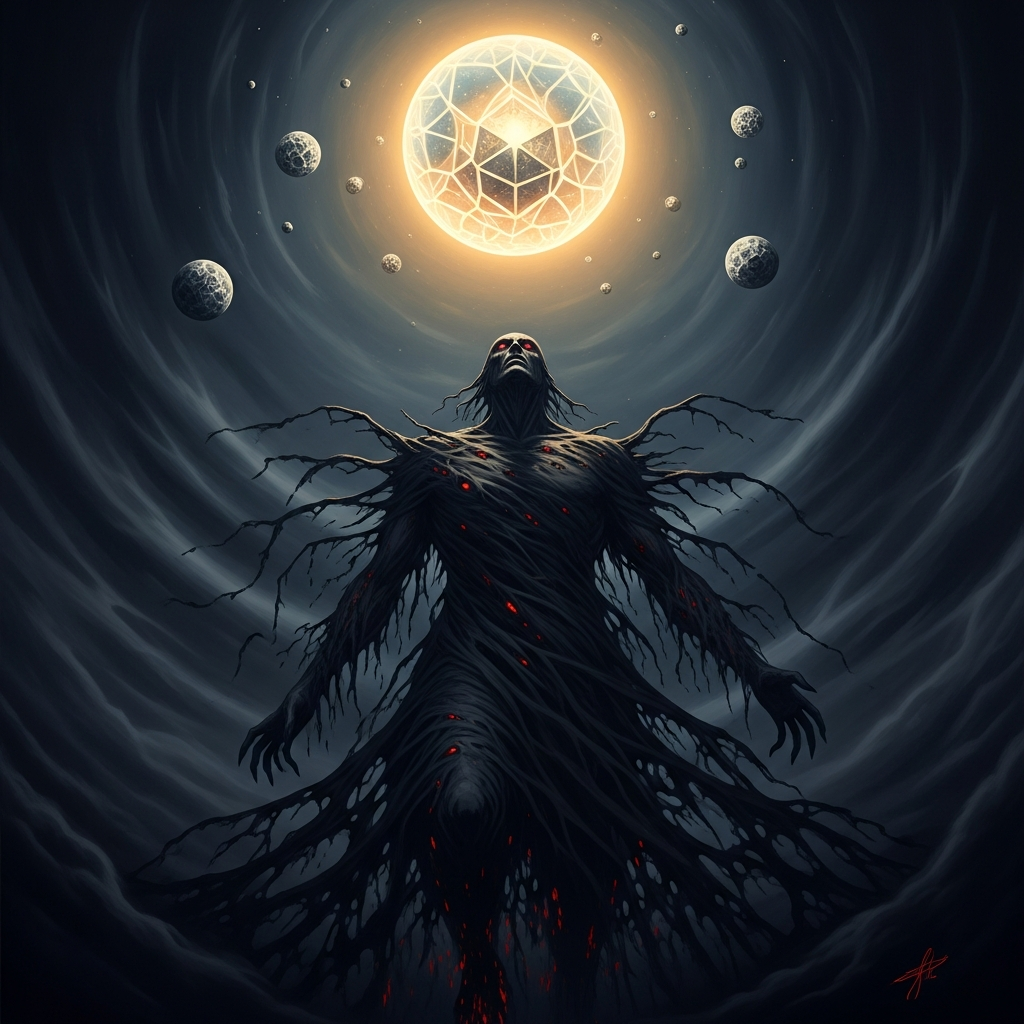
His most fundamental production is Druj itself — the Lie, personified as a cosmic principle and also as a female demon of immense power who embodied falsehood in all its forms. Where Asha Vahishta embodies truth and right order, Druj embodies untruth and disorder. Where Vohu Manah embodies Good Mind, Aka Manah embodies Bad Mind. The pattern is exact and total.
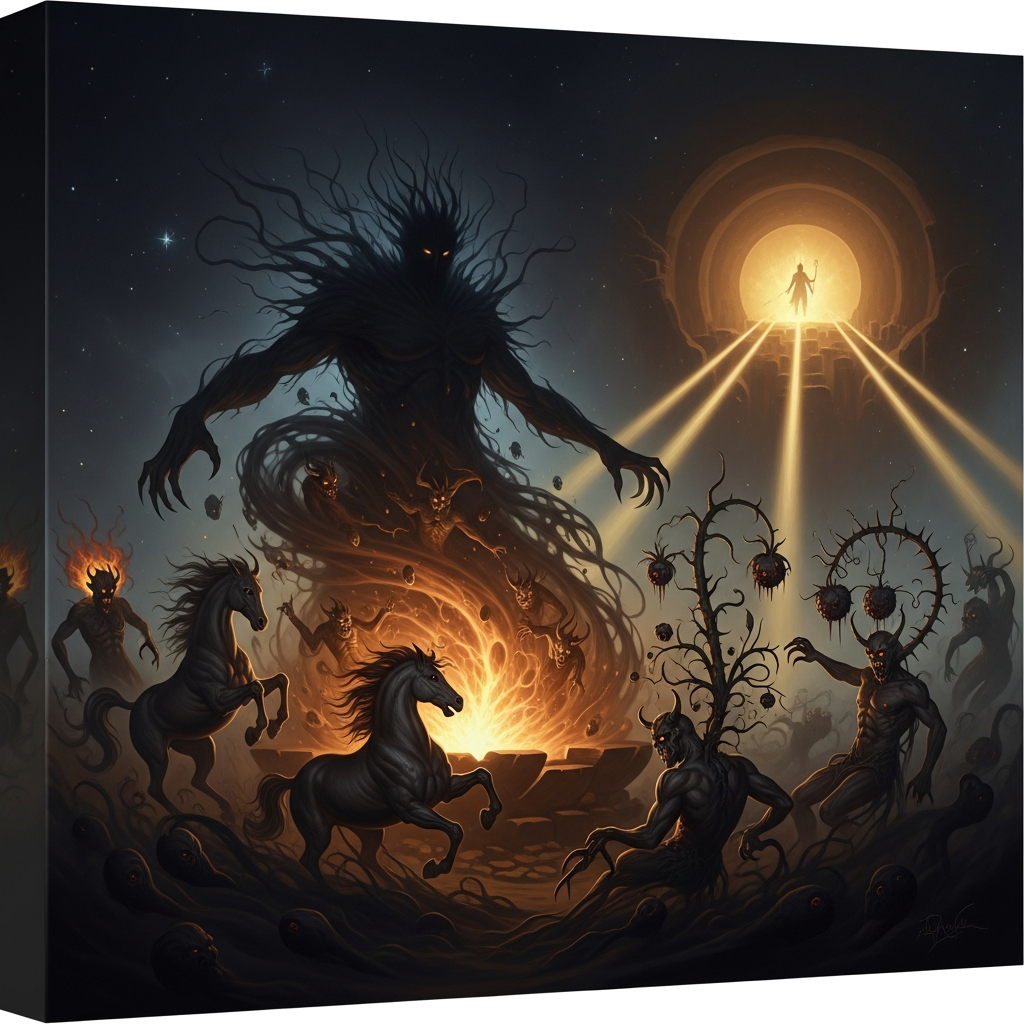
The daevas — the demons who fight alongside Angra Mainyu — are arranged in this counter-pattern.
Aeshma is the counter-creation of Sraosha. Sraosha embodies obedience, attentiveness, the quality of hearing and responding to the cosmic order. Aeshma embodies the violence of the berserker, the cattle-raider, the man who destroys what he cannot take. He is fury without purpose, force without order. In later Persian tradition he will become Asmodeus in the Hebrew Book of Tobit — the demon of wrath who kills seven bridegrooms, whom Raphael finally binds.
Nasu is the fly-demon — the Corpse Demoness who rushes to possess a body at the moment of death, bringing the ritual pollution that makes the corpse dangerous to the living. Every Zoroastrian funeral practice, every careful disposal of the body by exposure on the towers of silence, every restriction on contact with the dead, is a response to Nasu’s counter-creative work. She is what death looks like in the economy of Angra Mainyu: not a transition but a defilement.
Taurvi and Zairi are the demons of fever and thirst. Spenjagra and Paitisha are the demons of unbelief. Mitokht is the demon of slander. Arashk is the demon of envy. The list in the Avestan texts is long, systematic, and precise — each daeva occupying a specific niche in the counter-creation, each one the anti-form of something the Amesha Spentas or the divine yazatas embody in the good creation.
What is significant is what Angra Mainyu cannot do.
He cannot create something genuinely new. Every demonic being in his army is a derivative, a corruption, an inversion. He has no original thought — only an original choice, the choice of the Lie, which by its nature generates only inversions of what is real. He is prolific in the way a mirror is prolific: he multiplies images endlessly, but every image is the reversal of something that existed first.
This is why the tradition holds that Angra Mainyu will eventually be defeated not by superior force but by the exhaustion of his counter-creative power. When all the inversions have been worked through, when the world has been completely healed and every corruption reversed, there will be nothing left for him to invert — no truth left unacknowledged, no good thing left unclaimed. His power is parasitic on the good creation, and the final renovation of creation will end the host organism on which the parasite depends.
Until then, he counter-creates with systematic thoroughness.
He cannot stop. The Lie, once chosen, requires maintenance. It requires each new truth to be immediately corrupted, each new good to be immediately shadowed. The exhaustion of maintaining the Lie is part of what will eventually end it — the cosmic fraud is structurally more expensive than the cosmic truth, and time, though Angra Mainyu invented its limited form to be the arena of his attack, runs against him.
The daevas know this. Some of the more ancient texts suggest they know this. They fight anyway, because the choice of the Lie, once made, cannot be unmade — only endured until the consequences complete.
Echoes Across Traditions
Entities
- Angra Mainyu (Ahriman)
- Druj
- Daevas
- Nasu
- Aeshma
- Aka Manah

Sources
- *Bundahishn* 1.24–57, translated by Behramgore Anklesaria
- Shaul Shaked, 'The Adversarial Spirit in Zoroastrianism,' *Jerusalem Studies in Arabic and Islam* (1987)
- R.C. Zaehner, *The Dawn and Twilight of Zoroastrianism* (1961)
- Mary Boyce, *A History of Zoroastrianism*, Vol. I (Brill, 1975)