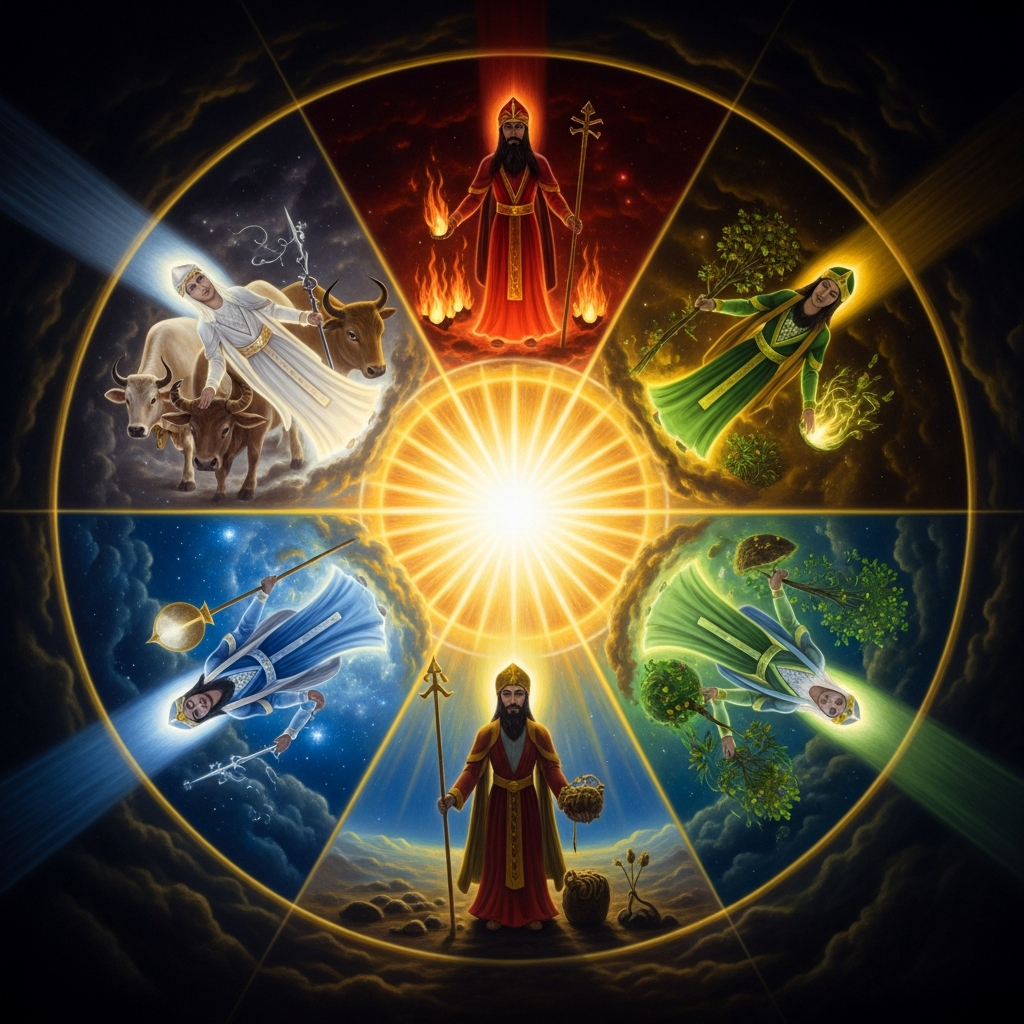
The Six Bounteous Immortals
The eternal present — the Amesha Spentas exist outside time as aspects of the divine nature · The realm of the divine — and simultaneously in every element of the material creation they protect
Contents
Ahura Mazda is surrounded by six divine emanations — the Amesha Spentas — who are simultaneously the six highest virtues, the six divine guardians of creation's elements, and the six qualities a righteous human being embodies by practicing righteousness.
- When
- The eternal present — the Amesha Spentas exist outside time as aspects of the divine nature
- Where
- The realm of the divine — and simultaneously in every element of the material creation they protect
They are six, and they surround the Wise Lord like light surrounds a flame.
Vohu Manah — Good Mind, Best Mind — is the first emanation and the first greeting: the divine quality that approached Zarathustra at the river’s edge and led him into the presence of Ahura Mazda. He is the guardian of cattle, which in the pastoral world of ancient Iran means the guardian of all domestic prosperity, all the patient animal life that sustains human civilization. His color is white. To embody Vohu Manah is to think rightly, to pursue understanding before action, to prefer wisdom to cleverness.
Asha Vahishta — Best Righteousness, Best Truth — is the principle that holds the cosmos in its right order. The word asha is cognate with the Sanskrit rta and the Latin ars — it means something like the inherent rightness of things being as they should be, the truth that is visible in natural order and reproducible in moral order. He is the guardian of fire, which is the most immediate symbol of truth in the Iranian world: fire cannot lie, cannot be hidden, burns toward the sky without deception. His color is red. To embody Asha Vahishta is to act in accordance with reality rather than desire.
Khshathra Vairya — Desirable Dominion — is divine power properly used. Not force but sovereignty: the quality of being in right authority over what is properly under one’s care. He is the guardian of metals and of the sky, whose structure is the visible expression of cosmic governance. His color is blue. To embody Khshathra Vairya is to exercise power justly, to govern what you are given rather than seize what you are not.
Spenta Armaiti — Bounteous Devotion — is the quality of faithful, loving compliance with the divine will: not servile obedience but the devotion of one who understands why the order is good and chooses it freely. She is the guardian of the earth — and here the Zoroastrian theology of the sacred earth is at its richest: the earth is not matter to be exploited but a divine being to be tended, a living entity whose guardian is the principle of loving attention. Her gender is female, her color is green. To embody Spenta Armaiti is to tend what has been given you with faithful care.
Haurvatat — Wholeness, Integrity — is the state of being complete and undivided, lacking nothing, functioning as designed. She is the guardian of water, whose purity and wholeness she maintains against the demons of pollution and drought. Her name gives us the concept of health as cosmic completeness, not merely the absence of disease. To embody Haurvatat is to pursue completeness of character — the integration of all one’s faculties in service of righteousness.
Ameretat — Immortality — is the quality of enduring rightly ordered existence, the triumph of life over the powers of dissolution. She is the guardian of plants, whose cycles of death and renewal are the material expression of immortal life recurring through mortal forms. To embody Ameretat is to live in the mode of one whose fundamental orientation is toward life’s persistence and flourishing.
Together they number seven with Ahura Mazda himself.
The theology of the seven is precise: Ahura Mazda is not separate from his six qualities, as a king is separate from his counselors. He is the totality of which they are the articulations. To worship them is to worship him. To embody them is to participate in the divine nature — which is the goal the Zoroastrian ethical system proposes with remarkable directness: not merely obedience to God’s commands, but the gradual transformation of the worshipper into a being who thinks, speaks, and acts as the divine qualities think, speak, and act.
Each Amesha Spenta has its demonic opposite.
Vohu Manah is opposed by Aka Manah — Bad Mind. Asha Vahishta by Druj. Khshathra Vairya by Saurva. Spenta Armaiti by Taromaiti. Haurvatat by Taurvi. Ameretat by Zairi. The cosmic war is not merely a war between Ahura Mazda and Angra Mainyu in some abstract divine realm — it is a war between these specific paired qualities, enacted in every human choice, in every thought and word and deed, until the final renovation resolves it.
The six qualities that surround Ahura Mazda like light surrounds a flame are also the six qualities that transform the human being who practices them into light.
Echoes Across Traditions
Entities


Sources
- Mary Boyce, *A History of Zoroastrianism*, Vol. I (Brill, 1975)
- Prods Oktor Skjærvø, *The Spirit of Zoroastrianism* (Yale, 2011)
- Shaul Shaked, 'Amesha Spentas,' *Encyclopædia Iranica* (1989)
- Almut Hintze, 'The Avestan Language and Its Problems,' *A History of Ancient Greek* (2007)