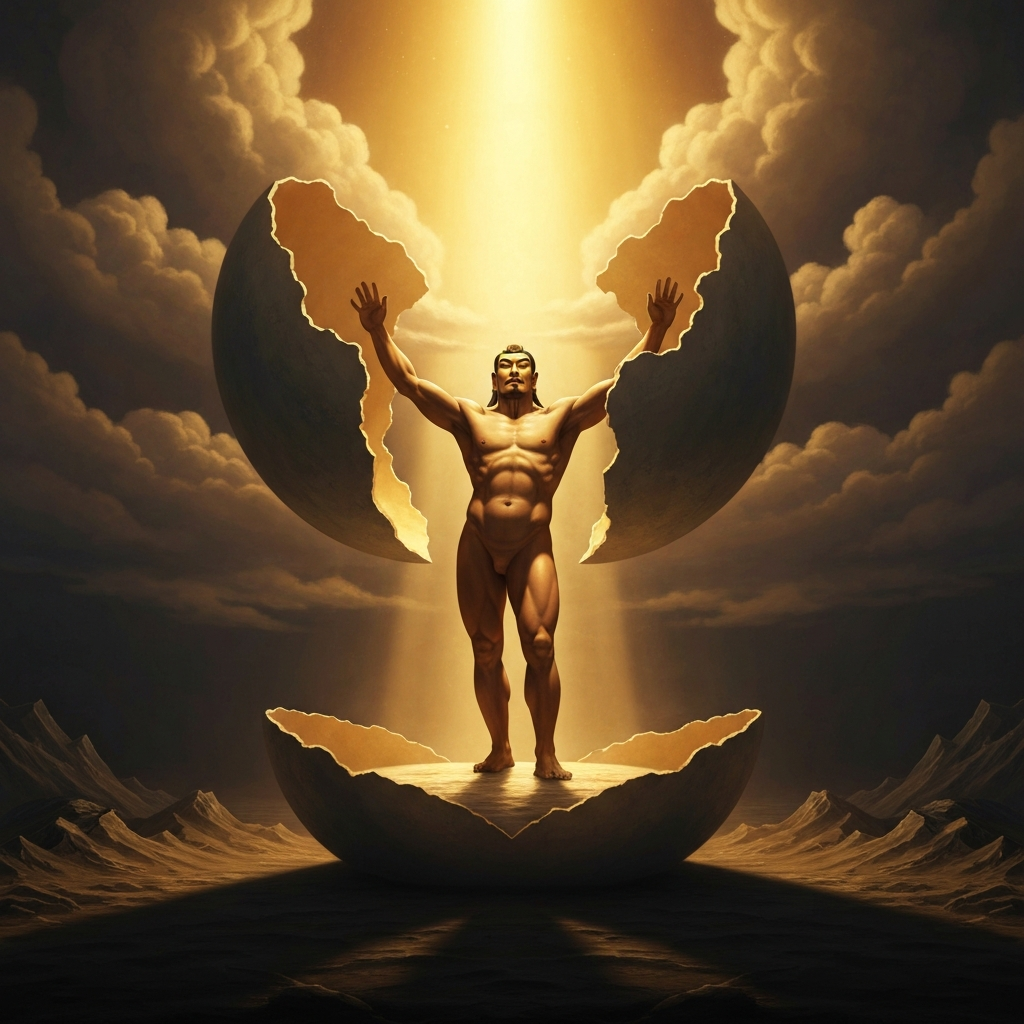
Pángǔ Cracks the Cosmic Egg
Before time — the absolute beginning of the cosmos · The undifferentiated chaos before the world existed
Contents
In the darkness before time, a vast giant sleeps inside an egg for eighteen thousand years, then wakes, and the crack that opens the shell becomes the crack between heaven and earth — and when he dies, his body becomes the world.
- When
- Before time — the absolute beginning of the cosmos
- Where
- The undifferentiated chaos before the world existed
Before the egg, there is only chaos. The texts call it hundun — swirling, undifferentiated, neither light nor dark but the thing that contains the possibility of both. No up, no down, no inside or outside, no time, because time requires something to move through, and nothing has moved yet. It is the universe dreaming of itself before it knows it is dreaming.
Inside the chaos, the egg.
Inside the egg, Pángǔ, sleeping.
He sleeps for eighteen thousand years. The number is precise because precision is the only way to speak about a duration that precedes measurement. Eighteen thousand years of absolute stillness, absolute warmth, absolute darkness. He grows inside the egg the way everything grows before it is born: fed by the shell around it, nourished by the boundary it will eventually break.
He wakes.
The waking is not gradual. He comes to consciousness the way light comes to a room — all at once, or at least all the available light all at once, which in the total darkness of the cosmic egg is whatever light his waking generates. He is enormous. He has been growing for eighteen thousand years and he is enormous. The egg is too small.
He reaches for something — the texts say he finds an axe, though some texts say the axe is a bone, or a piece of the shell itself — and he strikes. The crack runs through the chaos. Light separates from darkness. The light things rise and the heavy things sink. The shell splits into two halves and the two halves begin to move apart.
The light half becomes heaven. The dark half becomes earth.
Pángǔ stands between them with his feet on the earth and his head in the sky and he pushes — he pushes heaven and earth apart so they cannot collapse back into chaos, so the separation remains. He pushes for another eighteen thousand years, growing taller as he grows, keeping pace with the increasing distance between the two halves of the world. Three zhang per day, the texts say: as heaven rises, Pángǔ rises, as earth thickens, Pángǔ’s legs thicken.
He finishes his work and he dies.
The death is not tragic in the Chinese telling. It is the completion of the work. He has kept heaven and earth apart long enough that they now maintain their distance without him. He lets himself fall. And as he falls, as his enormous body lands across the new earth, his body becomes the world in detail.
His breath becomes the wind and clouds. His voice becomes thunder. His eyes become the sun and the moon — left eye sun, right eye moon, the texts are specific. His four limbs become the four cardinal mountains. His blood becomes the rivers. His veins become the roads. His flesh becomes the soil. His hair becomes the stars. His bones become the minerals in the earth’s interior. His sweat becomes the rain.
His fleas — the texts include this detail with a kind of democratic honesty — become the first human beings.
Or the first animals. The later tradition disagrees about which, because Nüwa creates humans from clay and there is a tension between the two accounts that the tradition has never quite resolved. Some texts say Pángǔ’s parasites become animals and Nüwa’s clay becomes people. Some say both stories are true and people are both things at once — descended from a god’s body and shaped by a god’s hands, which is perhaps the most accurate account of what it means to be human.
The mountains that were his limbs still carry his height. The rivers that were his blood still carry the direction of his circulation. The soil that was his flesh still carries the particular yield of a body that had time to become good at growing things. When you dig into the earth you are digging into Pángǔ. When you look at the sky you are looking at the inside of the egg he cracked.
He is still here. He was never anywhere else. He simply changed state.
Echoes Across Traditions
Entities
- Pángǔ
- the cosmic egg
- heaven and earth
Sources
- Sanwu Liji (三五曆記), Xu Zheng, c. 220-265 CE — earliest written record of Pángǔ
- Wuyun Linianji (五運曆年記), c. 300 CE
- Mark Edward Lewis, *The Flood Myths of Early China* (SUNY Press, 2006)
- Lihui Yang & Deming An, *Handbook of Chinese Mythology* (Oxford, 2008)