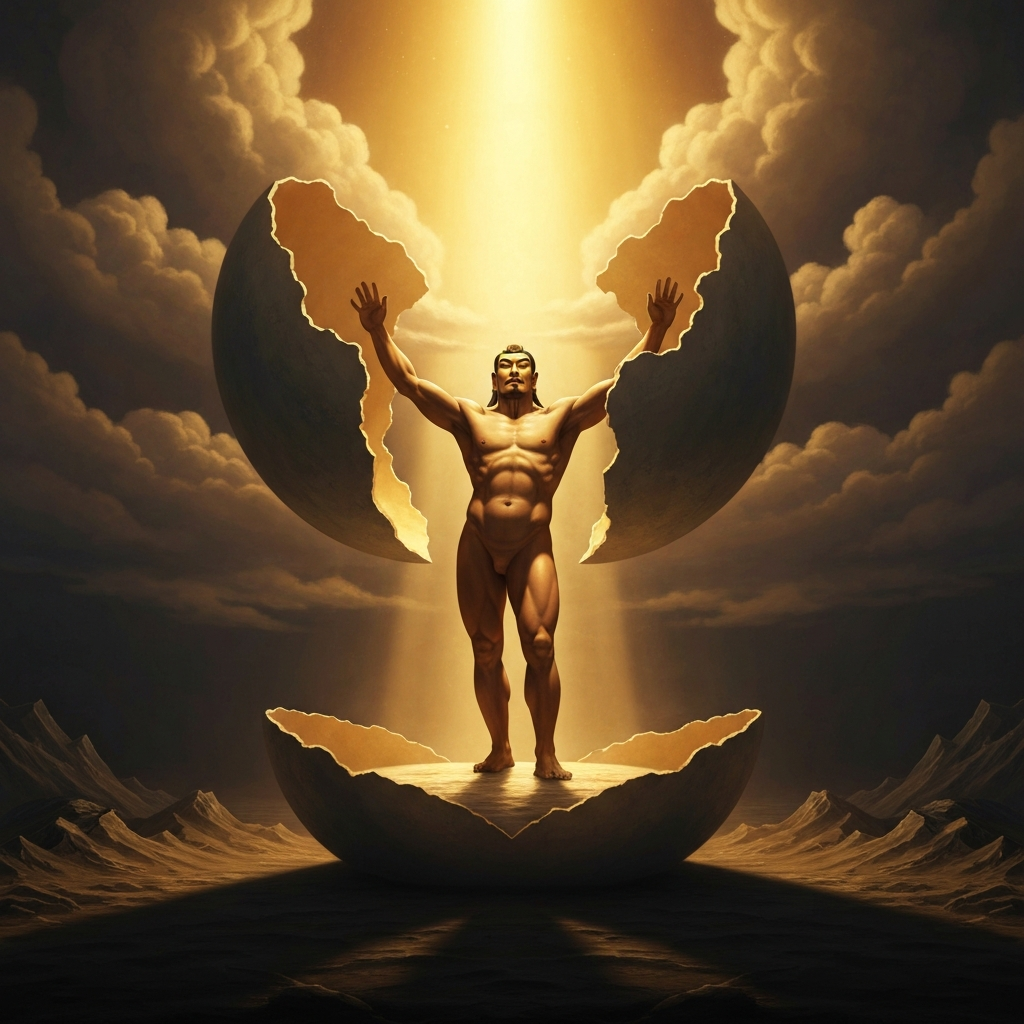
Nüwa Shapes the First People from Yellow Clay
The mythological beginning — the world exists but is empty of people · The banks of the Yellow River in the center of the world's first land
Contents
Alone in a new world still echoing with its own creation, the goddess Nüwa kneels by the Yellow River and begins to shape small figures from the mud — and the figures open their eyes.
- When
- The mythological beginning — the world exists but is empty of people
- Where
- The banks of the Yellow River in the center of the world's first land
Before the people, there is only the sound of the world breathing.
Nüwa walks through it — through the forests that have no names because there is no one to name them, through the rivers running clear because there is no one to disturb them, through the plains of yellow earth lying open to the sky like a promise waiting for content. She is not lonely. The texts do not say she is lonely. But they say she walks for a very long time before she stops.
She stops at the edge of the Yellow River.
She looks at the mud on the bank — the yellow mud the color of the earth the river carries from the interior, the mud that has the density and the particular smell of something that almost remembers being alive. She crouches. She takes a handful. She begins to work it in her palms.
She makes a figure the size of her thumb. It has a head, shoulders, two legs. She holds it in her cupped hands and breathes on it — not a breath of command, the texts are careful about this, not the breath of a god pronouncing existence into being, but the ordinary breath of a craftsperson warming cold material, the breath of someone who has been working in the cold long enough to need to warm her hands.
The figure moves.
It makes a sound. The sound is the first sound a human being makes: small, uncertain, and immediately questioning — a kind of ah that is not exactly a cry and not exactly a word but something that contains the seeds of both. It looks up at Nüwa with the eyes she has pressed into its small clay face.
She sets it down. It walks. It is a person.
She makes another. And another. She works with the intensity of someone who has been waiting to do this work for longer than she knew. Figure after figure, each one pressed from the yellow mud, each one warmed by her breath, each one set down to walk on the bank of the river while the others already walking come to look at the newcomers. The riverbank fills. The new people explore. They make the second sounds: the sounds of discovery, of confusion, of their first attempts at calling to each other across the small distances.
She works through the night and through the next day and through many days, but the world is very large and the making is slow. One maker, two hands, each figure shaped individually — she can see that this will take longer than the world has patience for. She looks at the figures already walking on the bank. She looks at the vast empty distances. She makes a decision.
She takes a long vine — a rope of river grass — and drags it through the mud, then whips it through the air, so that the droplets fly in every direction. Each droplet lands and becomes a person. Not the same as the hand-shaped ones — smaller, less precise, the features less carefully attended to. But alive. Walking.
Ying Shao, recording this in the second century CE, makes a note the tradition has not forgotten: those shaped by Nüwa’s hands became the aristocracy and the powerful. Those flung from the vine became the common people. This is the origin story told to justify the hierarchy — and it is also the story that subtly indicts the hierarchy, since it reveals that the distinction is not in the persons themselves but in the circumstances of their making, which is to say in the exhaustion of a goddess who ran out of time, which is to say in the arbitrary pressure of scale.
The people fill the world. The riverbank is crowded. The plain behind it is crowded. They find each other. They begin — without being taught, the texts imply, though Nüwa will later have to teach them marriage — to pair off. To form households. To begin the long project of making the world mean something.
Nüwa watches them go.
She stays by the river a little longer, the vine still in her hand, the mud still on her fingers from the careful ones. The river runs yellow past her. The people’s voices carry back to her on the wind — small, uncertain, and immediately questioning, just as they were the first moment, already becoming language.
Echoes Across Traditions
Entities
- Nüwa
- the Yellow River
- the first humans
Sources
- Fengsu Tongyi (风俗通义), Ying Shao, c. 195 CE — earliest written account of Nüwa creating humans
- Taiping Yulan (太平御览), citing earlier lost sources
- Anne Birrell, *Chinese Mythology: An Introduction* (Johns Hopkins, 1993)
- Lihui Yang & Deming An, *Handbook of Chinese Mythology* (Oxford, 2008)