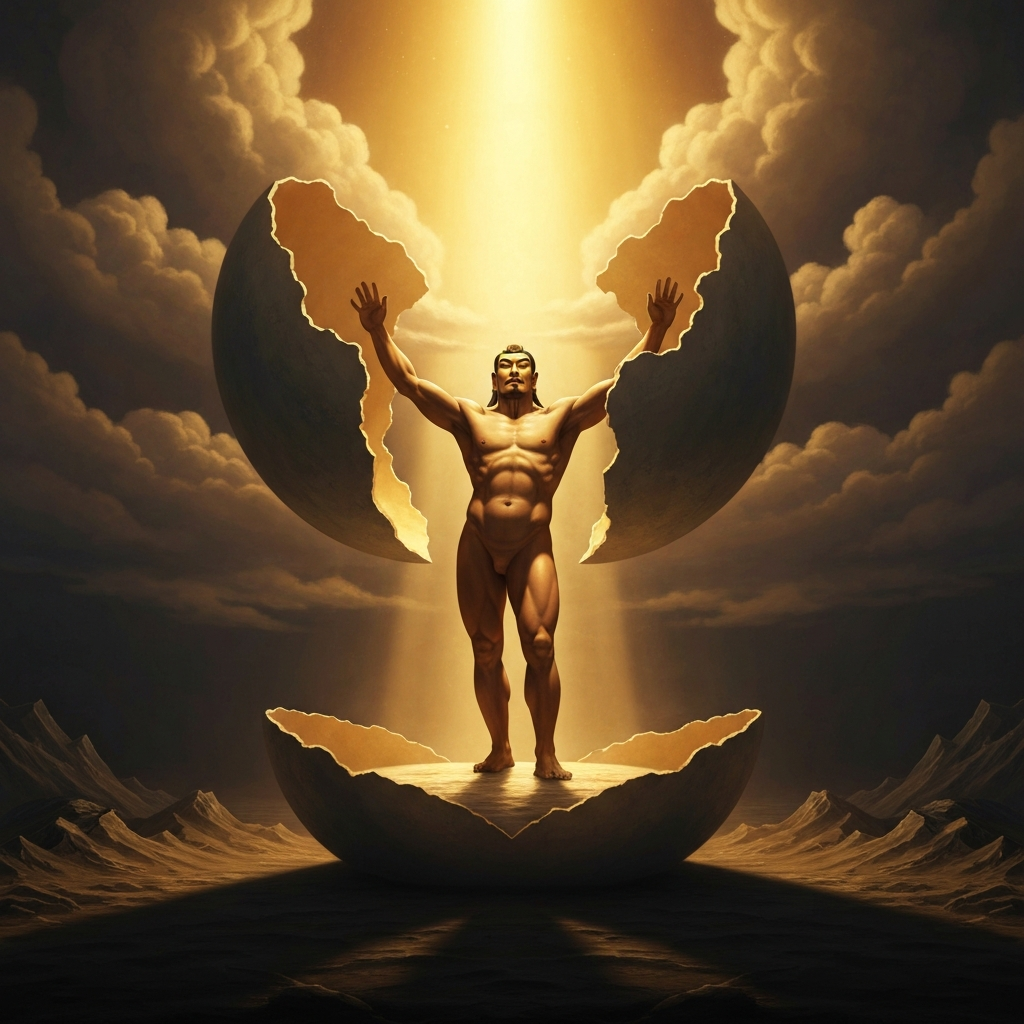
Fúxī Reads the River Tortoise's Back
The mythological age of the Three Sovereigns — c. 2800 BCE in traditional chronology · The banks of the Yellow River, the center of the ancient Chinese world
Contents
Standing at the banks of the Yellow River, the sage-king Fúxī stares at a tortoise emerging from the water and reads the pattern on its shell — and in that pattern he sees the eight trigrams that encode the grammar of all change.
- When
- The mythological age of the Three Sovereigns — c. 2800 BCE in traditional chronology
- Where
- The banks of the Yellow River, the center of the ancient Chinese world
He has been watching the river for three days.
This is not unusual for Fúxī. He is a watcher before he is a teacher, an observer before he is a sage. The tradition credits him with teaching humanity to fish, to hunt, to cook over fire, to play music on the qin — but all of these teachings begin the same way: he watches something, for a long time, until it yields its pattern.
What he is watching now is the river itself. The Yellow River running down from the northwest, carrying its load of silt, the color of the earth that made the people Nüwa shaped from its clay. The river has its own rhythms — flood and low water, the way the current bends at this particular bank, the way the surface breaks when something rises from below.
On the third day, something rises from below.
It is a tortoise, or it is shaped like a tortoise, or it contains within itself the idea of a tortoise the way a word contains within itself the idea of a thing. The accounts differ about which. What the accounts agree on is the shell — the pattern on the back of this creature that has come up from the bottom of the Yellow River into the light.
The shell is marked with a diagram the tradition calls the hetu — the River Diagram. It is a pattern of black and white dots arranged in a precise configuration. Nine groups. The numbers one through nine placed in a formation in which every row, every column, every diagonal adds to fifteen. But the dots are more than a number puzzle. They are a map. They diagram the relationships between forces — yin and yang, the five phases, the movements of heaven and earth. They contain, for those who can read them, the grammar of how the universe changes.
Fúxī can read them.
He stares at the pattern for a long time. The tortoise does not move. The river flows around them both. He begins to see that the diagram is not showing him a static picture of the world but a set of relationships — lines of force, lines of yield, lines of movement and stillness — and that these relationships can be abstracted from the dots into lines, and that lines can be broken or unbroken, and that three lines stacked in each of the eight possible combinations of broken and unbroken produces eight figures, and that each figure describes a fundamental condition of the world.
Heaven. Earth. Thunder. Wind. Water. Fire. Mountain. Lake.
He draws them.
Not on paper — paper does not yet exist. He draws them first in the earth by the river, with a stick, arranging them in a circle. Then he teaches them to the people who come to watch. He teaches them not as magic and not as religion, though the tradition will eventually make them both — he teaches them as description, as the most accurate map of change he can construct from the pattern on the tortoise’s back.
The I Ching will take centuries to arrive at its finished form. King Wen in prison during the Zhou dynasty will add sixty-four hexagrams — pairs of trigrams, all sixty-four combinations — and attach judgments to each. Confucius, a millennium after Fúxī, will write the commentaries that give the text its philosophical depth. But the origin is here, on this bank, with this watcher and this creature from the bottom of the Yellow River.
The tortoise returns to the river. Fúxī watches it go. The pattern on its back is already fading in his memory into the abstract lines he drew in the earth — not because he is forgetting, but because the abstraction is the point. The tortoise carried the particular instance. The eight trigrams carry the principle. It is the principle that he has received today, on this bank, from the water.
He sits for a while longer.
The river runs past him, yellow and ancient, carrying what it has always carried: the earth of the interior, the silt that will become the fields, the water that will become the rain, the pattern that is always there, for anyone willing to watch for three days while something slowly rises from below.
Echoes Across Traditions
Entities
- Fúxī
- the Yellow River tortoise
- the hetu diagram
- the eight trigrams
- the Dragon Horse
Sources
- Yijing (易經) / Book of Changes, with traditional commentary attributed to King Wen and Confucius
- Shiji (史記), Sima Qian, 'Basic Annals,' c. 91 BCE
- Richard John Lynn, *The Classic of Changes: A New Translation of the I Ching* (Columbia, 1994)
- Richard Wilhelm, *The I Ching or Book of Changes*, trans. Cary Baynes (Princeton, 1950)