Etana and the Eagle: The Flight to Heaven
Old Babylonian period, c. 2800 BCE legendary horizon · Kish, southern Mesopotamia, and the heavens above
Contents
Etana, the first king of Kish, has no son. The plant of birth grows only in the heaven of Ishtar, and only an eagle can carry him there. They climb until the earth becomes a mountain, then a ditch, then nothing — and then Etana's nerve fails.
- When
- Old Babylonian period, c. 2800 BCE legendary horizon
- Where
- Kish, southern Mesopotamia, and the heavens above
Etana is king of Kish, and the city is a long, narrow, brick-walled place beside the river, the first city after the flood, the seat from which kingship was lowered down again from heaven. He has done everything a king is supposed to do. He has dug canals. He has built walls. He has sat in judgment under the sun. He has prayed to Shamash every dawn, and to Ishtar every dusk, and to the household gods at every meal.
He has no son.
His wife dreams of a plant. The plant of birth — that is what the dream calls it. It grows in the upper world, in the place where Ishtar keeps her garden, and a woman who eats of it conceives. Etana wakes from a dream identical to hers and the matter becomes settled between them with the stark clarity of two people who have run out of other options. He must go and get the plant. There is no plant of birth on earth. He has looked.
There is also, at this exact moment in the world, an eagle.
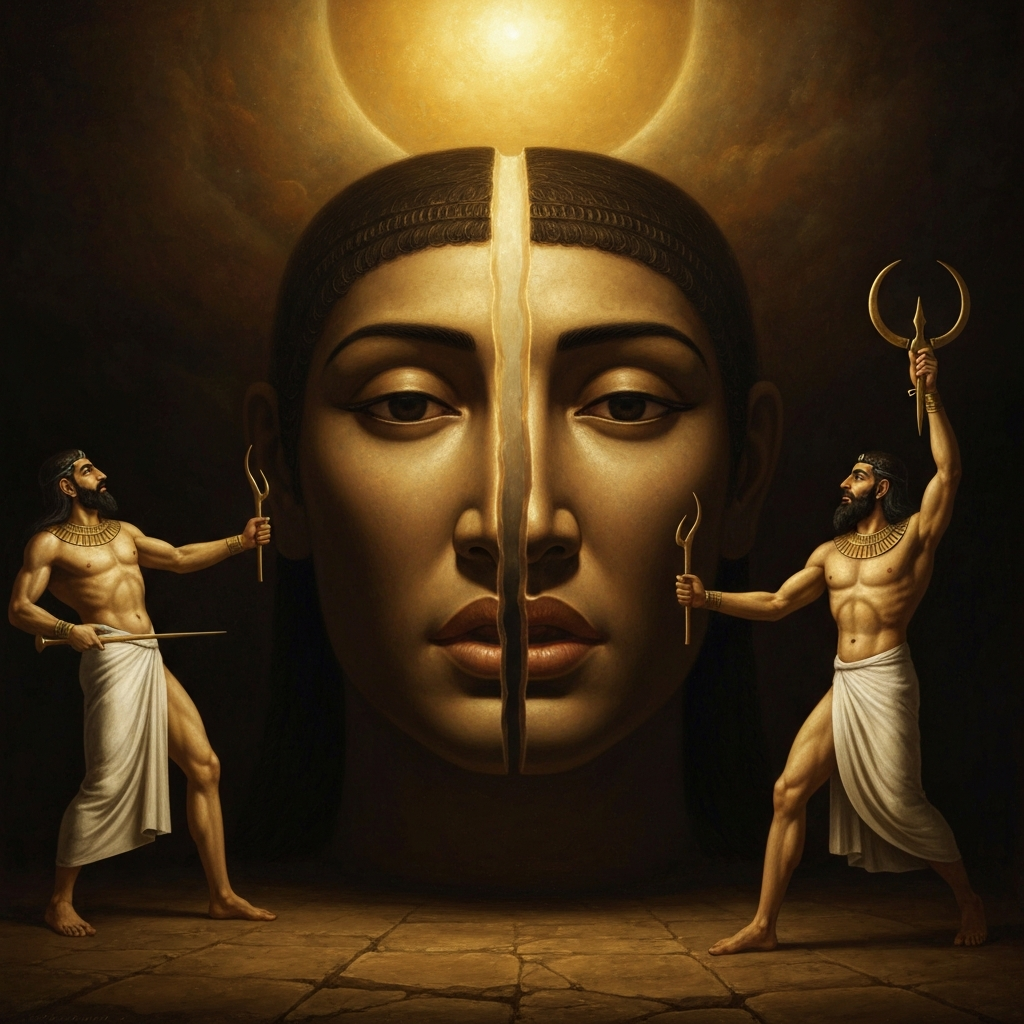
The eagle and a serpent had been friends. They had lived together in a great tree, the eagle in the high branches, the serpent in the roots, raising their young in sight of each other and sharing the kill. They had sworn an oath by Shamash — by the sun who sees everything — that neither would harm the other’s children.
The eagle had broken it.
Hungry one day, watching the serpent’s young curled in the cool earth, the eagle had calculated the distance, the speed, the long flight back to the high nest, and had decided that Shamash would not see, or would not care, or would not act. The eagle had been wrong on all three counts. Shamash sees. Shamash cares. Shamash acts. The eagle’s wings had been broken in his own nest by a hunting party that the sun god had personally arranged, and now the bird lay at the bottom of a pit, starving, his feathers falling out, calling up to the sky for the mercy he had not extended to anyone.
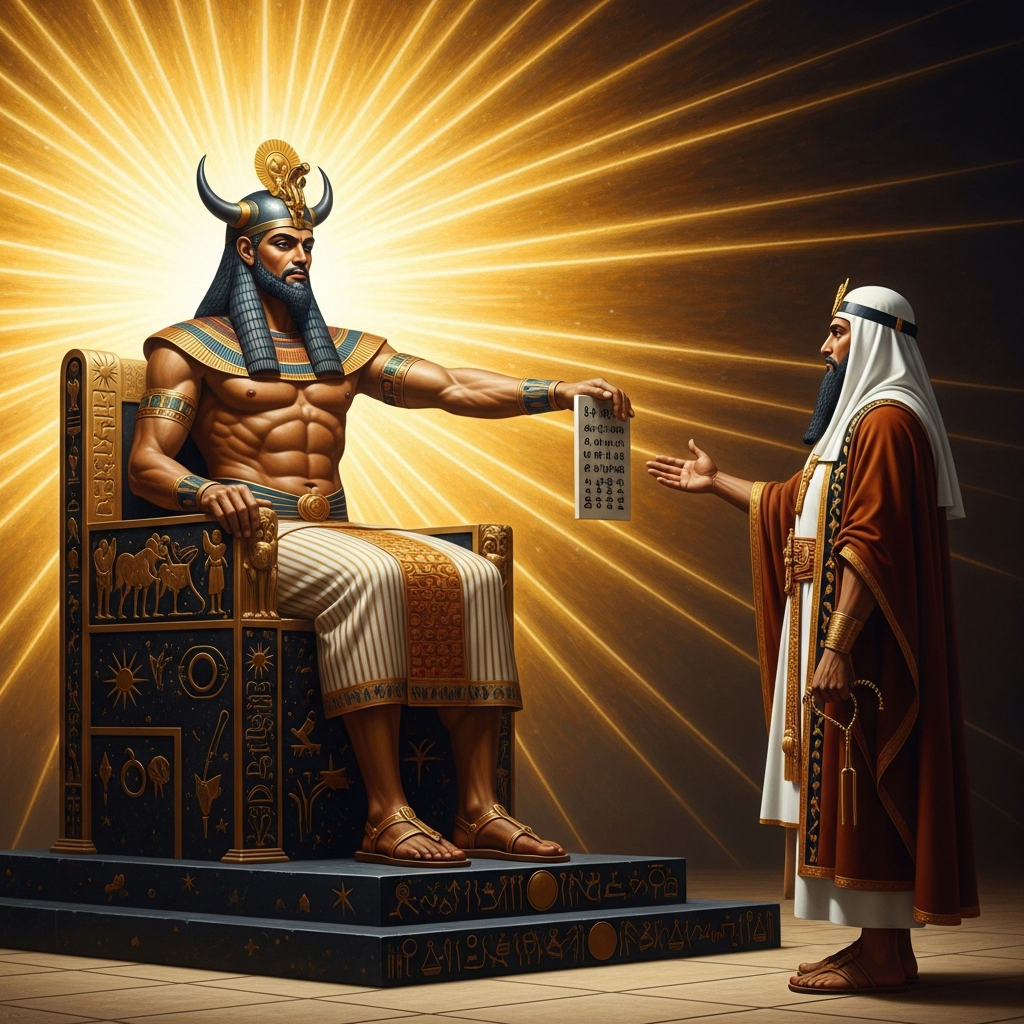
Shamash, who is a hard god but not a stupid one, listens. I will send you a man, the sun says. Help him, and you will fly again. Betray him, and you will die in the pit.
Etana finds the pit at noon, in the brightest part of the day, when Shamash is at his height and the eagle’s shadow is at its smallest. He climbs down. He feeds the eagle, day after day, scrap by scrap, until the wings can lift again. He says: Take me to the heaven of Ishtar. There is a plant there. I need it.
The eagle agrees. The eagle would agree to anything.
They begin in the morning.
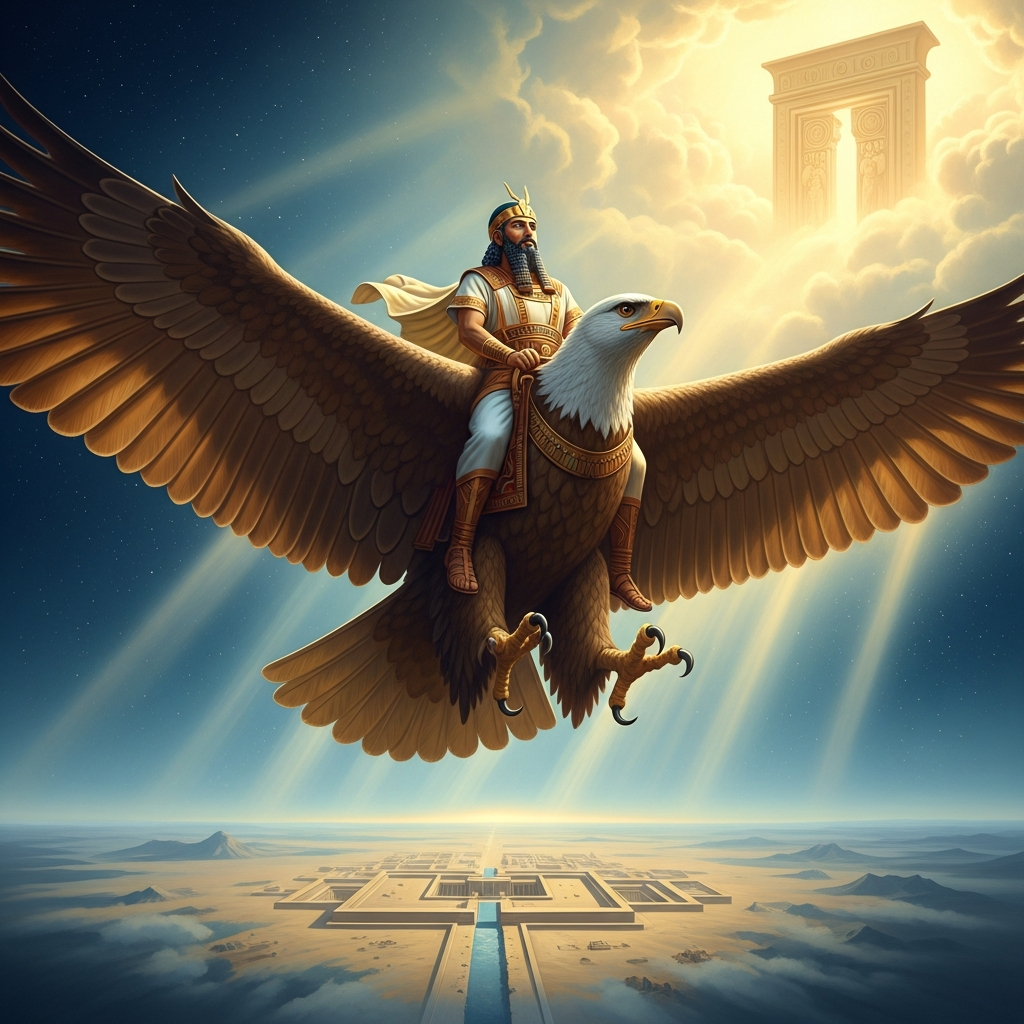
The first stage of the flight, the eagle calls down what he sees, and Etana clinging to his back can almost picture it. The earth has become a hill. The sea is a stream around it. Etana looks. It is true. The whole of Mesopotamia, every city he has ever known, every canal he has ever dug, has shrunk to the size of a low mound and a thin line of silver.
They climb again.
The earth has become a garden. The sea is the irrigation channel. Etana, who is a king who knows what an irrigation channel looks like from the height of a temple platform, understands. The cities are now indistinguishable from the fields. The whole of human enterprise has collapsed into a pattern, the kind of pattern a god might glance at and not see at all.
They climb again.
The earth has become a furrow. The sea is a bread-basket. The metaphors are reaching for things smaller and smaller. Etana, looking down, sees that the eagle is right and that Etana himself is now somewhere a man should not be. The light up here is not yellow. The wind is not the wind of the lower air. The cold has a different quality, an indifference, as if the cold itself is busy with other matters and barely registers him.
They climb again.
The earth, the eagle says, has gone.
Here is where the tablet breaks.
The cuneiform of the upper columns is intact, beautifully clear, written in the careful Old Babylonian hand of a scribe who was working from a story he loved. And then in the fourth column the clay is shattered, and we have only fragments — a word that may mean fall, a word that may mean fear, a word that may mean return.
Some scholars read the breaks and conclude that Etana lost his nerve. He looked down and saw nothing. The earth he was trying to bring a child back to had become an absence, and a man cannot navigate by an absence, and his hands let go of the eagle’s feathers, or his hands gripped them too hard, or his voice told the eagle to turn back, and they fell.
Other scholars read the breaks and conclude that the fall is the surface; the truth underneath is that Etana reached the garden, ate the plant, and returned. The Sumerian King List, after all, names Etana as the shepherd who ascended to heaven, and his son Balih reigned after him in Kish for four hundred years. Whatever happened up there, it produced a son. A king came home from the place where there is no earth and there was a child in the city the next year.
The Babylonian scribes, who knew the story, would not have been surprised by either ending. They lived with the understanding that some stories cannot end cleanly because the events themselves are not clean, that a man who flies far enough to lose sight of the world brings something back that cannot be entirely fitted into language.
What survives is the image: a king on the back of a wounded bird, both of them broken in different ways and held together by an exchange that neither has any reason to trust, climbing into a sky that grows colder and emptier the higher they go. A man trying to bring back a plant that will let his line continue. A bird trying to fly again after Shamash had taken his wings as the price of an old betrayal.
The tablets that remain love this image. They linger on the eagle’s voice calling down what the earth looks like at each stage. They linger on Etana’s silence — he says almost nothing during the flight, this man who has prayed to gods his whole life and now finds himself in their place, looking down. The Old Babylonian poets understood that vertigo is the right response to the heavens, and that a hero who does not feel it is not a hero but an idiot.
The plant of birth, if it exists, exists where Etana could not breathe. The kingdoms of the earth, seen from there, are gardens, then furrows, then nothing. A man who has been told all his life that his city is the center of the world climbs high enough to see that this is not true and that the people he has been ruling are smaller than he can imagine, and then he has to bring a child back to them anyway.
Etana is the first king to leave the earth and the first man in literature to look back at it from the place gods stand. The sight should make him into a god — and instead it nearly destroys him.
The story is fragmentary because the experience is fragmentary. The clay broke at the right place. The scribes who copied the tablet for fifteen hundred years did not invent an ending; they preserved the silence the original left, the way one preserves a missing word in a poem because the missing word is the poem.
Every later ascent — Enoch, Elijah, Muhammad’s night journey, the rishis pulled into the sky by their austerities — repeats some piece of Etana’s image. The fragmentary tablet is the original, and what it cannot say has shaped what every later tradition tries to say, with results that are also, in their own ways, fragmentary.
The eagle’s wings work again. The king came back, or did not. The plant of birth grows in a garden no one has photographed. And every parent who has stayed up at night counting the years, asking what they would give to be given a child, is standing on the eagle’s back with Etana, looking down at a furrow that used to be a world.
Echoes Across Traditions
Entities
- Etana
- Shamash
- Ishtar
- Anzu
- The Eagle
- The Serpent

Sources
- Stephanie Dalley (trans.), *Myths from Mesopotamia* (Oxford University Press, 1989)
- E.A. Speiser (trans.), 'The Legend of Etana' in *Ancient Near Eastern Texts* (Princeton, 1950)
- Benjamin Foster, *Before the Muses: An Anthology of Akkadian Literature* (CDL Press, 2005)
- Sumerian King List (the line of Kish names Etana as 'the shepherd who ascended to heaven')