Contents
Hammurabi, king of Babylon, did not write his law code from his own wisdom. He received it from Shamash, god of justice, the sun who sees everything. The famous stele shows the moment of transmission — and the 282 laws below it reveal an entire civilization's sense of fairness.
- When
- c. 1754 BCE, late in Hammurabi's forty-three-year reign
- Where
- Babylon, the temple of Esagila, and the cities of Hammurabi's empire
The stele is a piece of black diorite seven and a half feet tall.
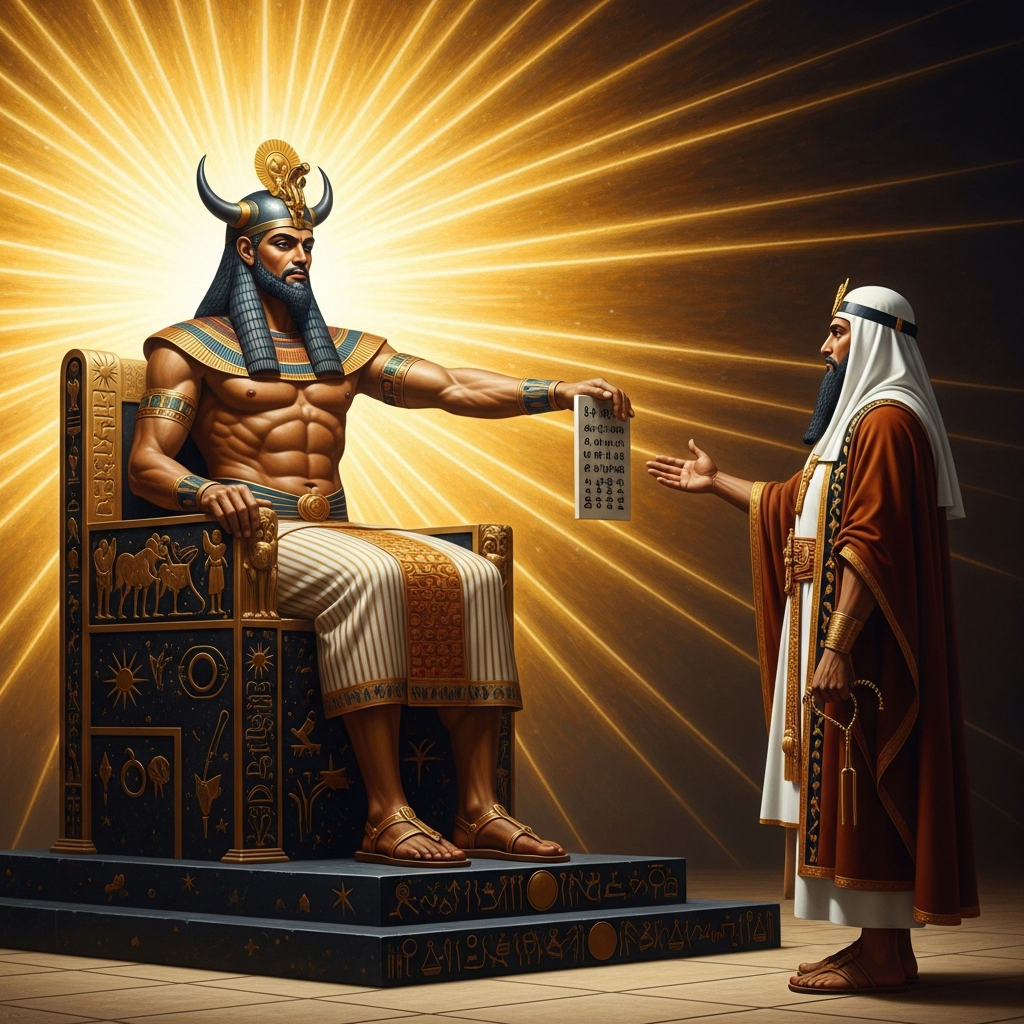
It is taller than the man it describes. It is heavier than two oxen could pull. The diorite is the deep black-green of the stone you find in the mountains of Oman, brought to Babylon by a journey of two thousand miles, polished to a hard mirror, carved with cuneiform so dense and so fine that the surface looks at first glance like a textured field rather than writing. At the top of the stele is a carving in low relief: a king standing before a god. The king is Hammurabi. The god is Shamash, the sun, with rays rising from his shoulders like solar flames, sitting on a throne of mountain peaks, holding a measuring rod and a coiled rope.
The two figures look at each other. The god is handing the king something — the texts say it is the rod and the ring, the symbols of just measurement, of the right governance of cities. The king’s hand is raised in the gesture of a man receiving an instruction he intends to carry out. He is listening. The expression carved into his face, in the tiny dignity of low relief, is not triumph. It is concentration.
Below the relief, the entire surface of the stele — front and back, base to top — is covered with the laws.
Hammurabi reigned for forty-three years.
He took the throne of Babylon as a minor king of a minor city, the fifth ruler of an Amorite dynasty that had not yet distinguished itself. The world he inherited was a checkerboard of small kingdoms — Larsa to the south, Eshnunna to the east, Mari upriver, Assyria in the north, Elam beyond the mountains — each one ambitious, each one armed, each one looking for the moment to expand. Hammurabi waited. He built canals. He reformed the calendar. He kept the temples in good repair. He let the larger kings exhaust themselves against each other. In the thirtieth year of his reign, when he was an old man already, he moved. Larsa fell. Eshnunna fell. Mari fell. By the end of the thirty-eighth year, Hammurabi was king of all Mesopotamia from the Persian Gulf to the upper Euphrates, and the world he had inherited as a checkerboard was now a single empire under a single throne.
He could have written the code at any point in those forty-three years. He chose to write it late.
The reason is encoded in the text itself. The preface — composed in elevated Akkadian, in long parallel cola, with the rhetorical magnificence of an old king summarizing his life — describes the empire as accomplished. I am Hammurabi. The shepherd, called by Enlil, the increaser of plenty, who provides for the cities of Anum and Enlil, the strong king who reestablished Eridu, who restored the temple of Ur, who provided for Sippar. Each city is named. Each shrine is named. The preface is a survey of the empire from the southern marshes to the northern hills, and the survey is the king’s letter of introduction to whoever will read the stele after him. I was a careful king. I rebuilt what was broken. I fed what was hungry. I prayed at every shrine. The gods saw this. They gave me the laws.
This is the claim. The laws are not Hammurabi’s. The laws are Shamash’s, given to Hammurabi in recognition of forty years of pious work. Hammurabi is the medium. The shepherd. The hand that holds the chisel.
Shamash is the right god for the job.
He is the sun. He sees everything. He sees the rich man and the poor man, the woman in the courtyard and the slave in the field, the merchant in the warehouse and the thief in the alley. Nothing escapes him. He rises in the east and crosses the sky and sets in the west, and during that crossing he illuminates every transaction, every betrayal, every kindness, every contract. He is the natural patron of justice in a way the other high gods are not, because his job description is precisely to see. Anu sees the heavens; Enlil sees the air; Enki sees the underground waters; but Shamash sees the surface of the earth where humans live and act, and what he sees is what justice has to be measured against.
The Babylonian theology of law is built on this. A king’s law that contradicts what Shamash sees is not law. It is just an opinion that happens to be enforced. A real law has to align with what the sun observes — what actually happens in markets, what actually happens in households, what actually happens between debtors and creditors. The 282 provisions on the stele are, in this view, descriptions of a fairness that already exists in the cosmos and that Hammurabi has merely transcribed.
This is how Hammurabi’s preface presents it. Anum and Enlil called me by name to make justice rise in the land, to destroy the wicked and the evil, that the strong might not oppress the weak, to rise like the sun over mankind, to light up the land. The sun is the verb. The king is the noun. The laws are the predicate.
The laws themselves are arranged not by category but by consequence.
The first laws deal with false accusation. If a man accuses another man of murder and cannot prove it, the accuser shall be put to death. The principle: the law itself can be used as a weapon, and the law’s first business is to defend itself against that misuse. Anyone reading the stele in a city square is meant to understand, before they get to anything else, that frivolous prosecution will return on the prosecutor’s own head.
Then theft. Then property. Then the famous laws of the goring ox: If an ox gores a man and the owner knew the ox was a gorer and did not restrain him, the owner shall pay half a mina of silver. This provision will appear in Exodus 21 in nearly identical form a thousand years later. It is not a coincidence. The Babylonian goring-ox formulation became one of the standard cases that all subsequent Near Eastern legal codes had to address, and the Hebrew Bible inherited the case along with the broader legal tradition.
Then debt and credit. The Babylonian economy ran on credit — silver loaned at interest, grain loaned at interest, fields mortgaged against the next harvest — and the code is precise about default, about partial payment, about the rights of the lender and the rights of the borrower. If a creditor takes a borrower’s son as a debt-pledge, and the son dies of natural causes in the creditor’s house, no further claim can be made. But: if the son dies of mistreatment, the creditor’s son shall be put to death. The principle of proportionate retaliation runs throughout — eye for an eye, tooth for a tooth, bone for a bone — but with a strict limit on its application: the eye that is taken must equal the eye that was lost, and no more.
Then family law. Marriage contracts. Dowry rights. Adultery (drowning for both parties, unless the husband chooses to spare them, in which case the king must also spare them). Inheritance. Adoption. The treatment of widows and orphans. The protection of women whose husbands are away on military campaign. The rights of children of slave concubines. The provisions go on for column after column, and the cumulative impression is of a society that has thought carefully about the small fractures of family life — the dowry that gets spent, the second wife who is preferred, the brother who tries to disinherit the orphan, the husband who returns from war to find his wife has remarried — and has worked out, case by case, what fairness looks like in each fracture.
Then injury. Then medical malpractice. Then construction defects (the famous if a builder builds a house and it collapses and kills the owner, the builder shall be put to death). Then trade and contract.
Two hundred and eighty-two provisions. Carved into diorite. Set up in every major city of the empire.
The provisions are not perfect. They are class-stratified. A free man who injures another free man pays one fine; a free man who injures a commoner pays a smaller fine; a free man who injures a slave pays the slave’s owner. The lives of slaves are worth less than the lives of commoners, and the lives of commoners are worth less than the lives of free men. This is not concealed. It is built into the schedule of payments. The Babylonian conception of justice is not egalitarian; it is proportional, with the proportion calibrated to the social hierarchy.
What is striking, by the standards of its own world, is what the code does include. If a creditor seizes a debtor’s wife or son and the captive dies in his custody from beating, the creditor’s son shall be put to death. The protection is real. If a man marries a woman and she contracts a chronic illness and he wishes to take a second wife, he shall not divorce his first wife. He shall keep her in the house he built and support her as long as she lives. The provision is unprecedented in the ancient world — most of which had no protection for a chronically ill wife at all. If a soldier is captured in war and his property is taken and given to another, when the soldier returns he shall recover his property. If a slave woman has borne her master children and the master dies, neither she nor her children shall be sold; she shall go free.
There are provisions for the protection of the rented field against drought. Provisions for the responsibility of a shepherd who loses a flock to wolves (he is liable; he is paid to keep the wolves off; if he was diligent and the loss was extraordinary, the loss is shared). Provisions for the rights of the woman who manages a tavern (she may not water the beer; she may not host conspiracy; she must turn in fugitives, or she will be put to death). Provisions for the captive of war who has been ransomed by a temple or a private creditor (she is free; the ransom does not become a new debt).
The whole document, taken together, is the output of a long-running civil society that has spent a thousand years arguing in courts and writing down the resolutions, and a king who at the end of his reign assembled the resolutions into a single coherent statement and put it on a black stone.
The epilogue is the part that closes the loop.
I am Hammurabi, the king of justice, to whom Shamash has granted the truths. He has done his work. He has carried Shamash’s instructions down to the people. He invokes the future king. Let any oppressed man who has a case come and stand before my image as king of justice; let him have my inscription read aloud to him, that he may hear my precious words and that my stele may make his case clear to him. The stele is to remain. It is to be read aloud, in the open square, to anyone who comes to it with a grievance. The reading itself is part of the legal procedure.
And then the curses. If any king who comes after me does not heed the words I have set on this stele, who effaces my name from it and writes his own name, let Anu strike him with leprosy. Let Enlil send confusion into his city. Let Ninlil deny him children. Let Shamash, who gave me these laws, withdraw his light from him forever. The curses run for column after column. They are some of the most ferocious in cuneiform literature. Hammurabi knew that future kings would try to claim the stele as their own. He had carved the curses into the stone deeper than the laws.
The stele was set up in Babylon, at Esagila, the great temple of Marduk. Copies were placed in Sippar, Ur, Larsa, and other cities of the empire. The original copy survived for six hundred years before it was carried off as war booty by the Elamite king Shutruk-Nahhunte, who took it to Susa as a trophy and erased a few columns of the laws to put his own name on the blank space. (He did not, mercifully for archaeology, erase the relief at the top.) It sat in Susa for three thousand years. French archaeologists found it in 1901. It is now in the Louvre.
The curses, as it happens, did not strike Shutruk-Nahhunte personally during his lifetime, but the city of Susa was sacked by the Assyrians in 645 BCE and never recovered. Hammurabi’s gods were patient.
The Code of Hammurabi is the oldest substantially preserved law code in the world. There were earlier codes — Ur-Nammu’s, Lipit-Ishtar’s, Eshnunna’s — but Hammurabi’s is the most complete, the most thought-through, and the most theologically explicit about the source of law. The other codes had divine approval. Hammurabi’s code claims divine authorship.
The claim is not unique. Every later code-bearer in Western history will claim a version of it. Moses on Sinai. Solon at Athens (whose code Plutarch describes as endorsed by the Delphic oracle). The Twelve Tables of Rome (delivered to a commission instructed to consult the gods). The Justinian Code (compiled under Christian sanction). The drafters of the American Constitution (writing in the language of self-evident truths and inalienable rights). The pattern repeats. A king or a body of legislators receives or composes a body of laws and locates the authority of those laws somewhere outside the king or the body — in heaven, in nature, in self-evidence, in the right reason of the cosmos. The Babylonian template is the original.
The relief at the top of the stele — the king and the god looking at each other, the god handing down the rod and ring, the king receiving — is the template image of every later transmission of law. Every Moses-with-tablets, every Justinian-with-codex, every constitutional convention painting, repeats the geometry of this carving: the higher figure handing down, the lower figure receiving, the document between them as the link between cosmos and city.
Hammurabi understood that law is theater as well as text. The stele had to be tall. It had to be black. It had to be in every major city. The reading aloud had to be public. The relief at the top had to show the god giving the laws to the king, because the laws had to feel older than the king who carried them, had to feel like they had come down from a place higher than any palace.
Below the relief, in the cuneiform that covers the stone like dense fabric, are 282 provisions worked out by a thousand years of court cases and the wisdom of an old king at the end of his reign. The provisions are imperfect. The provisions are partial. The provisions outlived their author by thirty-seven hundred years and counting, because they are also, in many places, right.
Echoes Across Traditions
Entities


Sources
- Martha Roth (trans.), *Law Collections from Mesopotamia and Asia Minor* (SBL, 1997)
- The Code of Hammurabi stele, c. 1754 BCE, Louvre Museum, Paris
- Marc Van De Mieroop, *King Hammurabi of Babylon: A Biography* (Blackwell, 2005)
- G.R. Driver and J.C. Miles, *The Babylonian Laws* (Oxford, 1952-55)