Contents
A daughter of Xibalbá defies her father and the lords of death to approach the forbidden gourd tree, receives the saliva of the Maize God's severed head, carries the Hero Twins to the surface world, and earns her place in the house of their grandmother.
- When
- Mythic time — the generation between the Maize God and the Hero Twins; Classic Maya tradition
- Where
- Xibalbá; the road between the underworld and the earth's surface; Xmucane's house
She is the daughter of a lord of Xibalbá.
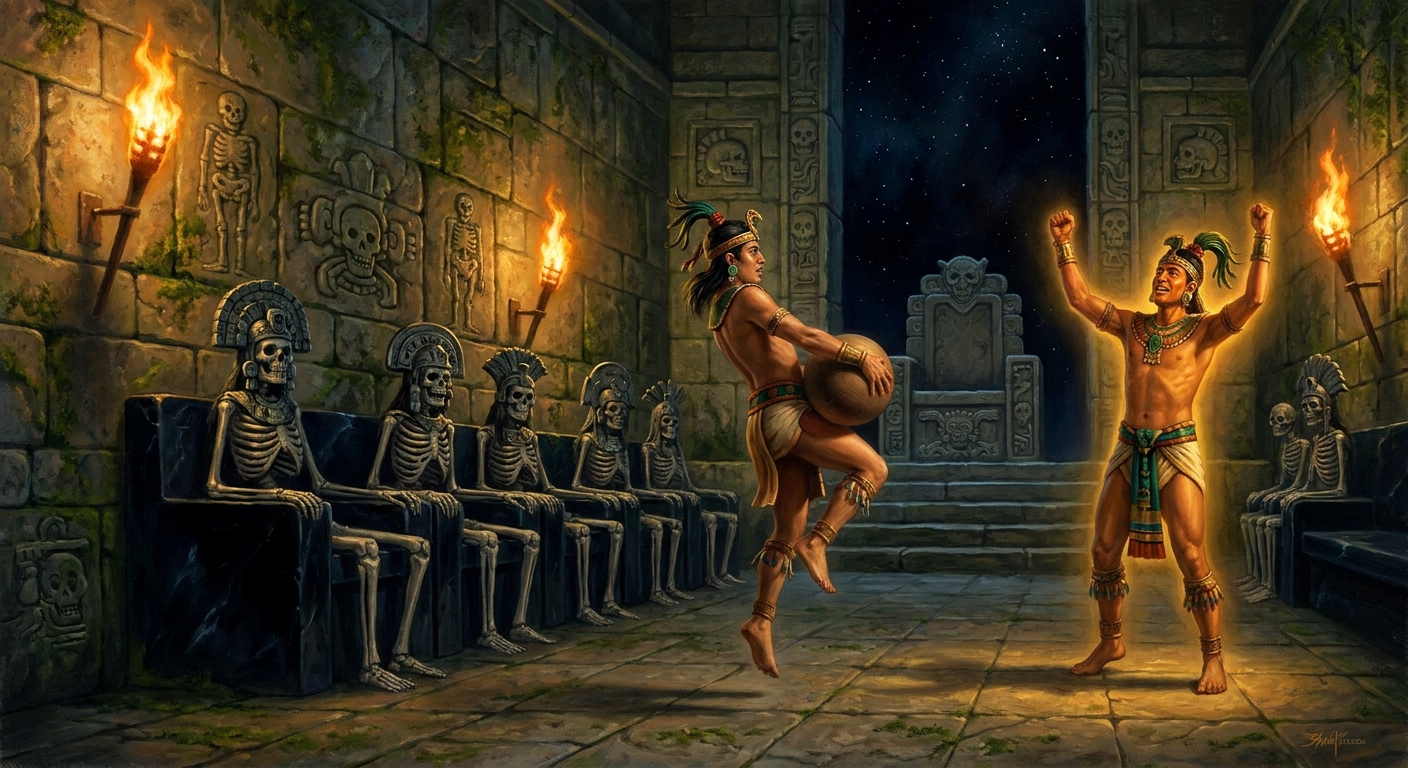
Xquic — Blood Girl, Blood Maiden, she whose name is carried in the word for blood — grows up in the underworld knowing its rules the way you know the rules of the house you grew up in: thoroughly, without thinking, without ever having chosen them. Her father is Cuchumaquic, one of the lords, a being of disease and blood magic. She has grown up in the dark and the cold and the deliberate unpleasantness that Xibalbá maintains as its atmosphere.
She hears about the gourd tree.
The lords have decreed that no one shall approach the tree where the head of Hun Hunahpú hangs among the gourds, no one shall try to pick its fruit, no one shall stand beneath it. The decree means the tree has become the most talked-about thing in Xibalbá. Xquic cannot stop thinking about it. She walks to the tree.
She stands below it looking up at the round pale gourds and at the one thing among them that is not a gourd. She reaches up toward the fruit.
What are you asking for? says the head of the Maize God. These things are only skulls.
I still want the fruit, she says.
All right. Hold out your right hand.
She holds out her hand, palm up, and the head of Hun Hunahpú spits into her palm. The spittle lands and vanishes — absorbed immediately, as if it was always meant to be in her. The head tells her: I have given you my descendants. Go up to the surface. Do not die in Xibalbá. Trust what I have told you.
She walks home pregnant.
Her father notices the pregnancy.
He calls the lords together. She denies that any man has come to her. The lords of Xibalbá do not believe her and they do not particularly care whether she is telling the truth — she has violated the decree about the tree and that is enough. They sentence her to death and they give the sentence to the four owls: take her out of Xibalbá and cut out her heart and bring it back in a gourd.
The owls take her out.
On the road between Xibalbá and the surface of the earth, she talks to them. She makes her case: she is innocent of any real crime. She carries something precious. She tells them what to do instead: cut a tree and gather the red sap into the gourd. The red sap of the copal tree — the tree of incense, the tree whose smoke is used in prayer — is the same color as blood. It will satisfy the lords.
The owls consider this.
They are owls, not heroes. They are messengers and executioners by training. But Xquic is persuasive, and more importantly she is right about the copal sap, which does burn in the gourd with the color and smell of blood when the lords receive it. The lords take the burning gourd and they are satisfied. Good, they say. See that her face is smoked, see that she is scraped, see that she is put down the road. She is already gone.
She arrives at the house of Xmucane.
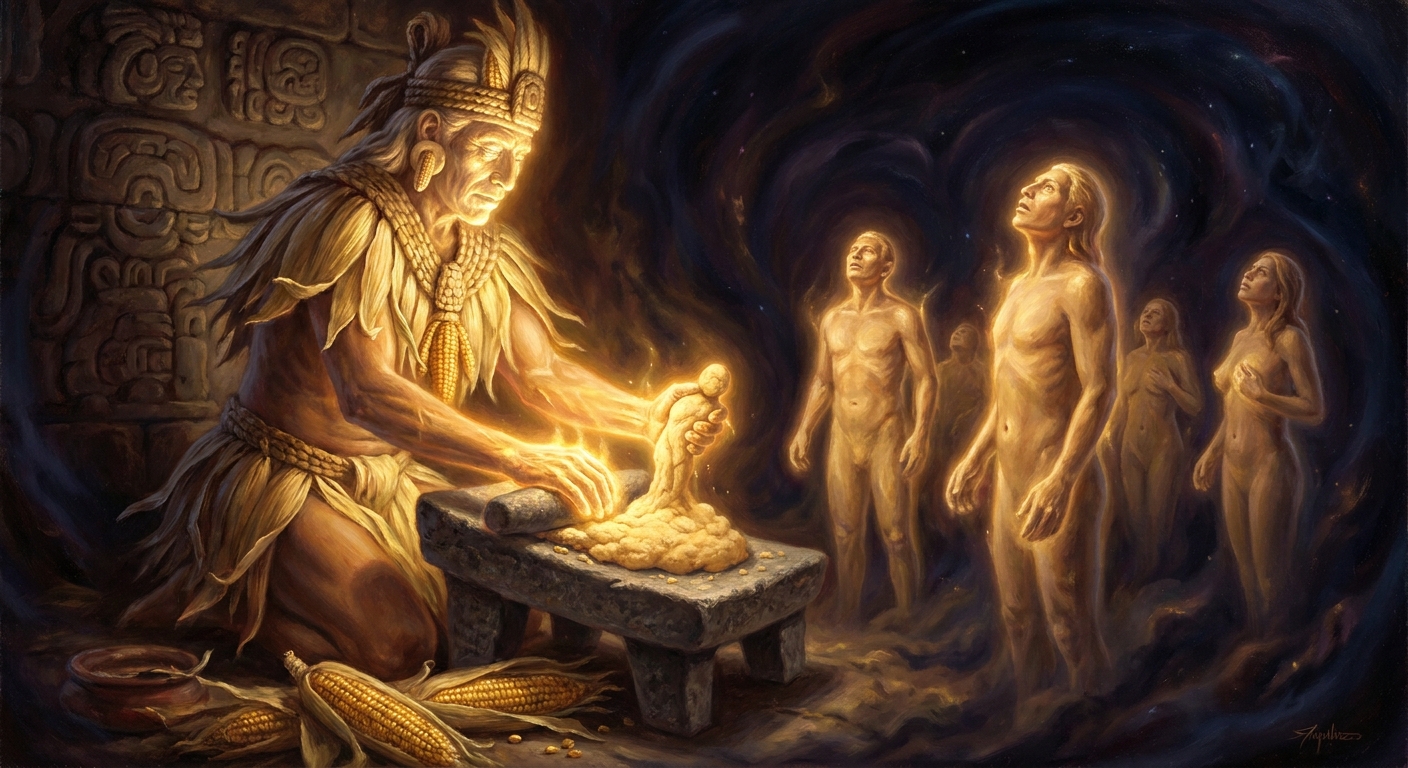
The grandmother is at her grinding stone. Xquic announces herself: I am your daughter-in-law. I am the wife of your son. Xmucane looks at her and says: I have no daughter-in-law. My son is dead. You are a liar. You are trying to shame me.
She sends Xquic to the garden with a net and tells her to bring back enough corn to fill it, though there is only one plant. This is a test designed to fail. Xquic goes to the garden and addresses the corn plant directly — she speaks to the silk, to the tuft at the top of the single stalk — and the net fills.
She carries it back full.
Xmucane looks at the full net and she looks at Xquic and she says: You are truly my daughter-in-law. Whether she believes the story about the gourd tree and the saliva, the text doesn’t say. What she accepts is the full net. What she accepts is the corn. Xquic has passed the grandmother’s test the same way the grandmother’s grandsons will pass the tests of Xibalbá — by understanding what is really being measured.
She stays in the house.
The twins are born there, on the surface of the earth, in the light that their father never saw again, that their mother fought her way toward and her father’s lords tried to stop. They sleep outside on the anthills at first. But they are alive, in the right world, with a grandmother to teach them and a mother who crossed the underworld alone to bring them here.
Echoes Across Traditions
Entities
- Xquic
- Cuchumaquic
- Hun Hunahpú
- Xmucane
- the owls of Xibalbá
Sources
- Popol Vuh, translated by Dennis Tedlock (Simon & Schuster, 1985)
- Allen J. Christenson, *Popol Vuh: The Sacred Book of the Maya* (University of Oklahoma Press, 2007)
- Karen Bassie-Sweet, *Maya Sacred Geography and the Creator Deities* (University of Oklahoma Press, 2008)