The Sīmorgh's Last Gift
The reign of Gushtāsp — late in the heroic age, after the coming of Zarathustra's revelation · Zābolestān — the southeastern province, Zāl and Rostam's homeland
Contents
When Rostam faces Esfandiyār — whose body is invulnerable except to a single tamarisk arrow prepared by the Sīmorgh — Zāl burns his last feather, and the great bird descends one final time to show the old hero how to end the unwinnable fight.
- When
- The reign of Gushtāsp — late in the heroic age, after the coming of Zarathustra's revelation
- Where
- Zābolestān — the southeastern province, Zāl and Rostam's homeland
Zāl is very old when he burns the last feather.
He was twenty when the Sīmorgh gave them to him — three feathers, a promise, a farewell — and in the decades since he has burned two. The first when Rūdāba could not deliver Rostam. The second at another crisis, now less remembered. The third he has kept, knowing what the keeping costs and what the burning will mean.
It means the end of things.
The situation is this: Rostam, his son — the greatest warrior Iran has ever produced, the man who defeated the White Div and killed dragons and rescued kings and fought for generations without being wounded by any weapon any enemy could bring — has been challenged by Esfandiyār, the prince of the new king Gushtāsp. Esfandiyār is also invulnerable. He completed the Seven Trials of his own youth and his body was sealed against harm. No conventional weapon can wound him.
Rostam and Esfandiyār have already fought once.
They fought all day and accomplished nothing — two invulnerable men on horseback, their weapons doing nothing, their horses bleeding, the combat a stalemate of mutual invincibility. Rostam has retreated to his home in Zābolestān to think. He has no answer. There is no weapon in his armory that can hurt Esfandiyār, and Esfandiyār will come again in the morning.
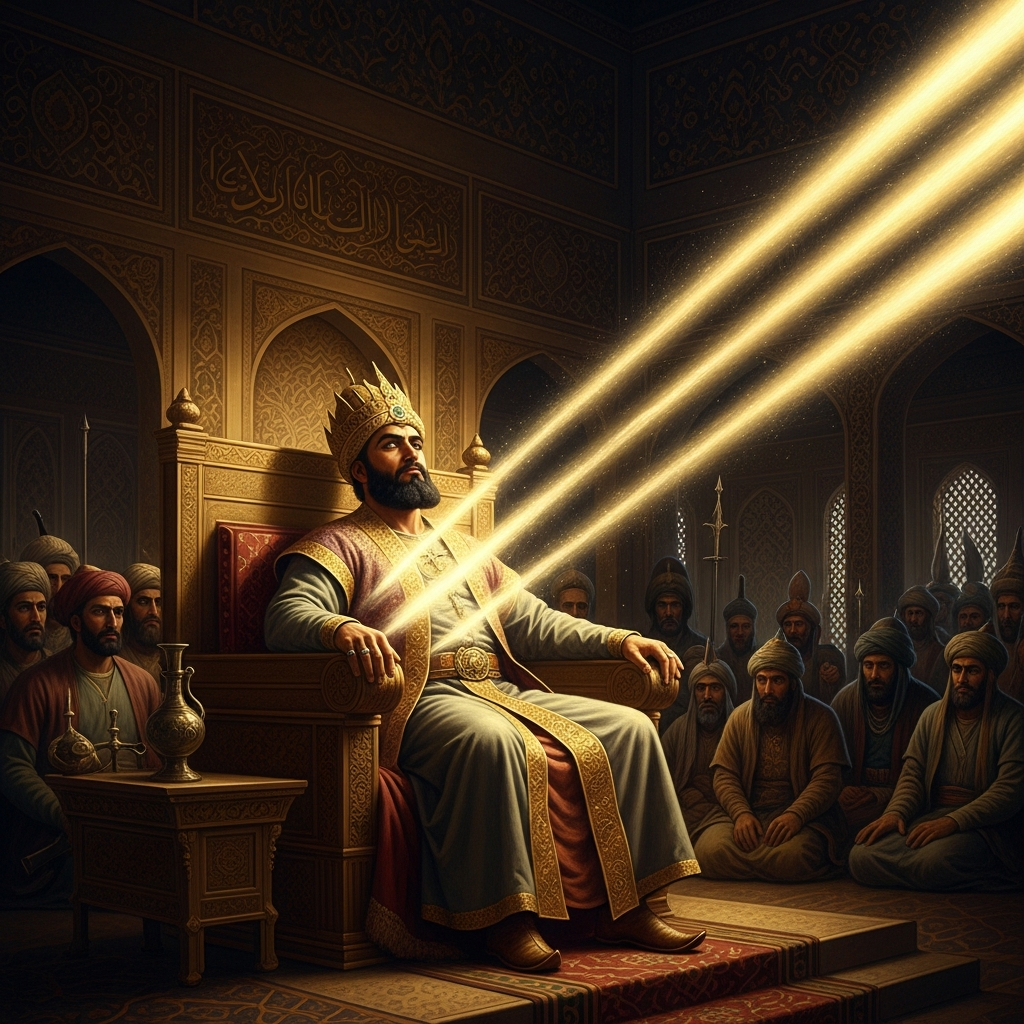
Zāl holds the last feather in his aged hands.
He burns it.
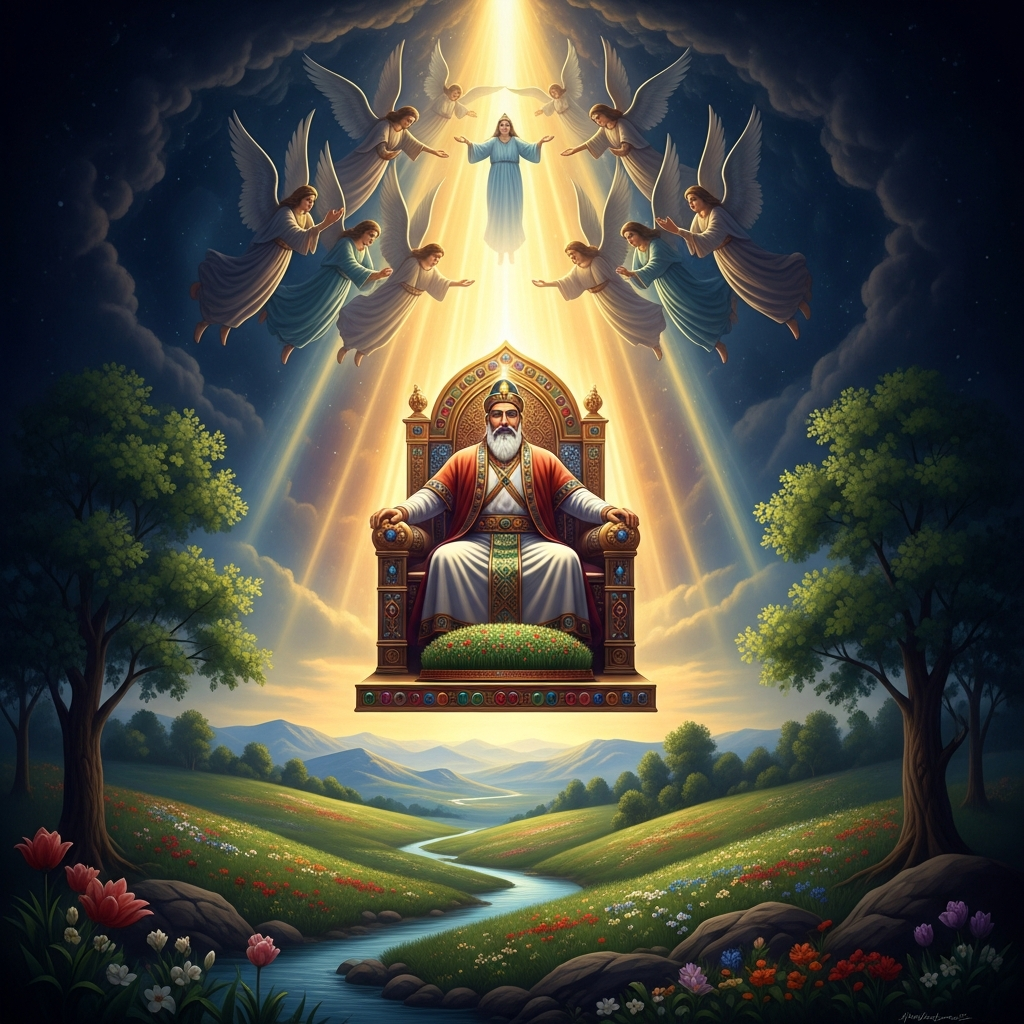
The Sīmorgh comes down from Alborz. She is as she has always been: vast, ancient, smelling of sandalwood, radiating the patience of something that has watched the world from its beginning. She looks at Rostam and she grieves, visibly — the Shahnameh says she grieves, and it is one of the few moments the text shows an immortal being expressing sorrow rather than instruction.
She tells him what she knows.
She says: Esfandiyār’s vulnerability is in his eyes. She does not explain this theologically, though the tradition knows the reason — when Esfandiyār completed the brazen fortress trial, he dipped himself in the pool of invulnerability but kept his eyes closed, and what the eyes saw remained unprotected. She tells Rostam to go to the tamarisk tree. She directs him to a specific branch. She tells him how to make an arrow from it — the dimensions, the feathering, the tip.
Then she tells him what will happen when he fires it.
She says: the arrow will find Esfandiyār’s eyes. He will die. And you, Rostam — you will not live long after this. The killing of Esfandiyār will be an act that has consequences that follow you until the day you die. You will not die of a wound in battle. You will die of a trick, in a pit. But this is the path.
Rostam asks: is there another path?
She says no.
This is the moment the Sīmorgh earns her place in the tradition as something more than a useful divine ally — she is a being who can see the whole course of events, who has loved these people she is now equipping for tragedy, and who tells the truth about what she sees even when what she sees is terrible. She does not pretend there is a way to avoid this. She does not offer comfort that would be dishonest.
She tells him to make the arrow and fires it in the morning.
Rostam makes the arrow. In the morning he fires it. It finds Esfandiyār’s eyes, as the Sīmorgh said it would. The great prince dies with the slow dignity the Shahnameh gives its best characters — composing himself, saying farewell, predicting what he wants said at his grave.
The Sīmorgh has returned to her mountain.
Zāl is very old, sitting in the house that was built when he came down from the summit carrying three feathers and a foster-mother’s love. All three feathers are burned now. He has no way to call her back.
He will not need to. There are no more impossible births coming, no more invulnerable enemies requiring cosmic guidance. The age of heroes is ending, as it ends in all traditions, with the heroes killing each other and the divine animals retreating to their peaks.
The nest on Alborz is still there.
The feathers she has shed over the centuries, the Shahnameh says, are sovereign medicines — whoever finds one and burns it can cure any disease. The mountain keeps her gifts even when she withdraws her presence.
It is not nothing.
Echoes Across Traditions
Entities


Sources
- Ferdowsi, *Shahnameh*, 'Rostam and Esfandiyār,' translated by Dick Davis
- Jerome Clinton, *In the Dragon's Claws: The Story of Rostam and Esfandiyar* (Mage, 1999)
- Olga Davidson, *Poet and Hero in the Persian Book of Kings* (Cornell, 1994)
- A.Sh. Shahbazi, 'Sīmorḡ,' *Encyclopædia Iranica* (2002)