Two Invincible Men Must Fight
The reign of Gushtāsp — late in the heroic age, after Zarathustra's revelation · Zābolestān — the plain outside Rostam's ancestral home
Contents
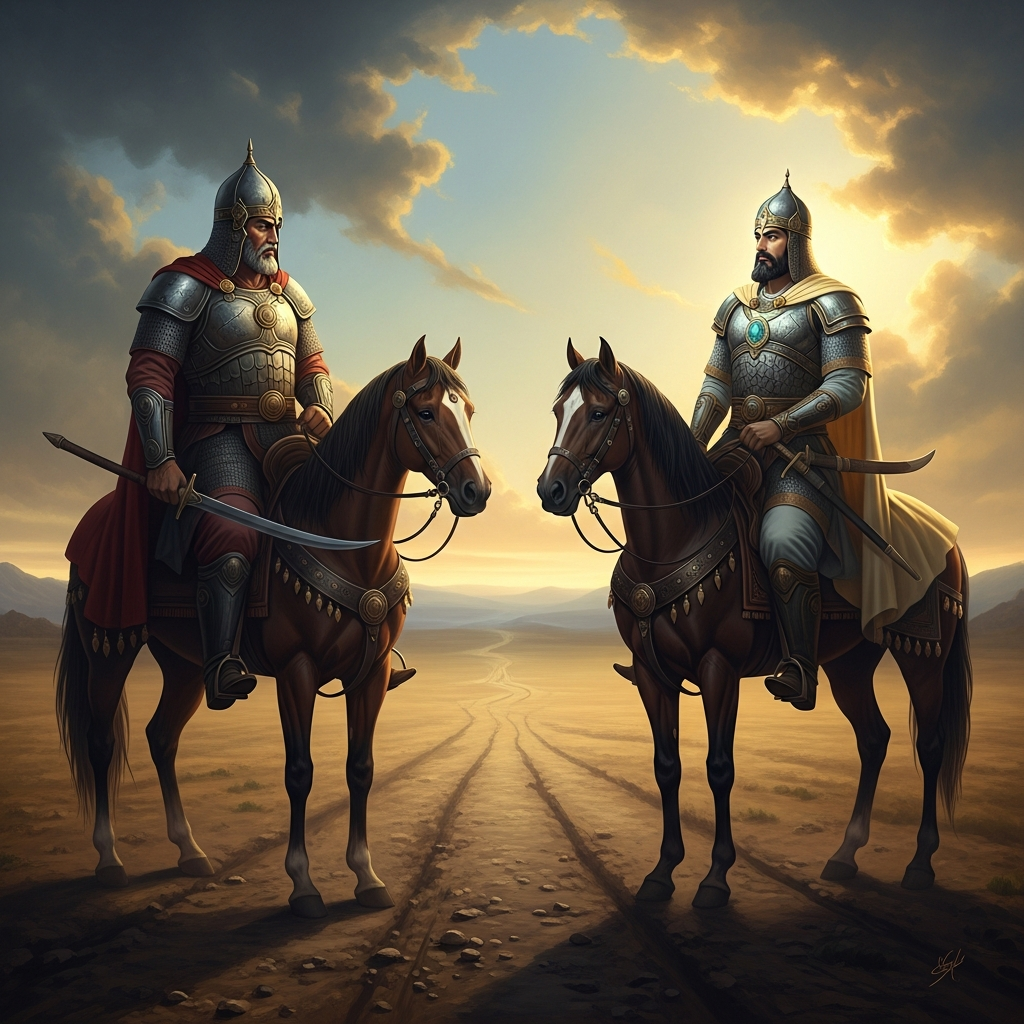
Rostam and Esfandiyār — the greatest warrior of the old heroic age and the greatest hero of the new religious order — are both too honorable to begin the fight and too bound by obligation to avoid it, until the Sīmorgh's arrow ends what neither man wanted to start.
- When
- The reign of Gushtāsp — late in the heroic age, after Zarathustra's revelation
- Where
- Zābolestān — the plain outside Rostam's ancestral home
Before the fight, they talk for three days.
This is what makes the episode remarkable: the combat between Rostam and Esfandiyār is preceded by negotiations that are as carefully constructed as the best diplomatic exchanges in history, and that fail not because either party is foolish or dishonest but because the structure of the situation has no exit.
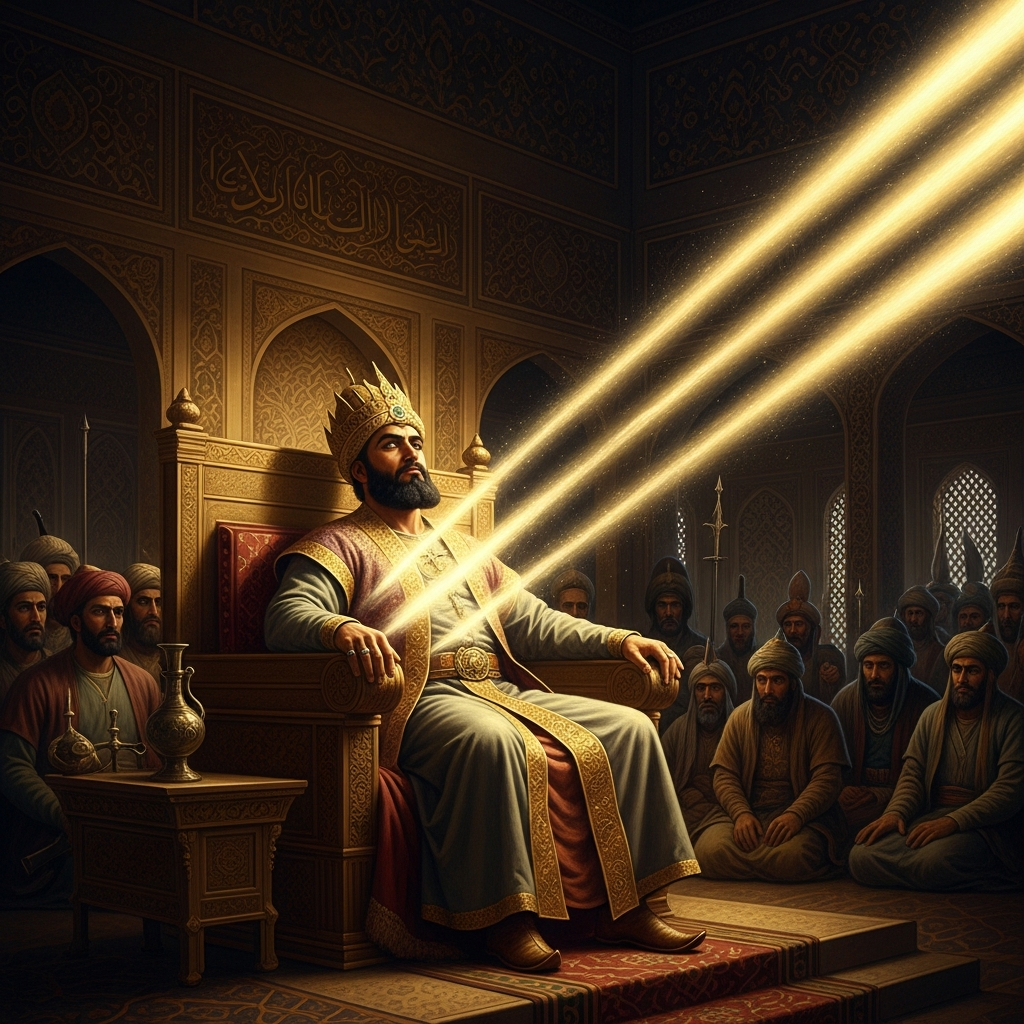
Esfandiyār has come from his father Gushtāsp with an order: bring Rostam back to the court in chains. The chains are ceremonial — they will be removed at the court — but Rostam must be seen to submit to royal authority, because the age of the independent hero must end now that the new religious order under Zarathustra has established a divine kingship in Iran. Gushtāsp wants to demonstrate that even Rostam, the greatest of the old heroes, acknowledges the king’s supremacy.
Rostam offers everything short of the chains.
He offers to come to the court voluntarily and acknowledge the king. He offers to fight Esfandiyār as a friend, a competition rather than a submission. He offers gifts. He offers his sons. He offers, with extraordinary care, all the things that would be equivalent to the submission in practice without the specific humiliation of the chains.
Esfandiyār, who clearly finds the situation as uncomfortable as Rostam does — who is, the text establishes, a good man who would prefer to accomplish his mission without this collision — can accept none of it. His father’s instruction was specific. The chains are the point. The chains are the demonstration. If he returns without the chains, he has failed the mission, and the throne that was promised him for completing the mission will remain unpromised.
The two men eat and drink together through the negotiations.
They praise each other. Esfandiyār says: there is no warrior your equal and there never has been, and it is an honor to be in your presence. Rostam says: you are the greatest champion of the faith and a worthy opponent for any man alive. They are both sincere. The compliments make the situation worse, because they establish so clearly what is about to be destroyed.
The first day of fighting is a draw.
Two invulnerable men trade blows that would kill anyone else and accomplish nothing. Rostam’s superhuman strength against Esfandiyār’s supernatural invulnerability: an unstoppable force encountering an immovable object, and the world cannot hold both. They call it a day at nightfall and each man tends his wounds that should be worse than they are.
The second day begins.
Rostam goes to Zāl that night, and Zāl burns the last feather, and the Sīmorgh comes down. She gives him the tamarisk arrow. She tells him what it will cost. Rostam accepts the cost.
The arrow finds Esfandiyār’s eyes in the second day’s fighting.
Esfandiyār falls.
He does not die immediately — the Shahnameh gives him time to die, gives him the speech that dying heroes are owed. He says to Rostam: you have not killed me. My father’s treachery has killed me. He set me against you knowing what you are, knowing I would have to fight you to hold my own honor intact. My blood is on his hands, not yours.
He says: I have one request. My son Bahman — take him. Train him. Give him what you would have given me if the age had been different.
He dies at sunset.
Rostam carries the body into the camp.
Zāl, who is very old, sits in his house and holds the ashes of the last feather.
The Sīmorgh is back on her mountain.
Two good men met on a plain and the age ended.
There was no other way, given what the age had built.
Echoes Across Traditions
Entities
- Rostam
- Esfandiyār
- Gushtāsp
- Zāl
- Sīmorgh

Sources
- Ferdowsi, *Shahnameh*, 'Rostam and Esfandiyār,' translated by Dick Davis
- Jerome Clinton, *In the Dragon's Claws: The Story of Rostam and Esfandiyar* (Mage, 1999)
- Olga Davidson, *Poet and Hero in the Persian Book of Kings* (Cornell, 1994)
- Dick Davis, *Epic & Sedition: The Case of Ferdowsi's Shahnameh* (Arkansas, 1992)