Contents
After two failed creations, the gods grind white and yellow corn into dough, mix it with water from nine gourds, and shape the first true humans — who see too clearly, remember too perfectly, and must be partially blinded so they do not become gods themselves.
- When
- Mythic era — the creation of present humanity; Classic to Postclassic Maya tradition
- Where
- Paxil and Cayalá — the place of abundance where the corn was found; the place of creation
After the wooden people are destroyed, the world must begin again.
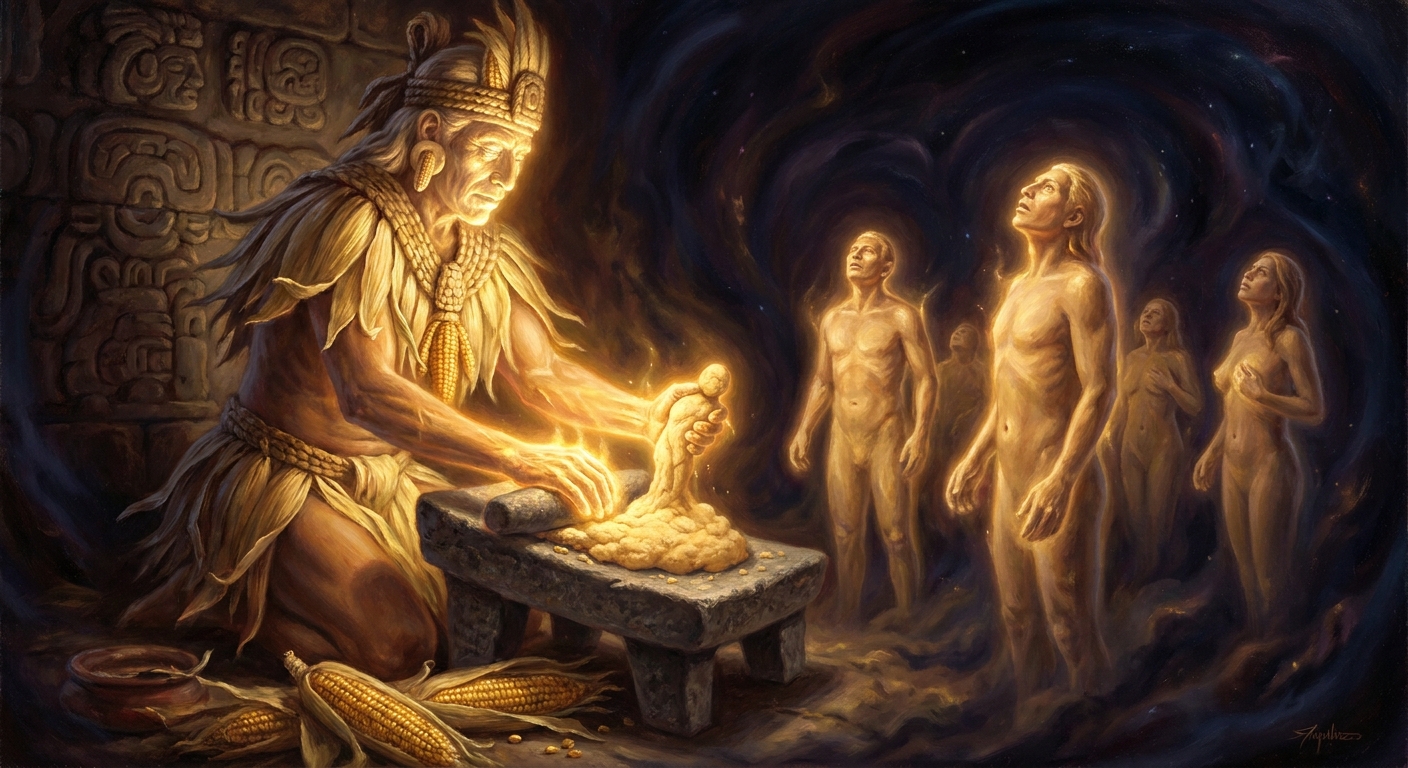
The animals lead the way to the food. Fox brings the news first, then coyote, then parrot, then crow — all of them arriving from the east, from the distant place called Paxil and Cayalá, where the yellow corn and the white corn grow together in great abundance. Grandmother Xmucane, the old diviner, the great-grandmother of the sunrise, takes the ears and grinds them. She grinds them nine times. She adds water from nine gourds, and the water carries strength, and the strength enters the dough, and from this dough the first true human beings are shaped.
Four men are made first: Balam Quitze, Balam Acab, Mahucutah, and Iqui Balam — Jaguar Quitze, Jaguar Night, Not Right Now, and Dark Jaguar. They are made of yellow corn and white corn, nothing else. No mud, no wood, no material of the previous failed creations. Corn is the material that has already been through transformation: it was planted, it grew, it was harvested, it was ground. It knows how to hold a shape.
These four men are complete.
They have eyes and they see. They see everything — the whole surface of the world, from one horizon to the other, all at once, simultaneously, without moving their heads. They look at the forest and see every tree. They look at the sky and see every level of it. They look at the sea and see to the bottom. They look at the mountains and see through them. They know what is in the darkness and what is behind the light.
The creators watch them and they are uneasy.
What shall we do with them now? the creators say to each other. They see everything. They know everything. They are as wise as gods. Is this what we wanted?
The creators speak together with Heart of Sky, with Huracán, and together they decide: the corn-people see too much. If they see everything now, they will not need the gods — they will not look up to find what they already possess. They will not pray because prayer is a reaching toward something beyond you, and these men have nothing beyond them.
Let their sight reach only to what is nearby, the creators decide. Let them see only a little of the face of the earth.
Heart of Sky breathes on the eyes of the four men the way you breathe on a mirror to cloud it. The mist settles over their sight. They do not go blind — they can still see, they can still walk and work and recognize each other’s faces. But the far horizon goes soft. The bottom of the sea becomes invisible. The levels of the sky close off above the first one. They become, in their vision, what you are: able to see clearly what is near and only dimly what is far.
They are sad for a moment.
They sit in the darkness — it is still before the dawn, before the sun has risen for the first time over this new world — and they speak. They name what they have been given: sight, hearing, speech. They name the makers: Heart of Sky, Tepeu, Gucumatz, Xpiyacoc, Xmucane. They give thanks for the dough that made them, for the water that gave them strength, for the animals that showed the way to the corn.
This is what the mud-people could not do. This is what the wooden people would not do. These four men, in the darkness before the first dawn, spontaneously give thanks. They have been made of the right material.
Four women are made for them in their sleep, appearing when they wake: Cacahá Paluma, Choimhá, Tzununiha, Caquixahá. The four couples become the ancestors, the root of the present human race — the Quiché Maya, the Tamub, the Ilocab, the other peoples who will spread across the earth.
They wait, in the dark, for the sun.
When the sun finally rises for the first time, they weep. The light is so beautiful, and they have been waiting in the dark so long, and they know — with the clarity that remains to them even through the dimming — that the light is not something they made. They burn copal resin before the rising sun. The smoke rises. The prayer is real. The world, at last, works.
Echoes Across Traditions
Entities
- Tepeu
- Gucumatz
- Xmucane
- Heart of Sky
- Balam Quitze
- Balam Acab
- Mahucutah
- Iqui Balam
Sources
- Popol Vuh, translated by Dennis Tedlock (Simon & Schuster, 1985)
- Allen J. Christenson, *Popol Vuh: The Sacred Book of the Maya* (University of Oklahoma Press, 2007)
- David Carrasco, *Religions of Mesoamerica* (Harper & Row, 1990)