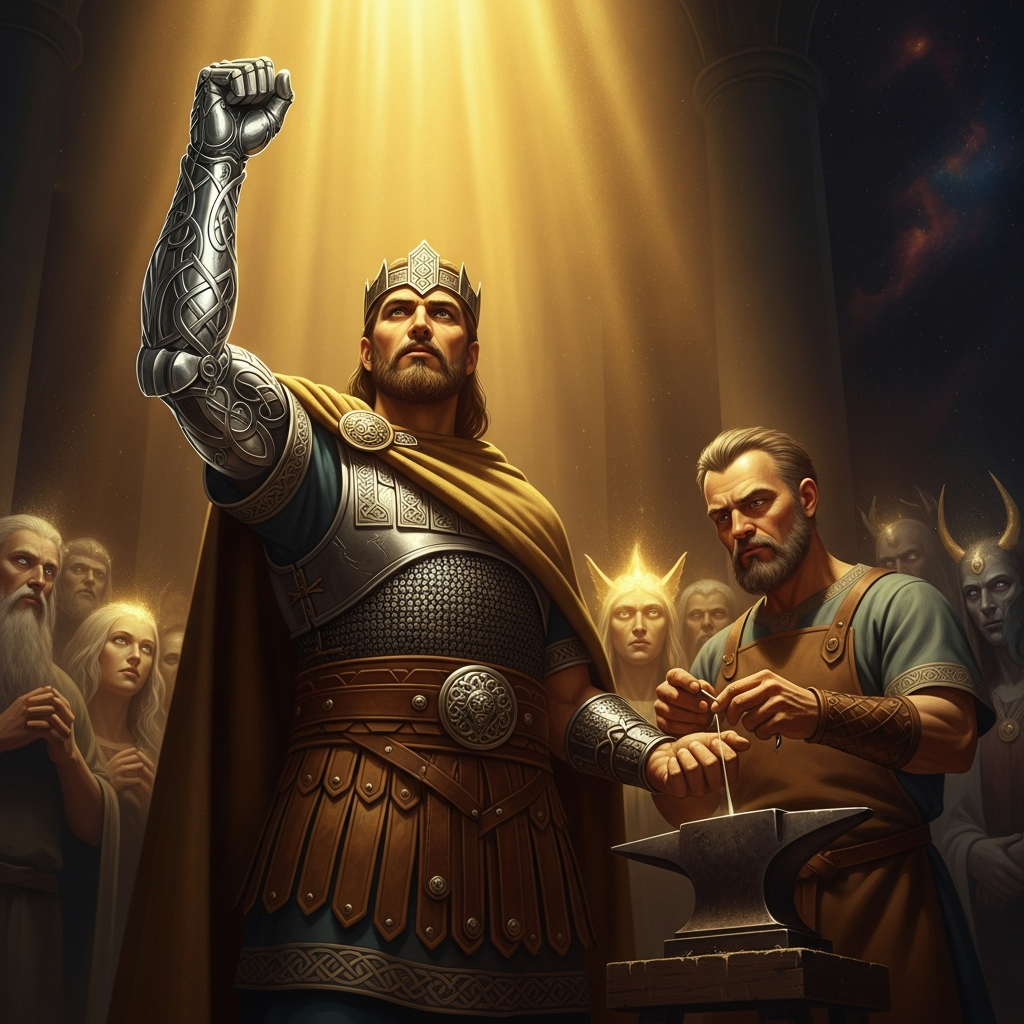
Nuada of the Silver Hand
mythic prehistory — after the First Battle of Mag Tuired · The battlefield of Mag Tuired, then the halls of the Tuatha Dé Danann, Ireland
Contents
When the king of the gods loses his hand at the First Battle of Mag Tuired, a blemished king cannot rule — so the divine physician crafts a silver hand that moves like flesh, and Nuada must reclaim what injury took from him.
- When
- mythic prehistory — after the First Battle of Mag Tuired
- Where
- The battlefield of Mag Tuired, then the halls of the Tuatha Dé Danann, Ireland
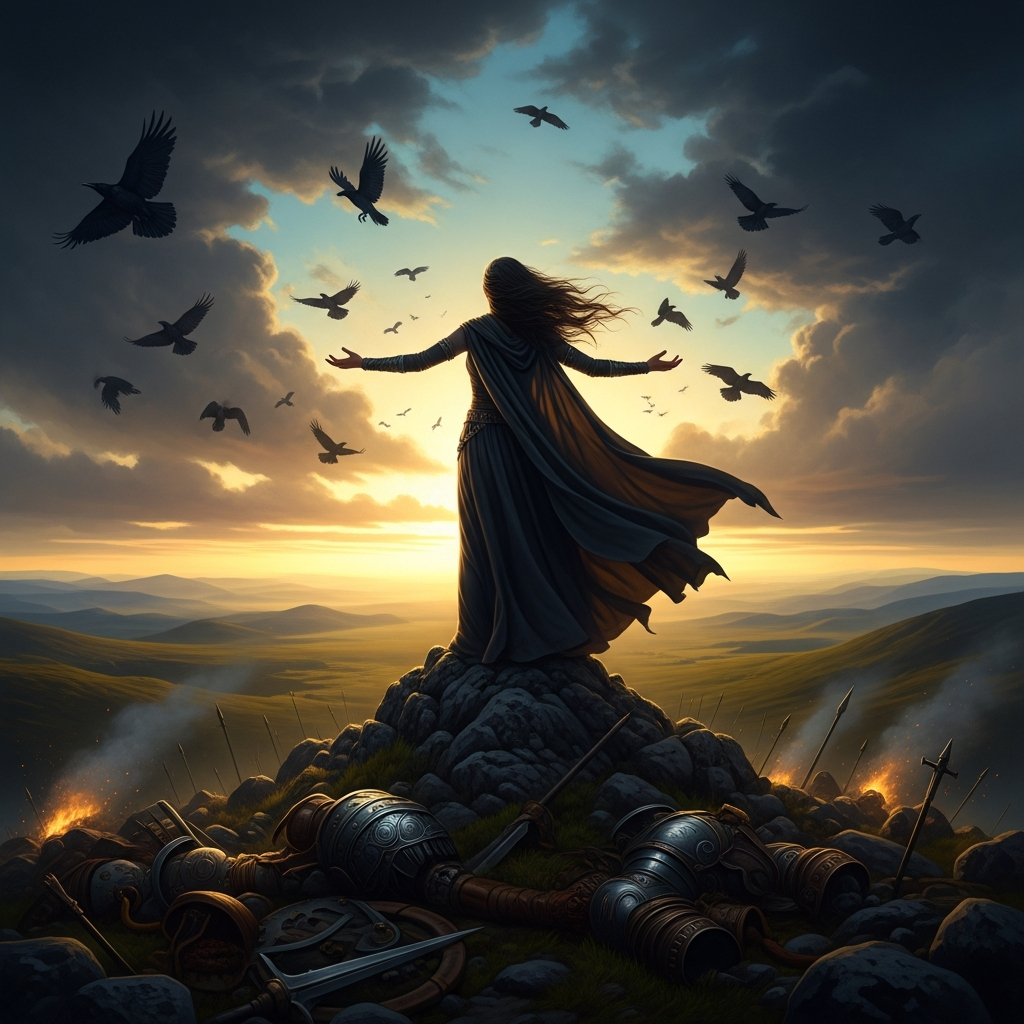
The hand comes off at the First Battle of Mag Tuired and everything changes.
Nuada Airgetlám is king of the Tuatha Dé Danann — a king renowned for justice, for the quality of his judgment, for the particular authority that comes from a man who is right so often that people stop arguing with him. He leads the Tuatha Dé Danann against the Fir Bolg, the previous inhabitants of Ireland, who have refused to share the island. The battle is tremendous. The Tuatha Dé Danann win.
Nuada loses his right hand at the shoulder to the sword of the Fir Bolg champion Sreng.
Irish law is precise about this: a king with a physical blemish cannot rule. The law is not punitive — it is theological. The king is the land’s body, and a blemished body cannot embody sovereignty. The king who cannot hold a sword cannot hold the kingdom. The logic is merciless toward a man who lost his hand defending the kingdom that now refuses him for losing it.
He steps down. He has no choice. The law is the law even when the law is cruel to the man it protects.
The divine physician Dian Cécht and the goldsmith Credne make him a new hand of silver. It is a masterwork of the divine craft: it articulates at every joint, it moves when he wills it to move, it catches light in the way that silver catches light — beautifully, impossibly, with a cold fire that real hands don’t have. It is a hand that is better than a hand in every visible quality.
Nuada rules again with the silver hand.
But Dian Cécht’s son Miach is also a physician, and he is better than his father, which is the particular domestic tragedy of sons born to great fathers. Miach places fresh flesh against the silver articulation and says the healing words and over nine days and nights grows Nuada a new hand — real flesh, real blood, the bones rebuilding themselves joint by joint under the skin.
Nuada has two hands again. He is whole.
Dian Cécht kills Miach.
He kills his own son out of professional jealousy, which the sources state plainly without editorial comment. Miach had surpassed his father’s work and Dian Cécht, the divine physician, could not bear it. He strikes Miach four times — three times the wounds heal, because Miach is too skilled even to be killed cleanly by his own father. The fourth blow reaches the brain and Miach falls.
From Miach’s grave, 365 healing herbs grow — one for every joint and sinew of the human body. Miach’s sister Airmid goes to sort them, laying them out on her cloak by their properties. Dian Cécht comes and scatters them, so no single human being will ever again possess the complete knowledge of what they could do.
Nuada wears his new flesh hand and does not comment on how it was made. He rules the Tuatha Dé Danann with the quality of judgment that made him king before Mag Tuired, and he rules until Lugh arrives and the Second Battle of Mag Tuired becomes necessary, and then he dies in that battle at the hand of Balor of the Evil Eye.
The silver hand is somewhere in the earth below County Sligo. The herbs of Miach’s grave are scattered across Ireland’s fields. The knowledge of what they could do together is scattered with them, accessible only to whoever happens to be kneeling in the right place at the right time, which is the form most healing knowledge takes.
Echoes Across Traditions
Entities
- Nuada Airgetlám
- Dian Cécht
- Miach
- Credne
- The Tuatha Dé Danann
- The Fir Bolg
Sources
- John Carey, trans., 'Cath Maige Tuired' in *A Celtic Reader*, ed. John Matthews (Aquarian, 1991)
- Elizabeth Gray, trans., *Cath Maige Tuired: The Second Battle of Mag Tuired* (Irish Texts Society, 1982)
- T.F. O'Rahilly, *Early Irish History and Mythology* (Dublin Institute for Advanced Studies, 1946)