Lugh of the Long Arm Arrives at Tara
mythic prehistory — the age of the Tuatha Dé Danann, perhaps 2000-1500 BCE in mythic reckoning · Tara, County Meath — the sacred hill-center of Ireland
Contents
A radiant young stranger arrives at the gates of the king's hall and demands entry — not by violence but by listing every skill he possesses, each one refused until he names the single art that no one else in the hall can do.
- When
- mythic prehistory — the age of the Tuatha Dé Danann, perhaps 2000-1500 BCE in mythic reckoning
- Where
- Tara, County Meath — the sacred hill-center of Ireland
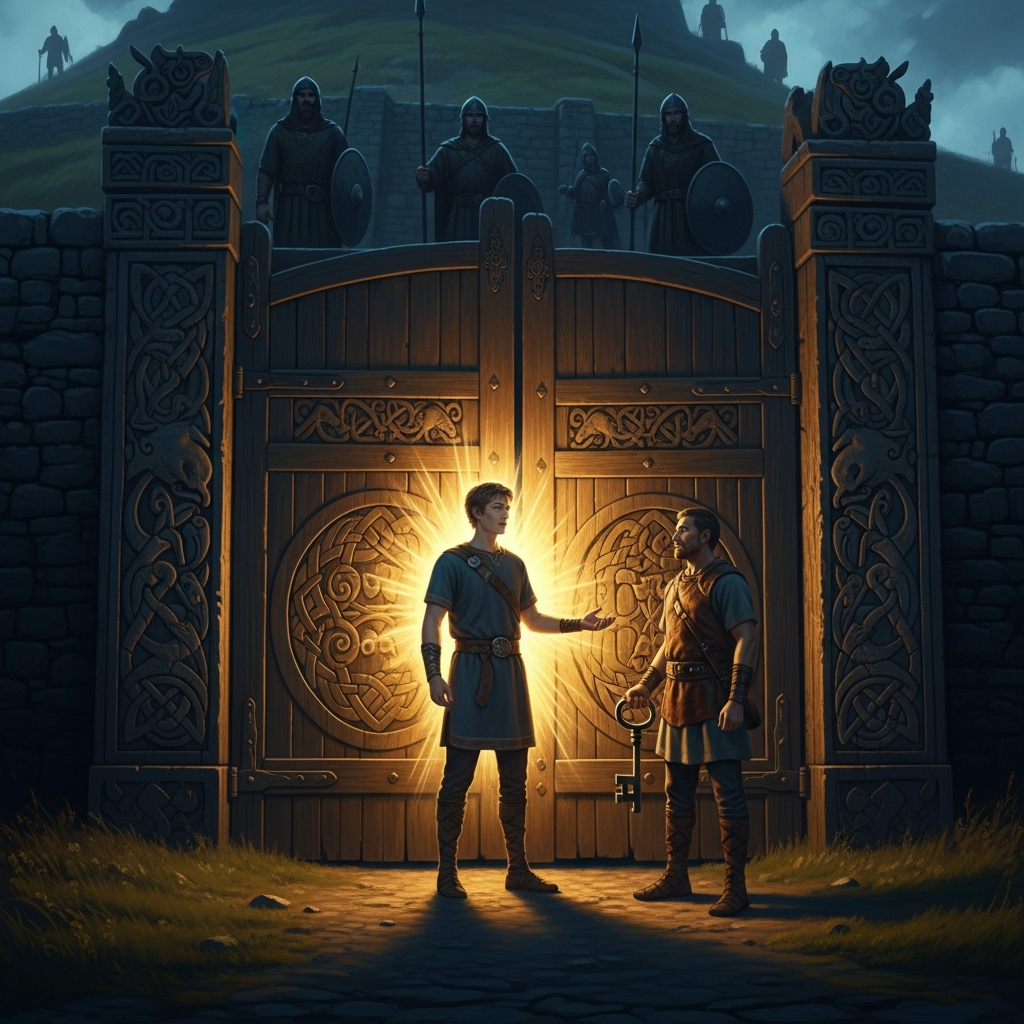
The gates of Tara are closed against the stranger.
The doorkeeper is doing his job: no one enters the king’s hall without a declared skill, because the hall of Nuada, king of the Tuatha Dé Danann, is not a place for dilettantes. Every craft and art has its master within. The doorkeeper is the gatekeeper of a meritocracy, and a serious one.
The stranger outside the gate is extraordinary to look at — the sources say his face is the face of the sun at noon, the light around him the light of a thing that has not yet learned to diminish itself. He is young, dark-haired, straight-backed, and he regards the closed gate with the patience of a man who has arranged this encounter in advance.
“What is your skill?” the doorkeeper asks.
“I am a carpenter.”
“We have a carpenter. The finest carpenter in Ireland is already in this hall.”
“I am a smith.”
“We have a smith.”
“I am a champion.”
“We have champions.”
“I am a harper.”
“We have a harper.”
The list continues — historian, poet, sorcerer, physician, cup-bearer, goldsmith. The doorkeeper names the master already seated at the fire for each one. The stranger does not argue. He does not force the gate. He simply states the next skill.
The pattern the doorkeeper begins to recognize is that the stranger is not trying to claim a single art. He is listing every art there is, one by one, systematically. There is something different about this from the normal credential-claim of a traveling craftsman. The doorkeeper consults the gatekeeper’s protocol for unusual situations — which is to say, he has no protocol for unusual situations — and falls back on a question.
“What is your claim that exceeds our court’s capacity?”
The stranger says: “Go to your king and ask him this: do you have in your hall, right now, a single man who is master of all those arts simultaneously? Because I am.”
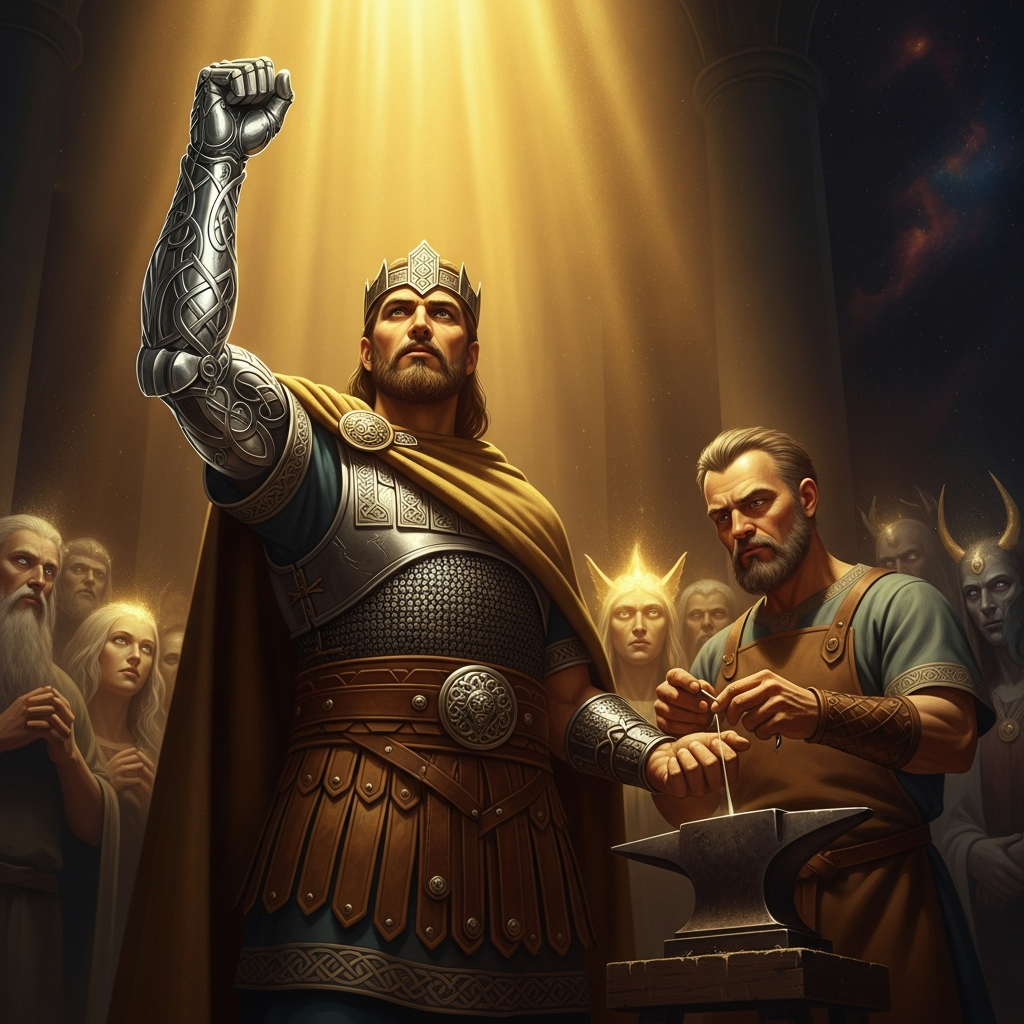
The doorkeeper carries the message to Nuada. The king of the Tuatha Dé Danann considers it, taps the arm of his throne — the silver arm that replaced the one he lost at the First Battle of Mag Tuired — and says: let him in.
Lugh Lámhfhada, the Long-Armed, the master of every skill, walks through the gates of Tara. The court looks at him and understands: the god of arts and crafts and light is not a specialist. He is the principle from which specialization derives.
He proves himself that night at fidchell — the board game of the gods, which he wins against the entire court simultaneously. He shows his harper’s skill; the music brings first weeping, then laughter, then sleep, in sequence, demonstrating mastery of the three strains that a true harper must command. He shows the court a display of athletic skill that leaves the champions blinking.
Nuada rises from his throne and gives the seat to Lugh for thirteen days. This is the highest gesture of recognition in the court: the king vacates his seat for the new arrival.
On those thirteen days, Lugh devises the strategy that will win the Second Battle of Mag Tuired against the Fomorians. He assigns each craftsman their task in the battle-plan. He speaks to each specialist in the language of their specialty. He is the node through which all the separate excellences connect.
This is what it means to be the god of light: not to burn brighter than anything, but to be the source through which all colors become visible. The doorkeeper, watching from the gate, understands this only afterward, standing in the light the new arrival carries with him through every room he enters.
Echoes Across Traditions
Entities
- Lugh Lámhfhada
- Nuada
- The Tuatha Dé Danann
- The Doorkeeper of Tara
Sources
- John Carey, trans., 'Cath Maige Tuired' in *A Celtic Reader*, ed. John Matthews (Aquarian, 1991)
- Proinsias Mac Cana, *Celtic Mythology* (Hamlyn, 1970)
- Jeffrey Gantz, trans., *Early Irish Myths and Sagas* (Penguin, 1981)