The Dagda's Inexhaustible Gifts
mythic prehistory — before the Second Battle of Mag Tuired · The ford at the River Unshin, and the camp of the Fomorians, Ireland
Contents
The great father-god of the Tuatha Dé Danann carries a club that kills with one end and resurrects with the other, owns a cauldron that no one leaves hungry, and yet is most powerful in the moment he appears most ridiculous.
- When
- mythic prehistory — before the Second Battle of Mag Tuired
- Where
- The ford at the River Unshin, and the camp of the Fomorians, Ireland
He drags his club behind him and it leaves a furrow in the earth deep enough to be a territorial boundary.
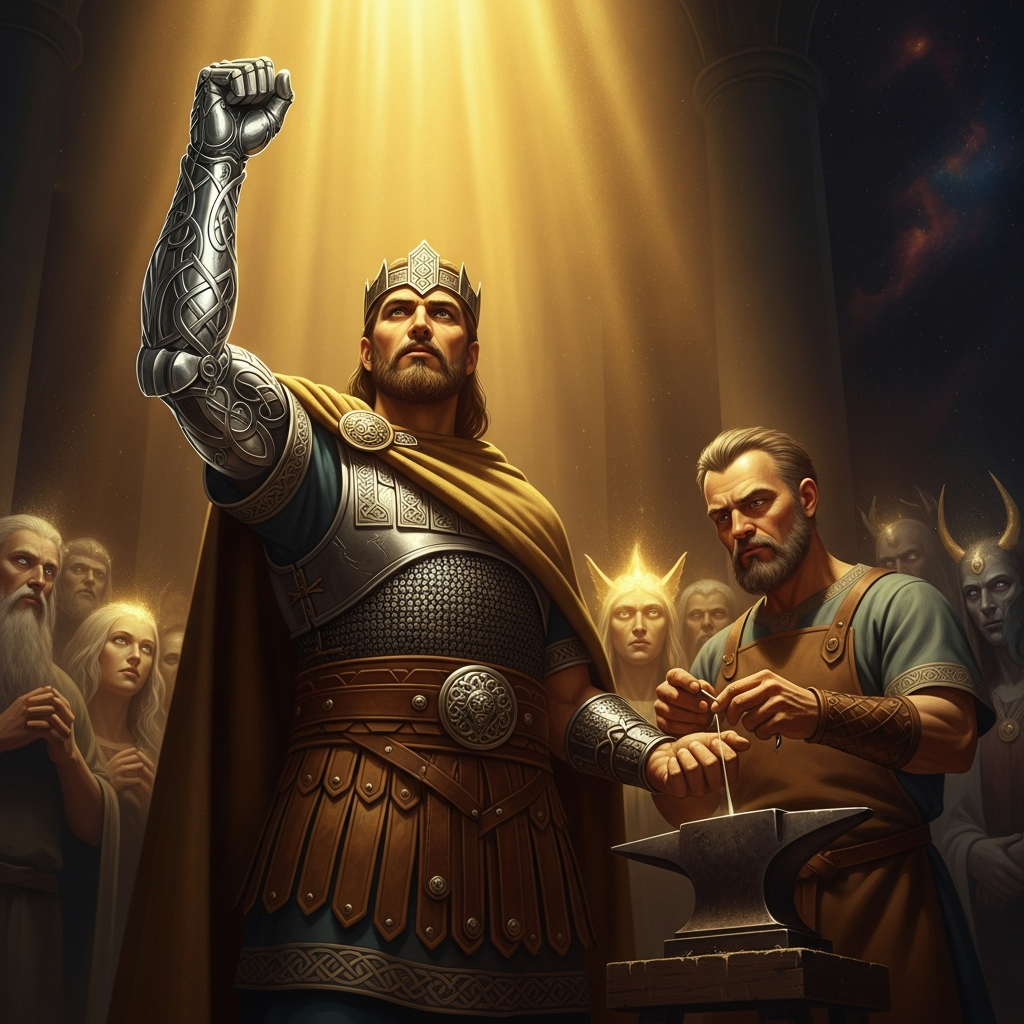
The Dagda is everything a war-god should not look like: enormous belly, short rough tunic that barely covers him, a club so large that eight men are needed to carry it when he is not, and an appetite that makes the warrior-feasts of Ulster look like polite tea. He is the All-Father of the Tuatha Dé Danann, the Good God — Dagda means simply the Good God, the effective one — and his effectiveness is expressed entirely through the principle of too much.
The club has two ends. One end kills the living; the other restores the dead. He has to be careful about which end he applies, but the power is absolute: there is no death his club cannot reverse, and no life that the other end cannot stop. He drags it on its wheels through the world and the earth records his path.
The cauldron is called Coire Ansic — the Undry. It was brought from Murias, one of the four cities of the Tuatha Dé Danann’s origin. No one who comes to it hungry leaves unsatisfied. It is inexhaustible. The principle it embodies is also simple: in a world where famine kills more people than war, the god who guarantees food is more fundamental than the god who guarantees victory.
Before the Second Battle of Mag Tuired, the Fomorians hold the Dagda in contempt. They invite him to a meal designed to humiliate: a cauldron of porridge made with eighty gallons of new milk and eighty gallons of fat and whole sheep and pigs and goats, poured into a pit in the ground. They tell him to eat it all or they will kill him. To them it is a death sentence. The Dagda sits at the edge of the pit and eats every drop with a ladle the size of a man, and then scrapes the bottom, and then falls asleep.
He goes to the ford of the River Unshin on the eve of the battle and meets the Morrigan.
She is there washing at the ford, which is the form the sovereignty goddess takes before a great battle: the woman at the ford who is washing the armor of the men who will die. She is, in this moment, the death that precedes the battle and the earth that receives the bodies afterward. The Dagda couples with her at the ford, which is not an act of violence but a ritual: the father-god of abundance and the mother-goddess of fate, meeting at the boundary between land and water before a battle, performing the act that guarantees the harvest will follow the fighting.
She tells him the battle will be won.
He arrives at the battle carrying his club, dragging the furrow behind him that the Fomorians step over as if it is simply a rut in the road, and they are wrong about it the way they are wrong about the Dagda generally: the furrow is a line drawn across the world, a territorial inscription, the mark of the god of the land asserting whose land this is.
The dead warriors of the Tuatha Dé Danann rise when he turns the second end of the club to them. The Fomorians die when the first end reaches them.
After the battle, exhausted, the Dagda sleeps for three days in the field. This too is theological: the god of abundance, having spent himself completely in the service of his people, must rest. The fertility principle requires fallowness. The inexhaustible must, periodically, be exhausted so that the inexhaustibility can be demonstrated again in the next growing season.
His cauldron returns to Murias with the rest of the sacred objects when the Tuatha Dé Danann go underground. But the furrow remains. It crosses a hillside in County Roscommon and has been there ever since, the inscription of a god dragging his instrument of death-and-renewal across the face of his own country, marking what he loves by the depth of the mark he leaves in it.
Echoes Across Traditions
Entities
- The Dagda
- The Morrigan
- The Fomorians
- Nuada
- Indech


Sources
- Elizabeth Gray, trans., *Cath Maige Tuired: The Second Battle of Mag Tuired* (Irish Texts Society, 1982)
- Proinsias Mac Cana, *Celtic Mythology* (Hamlyn, 1970)
- John Carey, *A Single Ray of the Sun: Religious Speculation in Early Ireland* (Celtic Studies Publications, 1999)