Caer Ibormeith: The Swan-Maiden's Bargain
mythic age of the Tuatha Dé Danann — the same events as the Dream of Óengus, from Caer's perspective · The lake at Croghan Hill, County Offaly, and the lands of Connacht, Ireland
Contents
The woman who appears in the dream of Óengus Óg is a swan every other Samhain — and she will come to him only if he can identify her by name from among a hundred and fifty identical white birds, a test she has set herself because she needs to be known before she can be chosen.
- When
- mythic age of the Tuatha Dé Danann — the same events as the Dream of Óengus, from Caer's perspective
- Where
- The lake at Croghan Hill, County Offaly, and the lands of Connacht, Ireland
She has known about him for years.
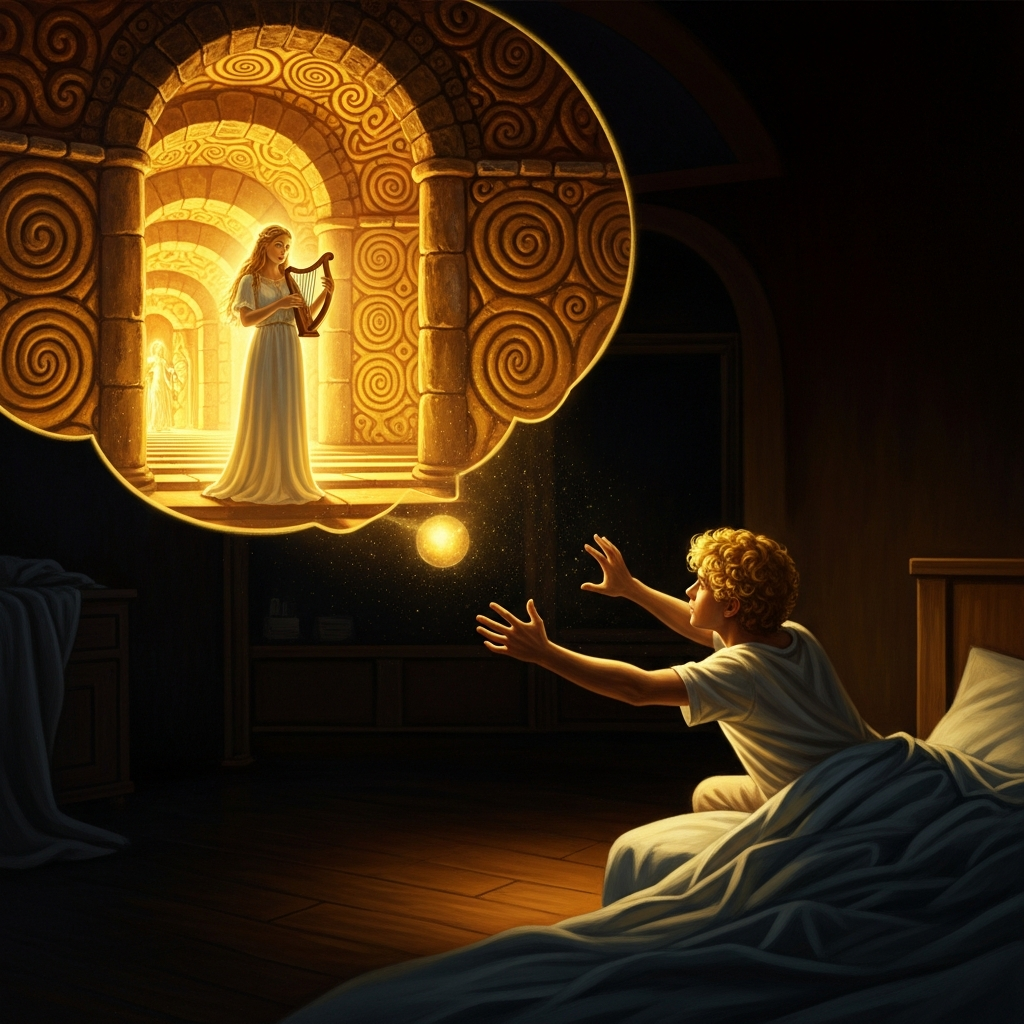
Caer Ibormeith, daughter of Ethal Anbuail of Connacht, is the woman in the love-god’s dream: she approaches his bedside every night in Brú na Bóinne, playing the harp, and leaves before he can touch her. This is the dream he is dying of. She knows about the dying.
She also knows about the search. She feels it the way you feel someone looking for you in a crowd — the specific pressure of directed attention, of a person turning over stones looking for your name. When the Dagda’s messengers and Ailill of Connacht’s men spend a full year searching for her, she is aware of the searching, though she does not help it. She lets it run its course. She is not hiding. She is waiting to be found correctly.
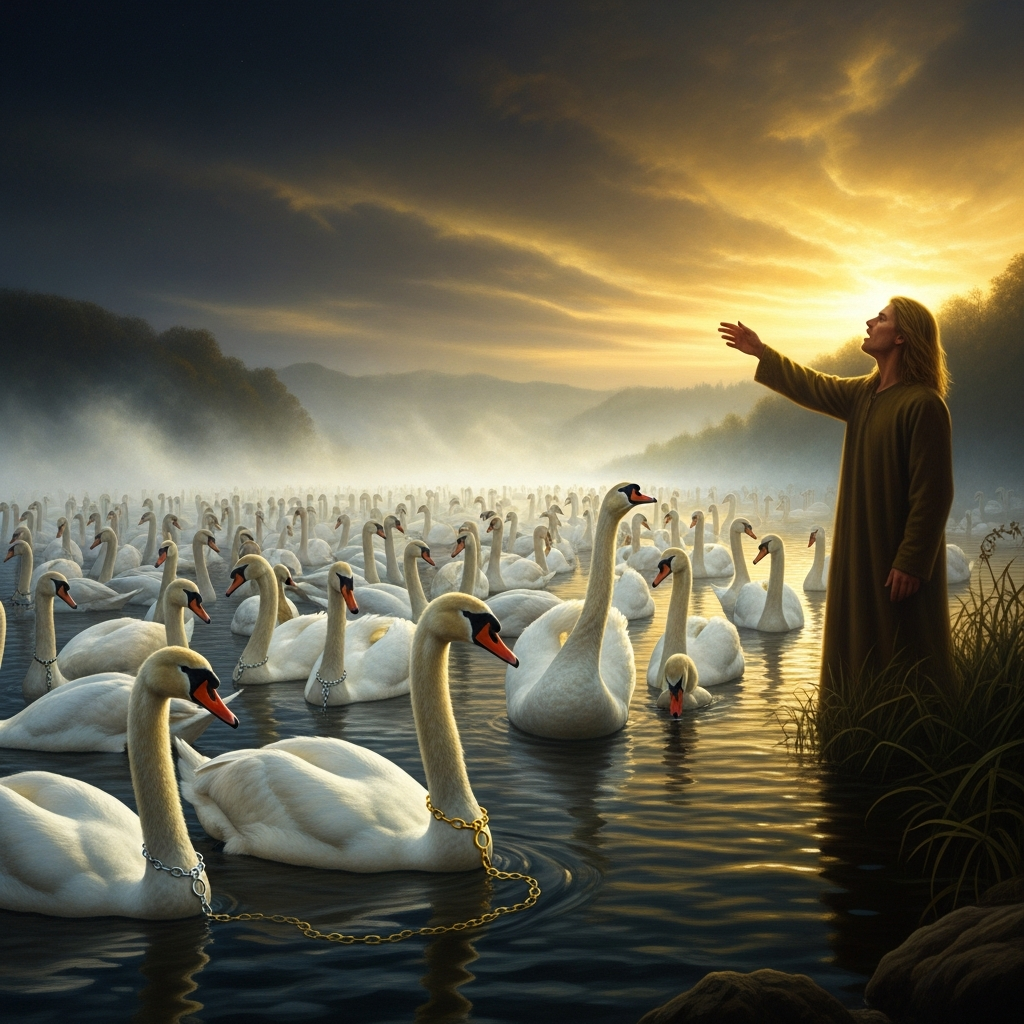
Her enchantment — the transformation into a swan every other Samhain — is presented in the sources as something that happened to her, an enchantment placed on her. But she has lived with it for a long time, and a woman who has been a swan half her life has a different relationship to the form than someone for whom it is only a curse. The lake at Croghan Hill is hers. The hundred and fifty white birds are her companions. Samhain on the lake is her time, not an imprisonment.
The test she sets — whether knowingly or by her own nature’s design — is the right test for what she needs. She needs to be known. Not recognized by her face, which she doesn’t have as a swan. Not identified by her family, which would simply be intelligence-gathering. Known. Called by name across the water by someone who has no way of being certain which bird is which, who chooses on the basis of what he carries inside him rather than what he can observe.
When Óengus arrives at the lake on the Samhain she is in swan-form, she watches him from the water. She watches him move along the shore looking at the hundred and fifty white birds with their silver chains and her single gold chain. She watches him hold the knowledge of her name without using it, deciding.
Then he calls it.
She turns at the sound.
This is the choice: to turn at the sound of the name, which is also to consent to what the turning means. She could stay still. She could be one of the hundred and fifty swans who didn’t turn. But she has been appearing in his dreams for years, she has been playing the harp at his bedside and leaving, she has been constructing a conversation across the boundary of sleep and waking that was leading to this lake on this evening.
She comes to the shore.
He transforms into a swan. They fly together to Brú na Bóinne, circling the lake three times — their song passing over Ireland and causing everyone within hearing to sleep three days in peaceful dreaming, which is the gift that love of this quality releases into the world as a side effect.
She becomes human again in her own time. The enchantment that made her a swan is done because it was always conditional on being met. She and Óengus are together in the golden hall above the River Boyne and she is done with the lake, and also she is never entirely done with the lake, because a woman who has been white on the water with a gold chain at her throat on a hundred Samhain mornings is never entirely done with it.
She plays the harp in the hall. He does not reach for her in his sleep anymore. She is there.
Echoes Across Traditions
Entities
- Caer Ibormeith
- Óengus Óg
- Ailill of Connacht
- Ethal Anbuail
Sources
- Jeffrey Gantz, trans., 'Aislinge Óenguso,' in *Early Irish Myths and Sagas* (Penguin, 1981)
- Alwyn Rees and Brinley Rees, *Celtic Heritage: Ancient Tradition in Ireland and Wales* (Thames and Hudson, 1961)
- Máire Herbert, *Iona, Kells and Derry* (Clarendon Press, 1988)