Isfandiyār and the Seven Trials
The reign of Gushtāsp — after the coming of Zarathustra's revelation to the Iranian court · The seven trials through the eastern wilderness, ending at Arjasp's brazen fortress
Contents
To win the throne promised by his treacherous father Gushtāsp, the prince Esfandiyār must pass through seven trials across the known world — facing wolves, lions, a dragon, a sorceress, a Simurgh, and finally a wall of ice.
- When
- The reign of Gushtāsp — after the coming of Zarathustra's revelation to the Iranian court
- Where
- The seven trials through the eastern wilderness, ending at Arjasp's brazen fortress
He does not want to be invulnerable.
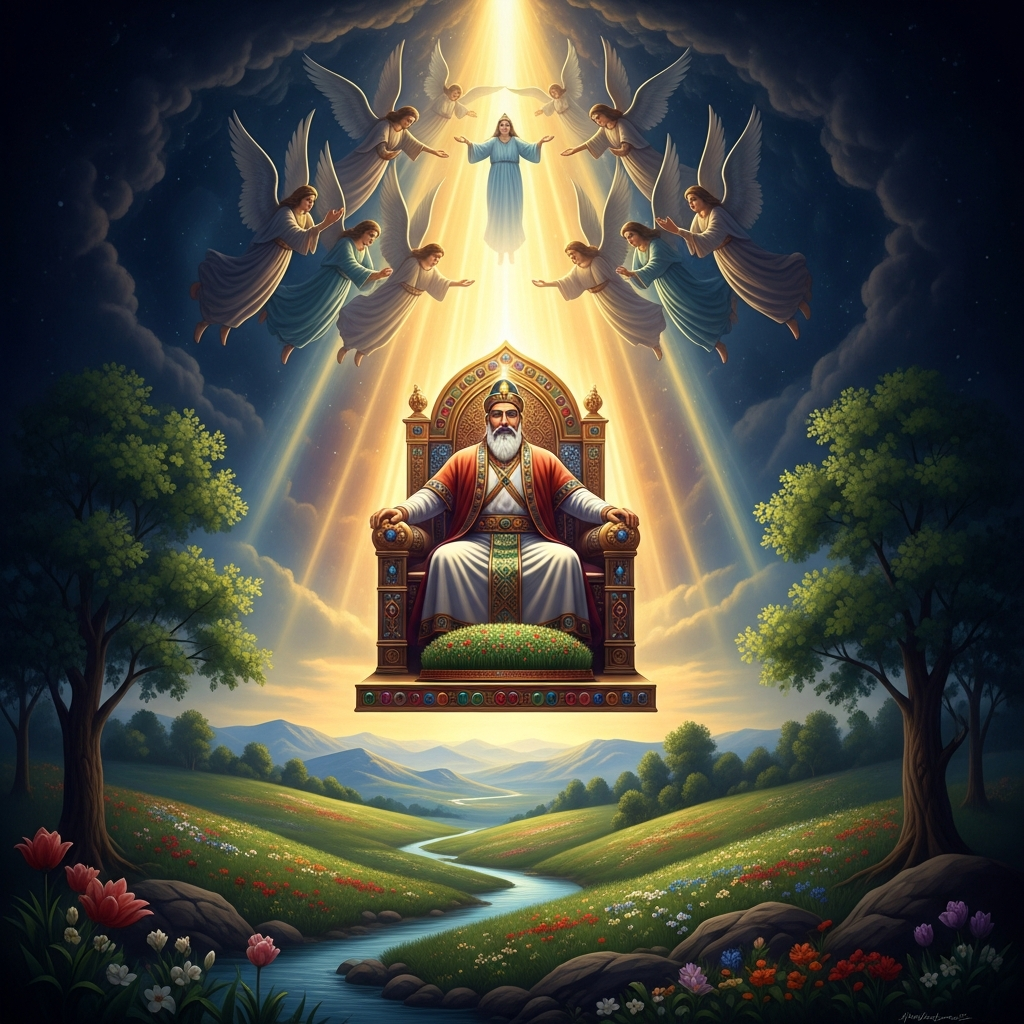
This is the detail that sets Esfandiyār apart from the usual hero who seeks invulnerability: when the pool of immortality is offered to him as a reward — a gift from the divine order for his service to the Zoroastrian faith — he hesitates. A man who cannot be wounded by mortal weapons is a man whose heroism means less, because courage requires the genuine possibility of its opposite. He steps into the pool anyway, because the trials require it, but he closes his eyes.
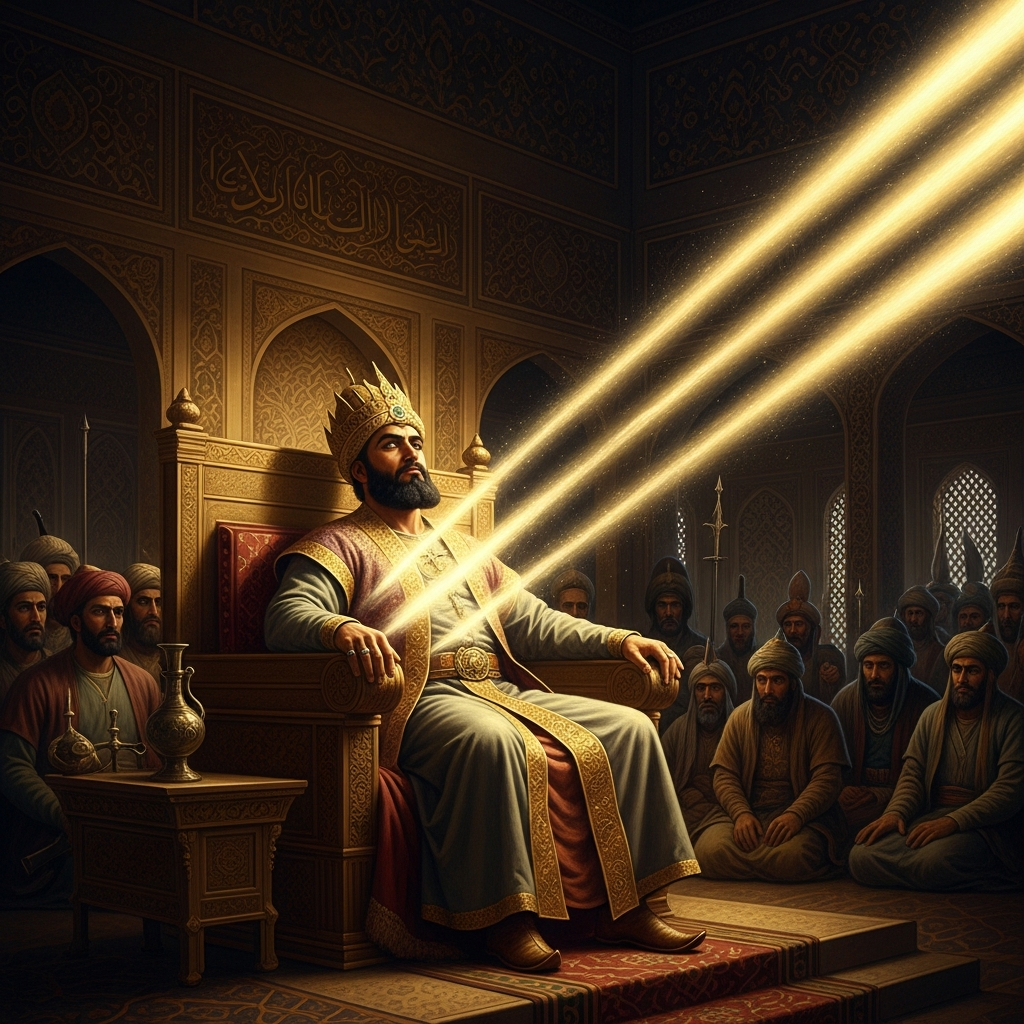
His father Gushtāsp has promised him the throne of Iran in exchange for a task: go to the fortress of Arjasp the Turanian king, who has captured Esfandiyār’s sisters and taken them captive. Rescue the sisters. The fortress is brazen — its walls are made of a metal that cannot be breached by conventional assault. Only a hero who has passed through the seven trials of the road to the fortress will be strong enough to reach it and enter.
Gushtāsp wants the task accomplished. He does not want Esfandiyār to return.
The prince knows this and does the task anyway. This is his defining characteristic — not the invulnerability but the knowledge that he is being used and the choice to serve anyway, because the task itself is righteous even if the one who assigns it is not.
The first trial is a pair of wolves.
They are not ordinary wolves — they are the guardian wolves of the first station, each one the size of a horse, with eyes like fire. Esfandiyār fights them from his chariot and kills them.
The second trial is a pair of lions. He fights them the same way.
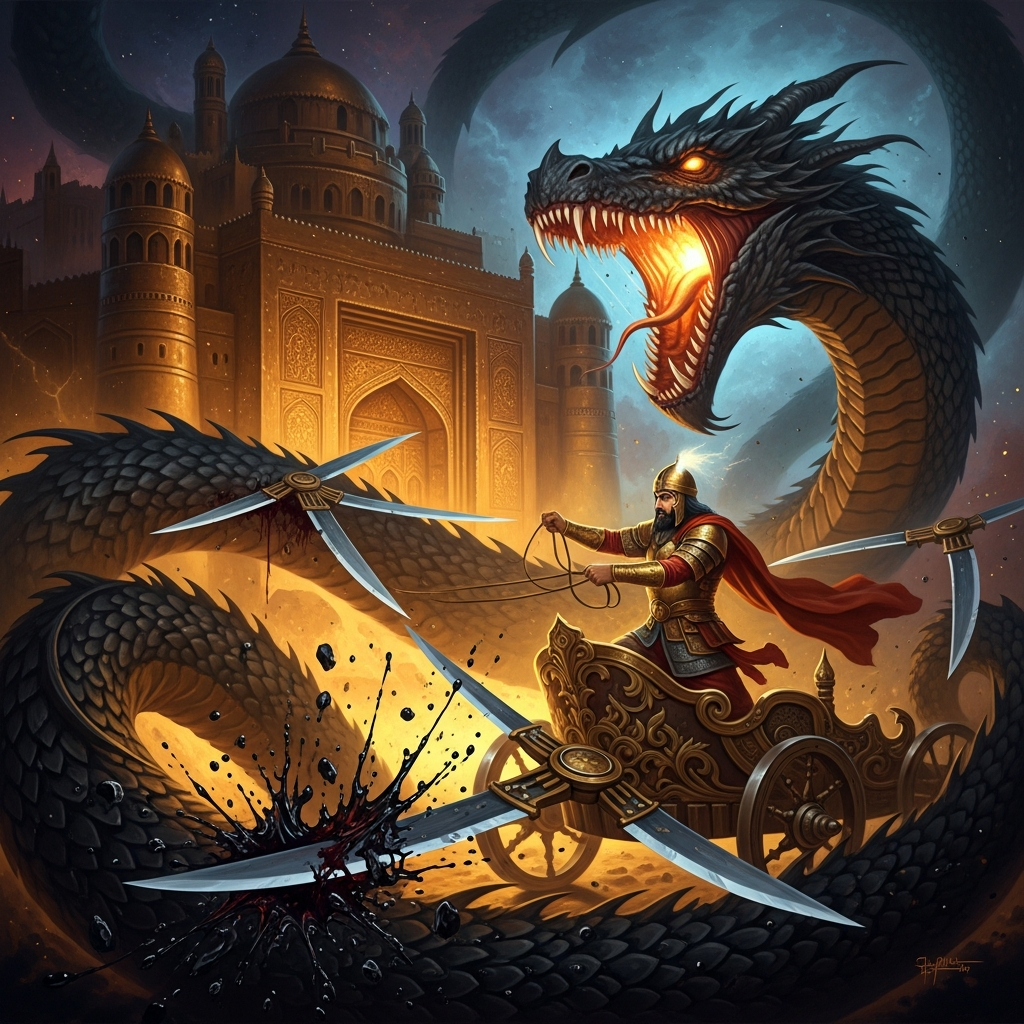
The third trial is a dragon. The dragon is not fought directly — it is too large, too armored. Esfandiyār has his chariot fitted with blades on the axles, like a war machine of rotating metal, and he drives it into the dragon and through the dragon, and the dragon is cut to pieces by the moving blades.
The fourth trial is a sorceress. She presents herself as a beautiful woman offering hospitality in the wilderness, which is always the structure of the fourth trial in Iranian hero-quests: after the monsters, the beautiful deception. He recognizes her and kills her.
The fifth trial is a Simurgh — not the great divine Sīmorgh of Mount Alborz who raised his counterpart Zāl, but a lesser monster-bird, a predator. He fights it and kills it.
The sixth trial is snow and cold that should be impossible to cross. He crosses it.
The seventh trial is the brazen fortress itself.
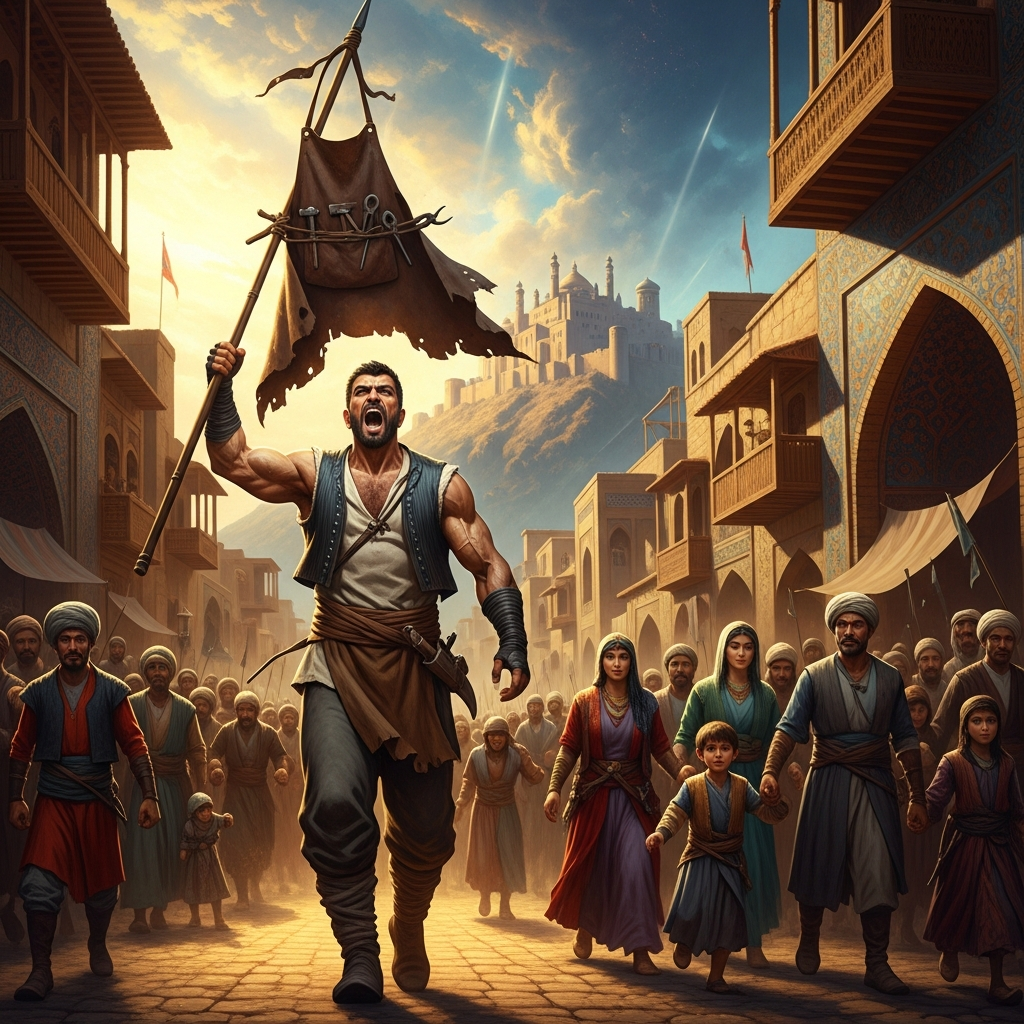
He does not enter it as a warrior. He enters it in disguise — dressed as a merchant, with his men disguised as merchants’ guards, with wagons full of goods that are actually wagons full of concealed weapons and warriors. It is the oldest infiltration strategy, and it works because the fortress is so confident in its walls that it neglects its customs inspection.
He finds his sisters. He fights the fortress from within. He kills Arjasp in single combat and takes his head. He brings his sisters out.
He rides back to Gushtāsp’s court with the head of the Turanian king and the freed captives and the expectation of the throne that was promised.
Gushtāsp finds a new errand.
The throne is not given. It is always just ahead, always conditional on one more impossible task. The cycle the Shahnameh records — the father who cannot give the throne he promised, the son who cannot stop earning it — is recognizable as a psychological pattern as well as a political one. Esfandiyār goes on performing heroic deeds in the service of a faith he genuinely believes in and a father he cannot stop trying to satisfy.
The last errand is Rostam.
The two trials that could not be given sequential numbers — the two invulnerable men on the plain of Zābolestān — do not have a winner, only a shape. The shape is determined by the Sīmorgh, who has waited on her mountain since before Esfandiyār was born, and who comes down when Zāl burns his last feather to show them the arrow that can end what cannot otherwise be ended.
Esfandiyār dies with his eyes open. He closes them on what he knows.
Echoes Across Traditions
Entities
- Esfandiyār
- Gushtāsp
- Zarathustra
- Arjasp
- Humāy
Sources
- Ferdowsi, *Shahnameh*, 'Esfandiyār's Seven Trials,' translated by Dick Davis
- Jerome Clinton, *In the Dragon's Claws: The Story of Rostam and Esfandiyar* (Mage, 1999)
- Khaleghi-Motlagh, 'Esfandīār,' *Encyclopædia Iranica* (1998)
- Prods Oktor Skjærvø, *The Spirit of Zoroastrianism* (Yale, 2011)