The Second World: The Wooden People Who Forgot to Pray
Mythic second era — before the present age; Preclassic Maya cosmological tradition · The second world, now destroyed — traces survive as the monkeys of the forest
Contents
The creators fashion people from wood — they speak, they multiply, they fill the earth — but they have no memory of their makers, no hearts, no minds, and the gods send a great flood and a world of vengeful objects to unmake them.
- When
- Mythic second era — before the present age; Preclassic Maya cosmological tradition
- Where
- The second world, now destroyed — traces survive as the monkeys of the forest
The creators consult the dawn.
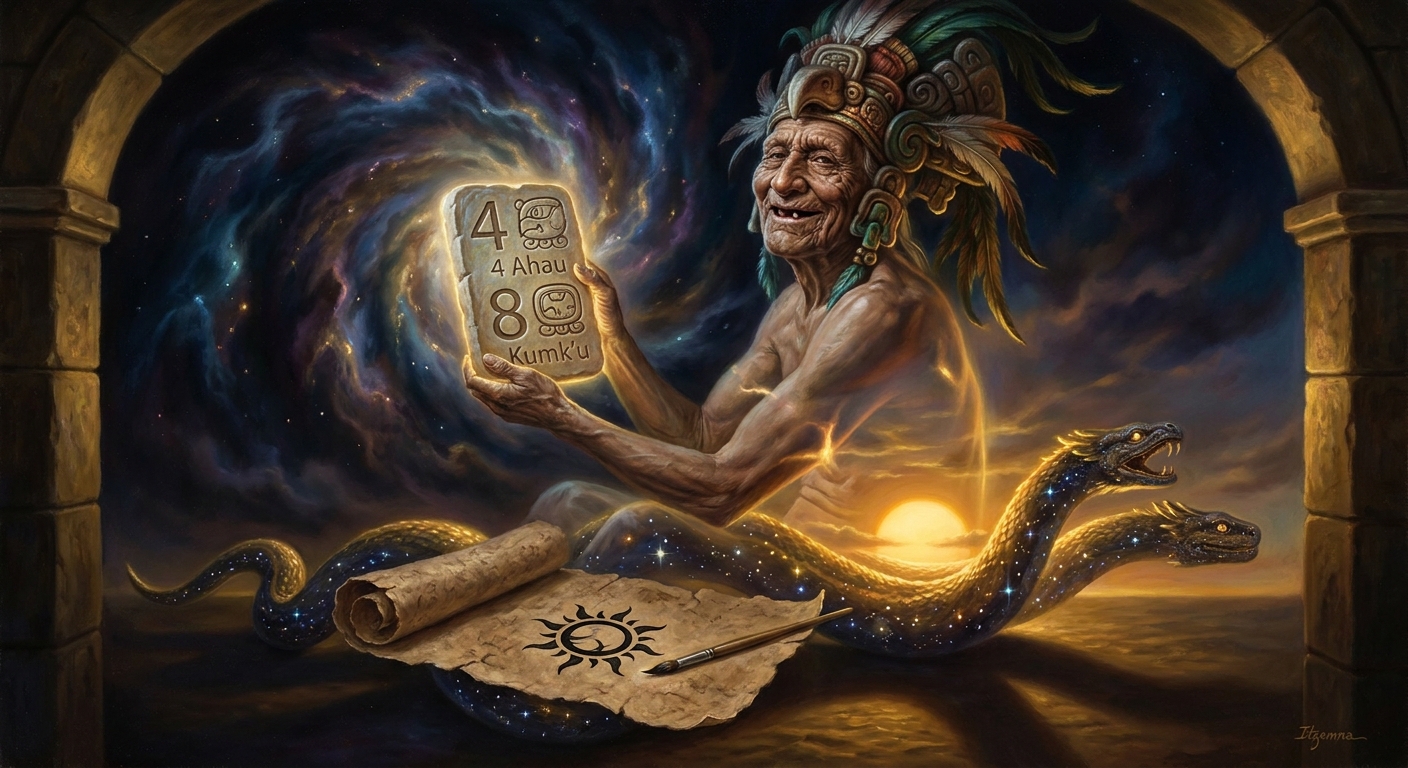
Before they try again they seek counsel from Xpiyacoc and Xmucane, the old grandfather and grandmother, the diviners who know the structure of days. They cast their seeds across the mat and read the fall of the corn kernels and the red tz’ite seeds, and the reading says: try wood. The male figure — carve him from the tz’ite tree, the coral tree whose red seeds are used for counting. The female figure — form her from the reed. Let them speak.
They speak.
The wooden people are made and they walk, they work, they fill the surface of the earth. They have faces and limbs and the shapes of people. They reproduce; more wooden people are born, and those wooden people have wooden children, and the world fills with the sound of wooden voices. They build villages. They grind corn on the grinding stones. They keep dogs in their houses. They eat from their clay pots.
But they have no hearts. The Popol Vuh is exact about this: they had no minds, no hearts, and they did not remember their Makers. They walked without purpose. They worked without gratitude. Their faces were dry. Their hands and feet had no strength because they had nothing behind them, no intention, no memory of the beings who had shaped them. They said words, but the words did not honor anything. They moved through the world using everything in it without acknowledging that the world was given.
The creators look at what they have made and they say: these are not right. They are to be killed, destroyed, their mouths and faces are to be crushed.
Heart of Sky sends the flood.
The black rain begins and does not stop. It rains by day and rains by night. Everything floods. And because this is a world where the objects and animals have been watching how the wooden people treated them, a rebellion breaks out on every side.
The dogs speak first. Why did you feed us nothing? the dogs say. You drove us away. You kept us hungry while you ate. Now we shall eat you.
The grinding stones speak. Every day, every day, you ground us down, the grinding stones say. Holi, holi, huqui, huqui — you wore us out without ceremony. Now we shall grind you.
The clay pots speak, the griddles speak. You burned us, you blackened us, you smoked our faces. We felt the pain and you never noticed. They heat themselves until they glow and press themselves against the wooden people.
The houses collapse onto their inhabitants. The trees of the forest lash back. Even the rocks rise.
And then comes Camalotz, the great bat — the death bat, the bat whose name means Sudden Bloodletter — swooping down out of the dark sky to take the heads. The wooden people run but there is nowhere to run. Some flee to the forest and climb the trees, but the trees shake them off. Some flee into the caves, but the caves collapse. Some flee to the rooftops, but the houses throw them down.
A few escape.
They go up into the trees — into the high branches where the bat cannot reach and the flood has not yet risen — and there they are transformed. Their features lengthen and flatten, their hands become grasping claws, their voices go high. They become the monkeys of the forest: the spider monkeys and the howler monkeys that are still there today, chattering in the canopy.
The Popol Vuh is clear about what this means: when you see the monkeys, you are seeing the remnant of a failed humanity. Their faces look almost like human faces because they are almost human. They have the motions of human curiosity — they watch, they reach, they examine objects with their hands. But they cannot pray. They cannot remember their makers. They are the shape of humanity without its substance, and their chattering in the trees is the sound of words that carry no gratitude.
This is the world that was destroyed.
It is the world that had all the outward forms of civilization — speech, reproduction, labor, shelter — and none of the interior qualities that make civilization worthwhile. The wooden people used everything they found without thanking anything. The pots cooked their food, the stones ground their corn, the dogs kept them company — and none of it was acknowledged, none of it was honored, none of it was held in memory.
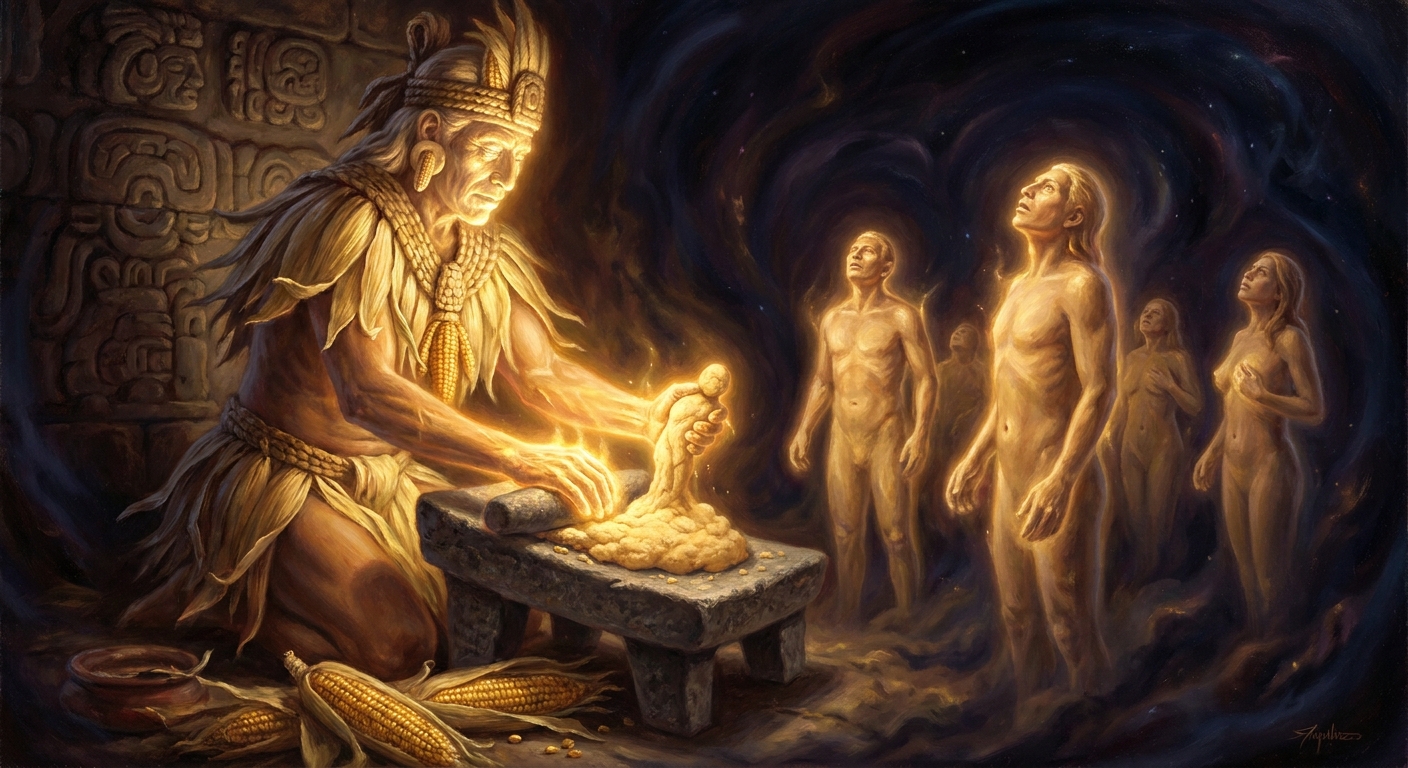
The creators will try one more time. The dough of ground white and yellow corn is waiting, in the darkness before dawn, for the third attempt that will finally succeed — the people who will remember, who will look at the sky and speak the names of those who made it, who will carry inside their chests something warm enough to be called a heart.
Echoes Across Traditions
Entities
- Tepeu
- Gucumatz
- Heart of Sky
- Huracán
- Xecotcovach
- Camalotz
Sources
- Popol Vuh, translated by Dennis Tedlock (Simon & Schuster, 1985)
- Allen J. Christenson, *Popol Vuh: The Sacred Book of the Maya* (University of Oklahoma Press, 2007)
- Oswaldo Chinchilla Mazariegos, *Art and Myth of the Ancient Maya* (Yale University Press, 2017)