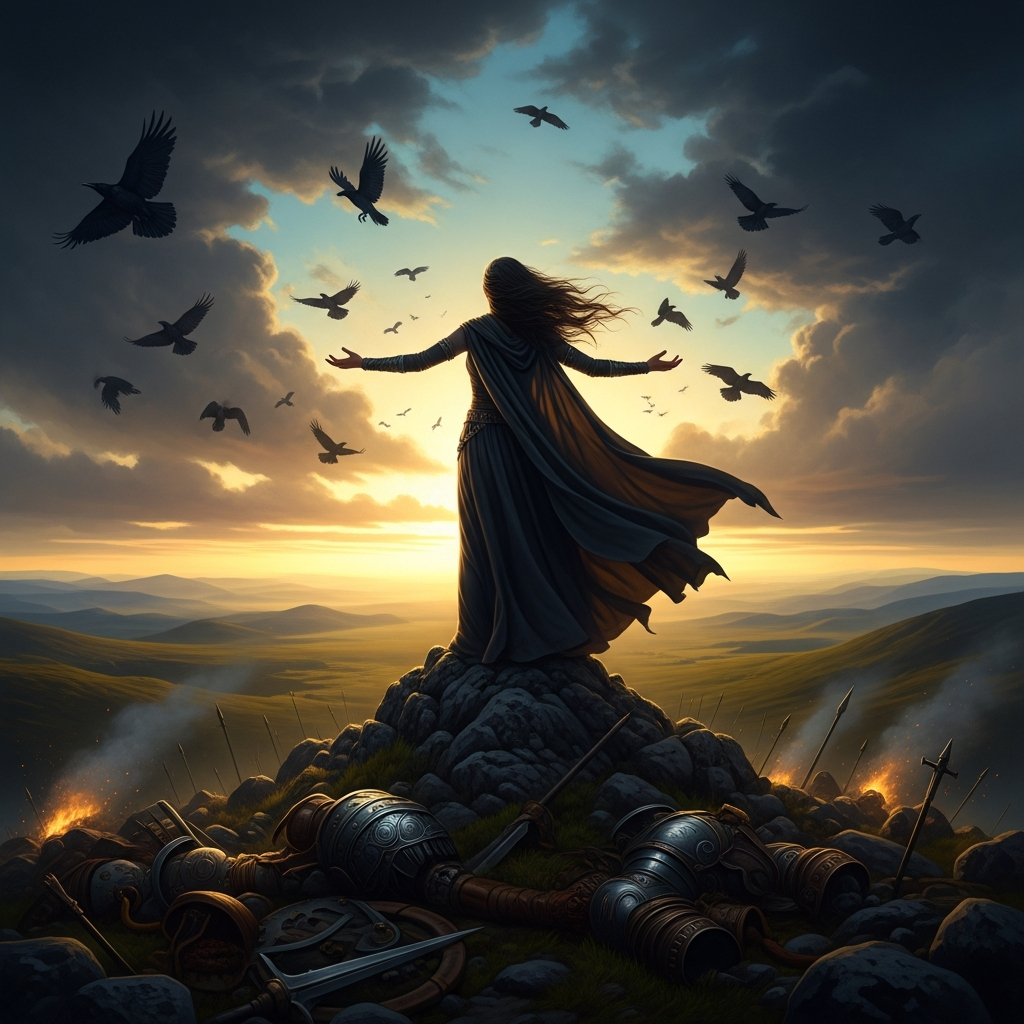
The Morrigan Over the Battlefield
mythic prehistory — after the Second Battle of Mag Tuired · The peaks of the mountains of Ireland, following the battle of Mag Tuired in County Sligo
Contents
After the Second Battle of Mag Tuired, the Morrigan ascends to the sacred peaks of Ireland and proclaims the victory — but the prophecy she chants next describes a world unmade, a future where every fixed thing dissolves.
- When
- mythic prehistory — after the Second Battle of Mag Tuired
- Where
- The peaks of the mountains of Ireland, following the battle of Mag Tuired in County Sligo
When the Fomorians are broken, she rises.
The Second Battle of Mag Tuired is over. The ground of County Sligo holds a generation of the divine dead. Lugh has driven his spear through Balor’s eye and the Fomorian king is finished. The Tuatha Dé Danann stand in the field among their own fallen, and the silence after the battle is the specific silence that follows a tremendous expenditure of violence — not peace, but the absence of noise before the world remembers what it is doing.
The Morrigan goes to the peaks.
She is the threefold goddess: Badb, the screaming crow who flies above battles shrieking the names of the dying; Macha, the sovereignty figure, the goddess of the land itself in its contested state; Nemain, whose shriek causes armies to destroy themselves. She contains these three and she contains more: she is the battlefield itself, the land that receives the blood, the fate that precedes the decision to fight. She is present at every Irish war and she is present now at this one, standing on the high places of Ireland to announce what has happened.
Her victory-proclamation is jubilant. She names the victory to the mountains and the rivers. The Fomorians are expelled. The Tuatha Dé Danann hold Ireland. The sacred order is restored. She announces it in the formal mode of the divine herald, addressing each of the land’s sacred features in sequence, calling their names as witnesses.
Then she turns.
The second prophecy is nothing like the first. It is a catalogue of inversions, a list of reversals: summers without blossoms, cows without milk, women without shame, men without courage, old men giving false judgments, noble men making bad laws, every sacred bond unraveled. She describes a world in which all the structures that make civilization possible have been withdrawn, one by one, like a weaver pulling threads from a finished cloth until only the warp remains, and then the warp too.
The scholars call it the Winter of the World prophecy. The Irish call it simply her second speech. No one is certain what it refers to — whether it is a prediction of the Milesian invasion, the coming of the Fomorians again, or something larger, a vision of the end of all the divine ages.
What is certain is its tone. She announces victory with fullness and turns immediately to disaster, the way a doctor who has saved a life stands in the hall and tells the family what the patient will eventually die of. She cannot be the goddess of battle without being the goddess of the cost of battle. Every victory she witnesses is also a future defeat she can see from the high places.
She returns to the battlefield.
The crows come to the field. They come to all battlefields and they come here: the black birds whose arrival signals the end of fighting and the beginning of the field’s other work. The Badb among them watches with eyes that have seen this field before and will see fields like it for as long as there are men who believe that the hill worth dying on is worth dying on.
The peace that follows the Battle of Mag Tuired lasts, in the mythological chronology, approximately one divine generation. The Morrigan’s second prophecy is patient. It does not need to be wrong. It only needs to be early.
Echoes Across Traditions
Entities
- The Morrigan
- Badb
- Macha
- Nemain
- The Dagda
- The Tuatha Dé Danann


Sources
- Elizabeth Gray, trans., *Cath Maige Tuired: The Second Battle of Mag Tuired* (Irish Texts Society, 1982)
- Rosalind Clark, *The Great Queens: Irish Goddesses from the Morrígan to Cathleen Ní Houlihan* (Colin Smythe, 1991)
- Máire Herbert, 'Transmutations of an Irish Goddess,' in *The Concept of the Goddess*, ed. Sandra Billington and Miranda Green (Routledge, 1996)