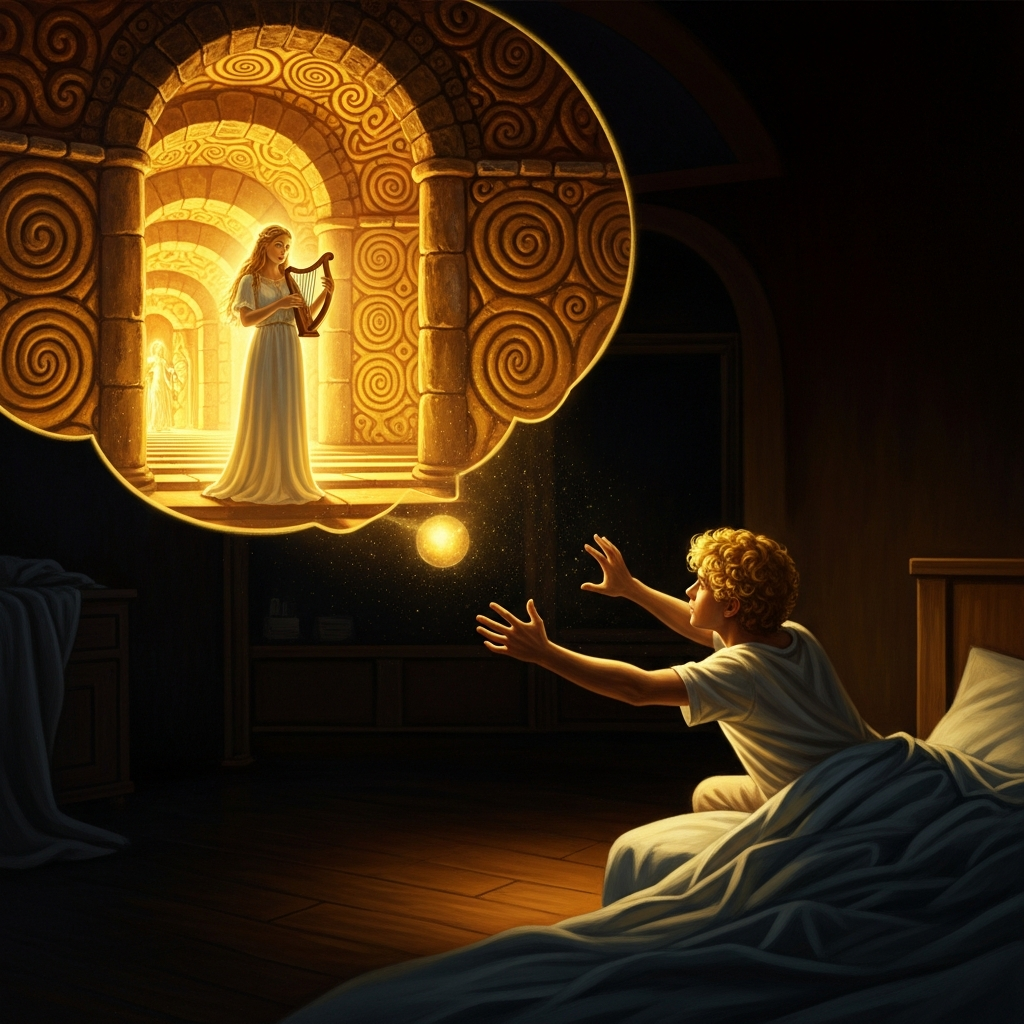
The Dream of Óengus
mythic age of the Tuatha Dé Danann, perhaps 2000 BCE in mythic reckoning · Brú na Bóinne (Newgrange), the Boyne Valley, then the lakes of Connacht, Ireland
Contents
The god of love falls sick from longing for a woman he has seen only in a dream — and his parents search all of Ireland for a full year to find her, because the love-god cannot live without the one his own dreams made for him.
- When
- mythic age of the Tuatha Dé Danann, perhaps 2000 BCE in mythic reckoning
- Where
- Brú na Bóinne (Newgrange), the Boyne Valley, then the lakes of Connacht, Ireland
He wakes reaching for someone who is not there.
Óengus Óg, the god of love who lives in the golden hall of Brú na Bóinne, has been dreaming the same dream. A woman approaches his bedside — the most beautiful woman he has ever seen, golden-haired, carrying a small harp — and he reaches for her and she is not there. He reaches each morning into the cold air and she is gone.
He stops eating. He cannot sleep without dreaming of her and cannot stay awake without longing for her. The love-god is wasting with love, which is what love does when it cannot find its object: it turns inward and eats the one who holds it.
His mother Boann, goddess of the River Boyne, goes through every province of Ireland looking for the woman. She searches for a full year. She finds no woman who matches the description Óengus gives — and his description is very specific, because men who are dying for love remember faces with a precision that healthy men never achieve.
His father the Dagda asks the King of Connacht for help. The king makes his own search through Connacht’s territories and at the end of a year sends a message: he has found her. She is Caer Ibormeith, daughter of a nobleman in Connacht, and she is under an enchantment. Every other Samhain she becomes a swan. This is who she is.
The Dagda brings word to Óengus. He recovers enough to travel.
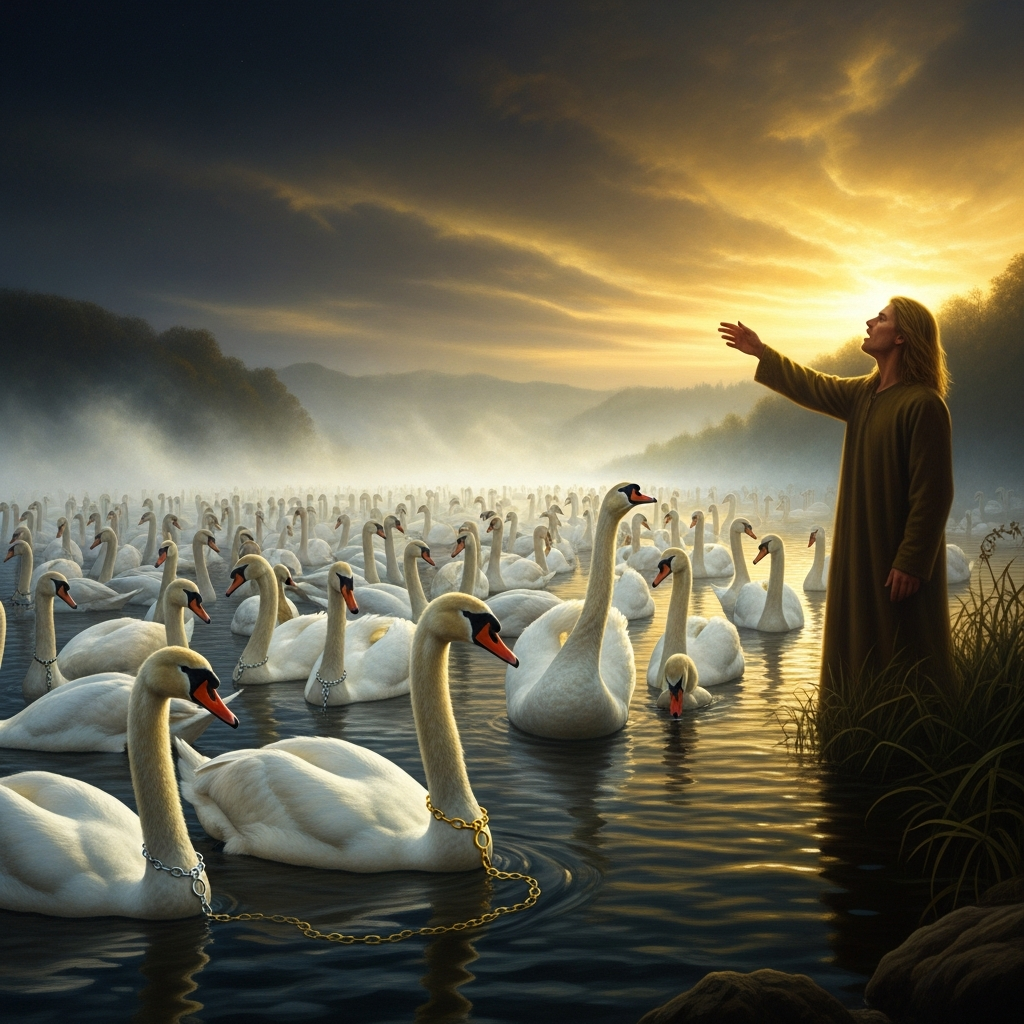
He goes to the lake at the Samhain when she is in swan-form: a hundred and fifty swans on the water, each wearing a silver chain, with one chain of gold. Óengus stands at the shore and must choose her from a hundred and fifty identical white birds. He has never seen her face in waking life. He has only the dream.
He calls her name.
One swan turns at the sound of her name and comes to the shore.
Óengus, standing at the lake’s edge, transforms himself. He becomes a swan. The two swans fly three times around the lake. They leave together, flying north to Brú na Bóinne, and their singing as they go is the sweetest music anyone in Ireland has heard — the kind of music that causes people to sleep for three days of peaceful dreaming when they hear it.
She becomes human again in time. The enchantment that made her a swan every other year is lifted by the act of love that chose her without seeing her face — by the recognition that happened in the dark of a dream and held all the way to a lake in Connacht a year later, and held even there, when the face was hidden and he had only the name and the water and the gold chain and the need to choose rightly without certainty.
Love requires this occasionally: the choosing without certainty. The voice across the water, the name said into the ordinary air, and the turning of the one who has been waiting to be called by the right voice.
She turns. He is already changed. They go home together across the autumn sky, and Ireland sleeps peacefully beneath their passage.
Echoes Across Traditions
Entities


Sources
- Jeffrey Gantz, trans., 'Aislinge Óenguso,' in *Early Irish Myths and Sagas* (Penguin, 1981)
- Proinsias Mac Cana, *Celtic Mythology* (Hamlyn, 1970)
- Alwyn Rees and Brinley Rees, *Celtic Heritage: Ancient Tradition in Ireland and Wales* (Thames and Hudson, 1961)