Contents
Semiramis, the Assyrian queen, hears of Ara the Beautiful — the most handsome man in the world — and sends ambassadors offering him her hand and her empire. Ara refuses: he loves his homeland and his wife. Semiramis sends her army; Ara is killed in battle. Semiramis has his body brought to her and commands her gods (the Aralezner) to lick his wounds and restore him to life. They do not succeed in time. She dresses another man as Ara and claims the gods answered.
- When
- Movses Khorenatsi, *History of Armenia*, c. 5th–8th century CE
- Where
- The Armenian highlands; the Assyrian court
No one disputes the description. Ara Geghetsik — Ara the Beautiful — is the most handsome man in the world, and the world knows it.
He is the king of Armenia: a young ruler of the highland people, known for his just governance and his love for his wife Nvard. He has everything a man might want. He does not want more. This is the detail that makes the story possible: his contentment, which in most myths is a virtue and in this one becomes the obstacle that destroys him.
Semiramis is the queen of Assyria. Her name is known across the ancient world — she has built cities and canals and armies; she has governed an empire that most men could not hold together in a generation; she has done things that no woman of her era was supposed to do and has been recorded by every tradition that encountered her. She is not lacking in experience, in will, or in the means to get what she wants.
She hears about Ara and she wants him.
The ambassadors she sends are not crude emissaries carrying a demand. They carry an offer: her hand in marriage. Her empire, to be shared with Ara. The wealth of Nineveh and Babylon and all the territories Assyria holds. Every material thing that a king might want for himself and his people. She is offering the arrangement that powerful monarchs have always offered to smaller neighboring rulers: alliance through marriage, which means absorption through beauty, which means the end of independence in the most gracious possible form.
Ara receives the ambassadors in his court. He hears the offer. He looks at his wife Nvard and he looks at the mountains outside his window and he says no.
He sends them back with his refusal and an explanation that is gentle but absolute. He is not in a position to leave Armenia. He is not in a position to leave his marriage. He is grateful for the honor of the offer.
The ambassadors return to Semiramis.
She sends them back. The offer is larger this time. The terms are more generous. She has restated the entire package at a higher price point, the way empires always negotiate when the first offer isn’t accepted.
Ara says no again.
She sends a third time. He says no a third time.
Three refusals, in the diplomatic conventions of the ancient world, are a kind of declaration. Semiramis had given Ara every opportunity to accept a deal that would have enriched him and his people and required only that he leave behind the things he loved. He had declined. She was now in the position that powerful people who desire something they cannot buy always eventually reach: she could stop wanting, or she could take.
Semiramis was not a person who stopped wanting.
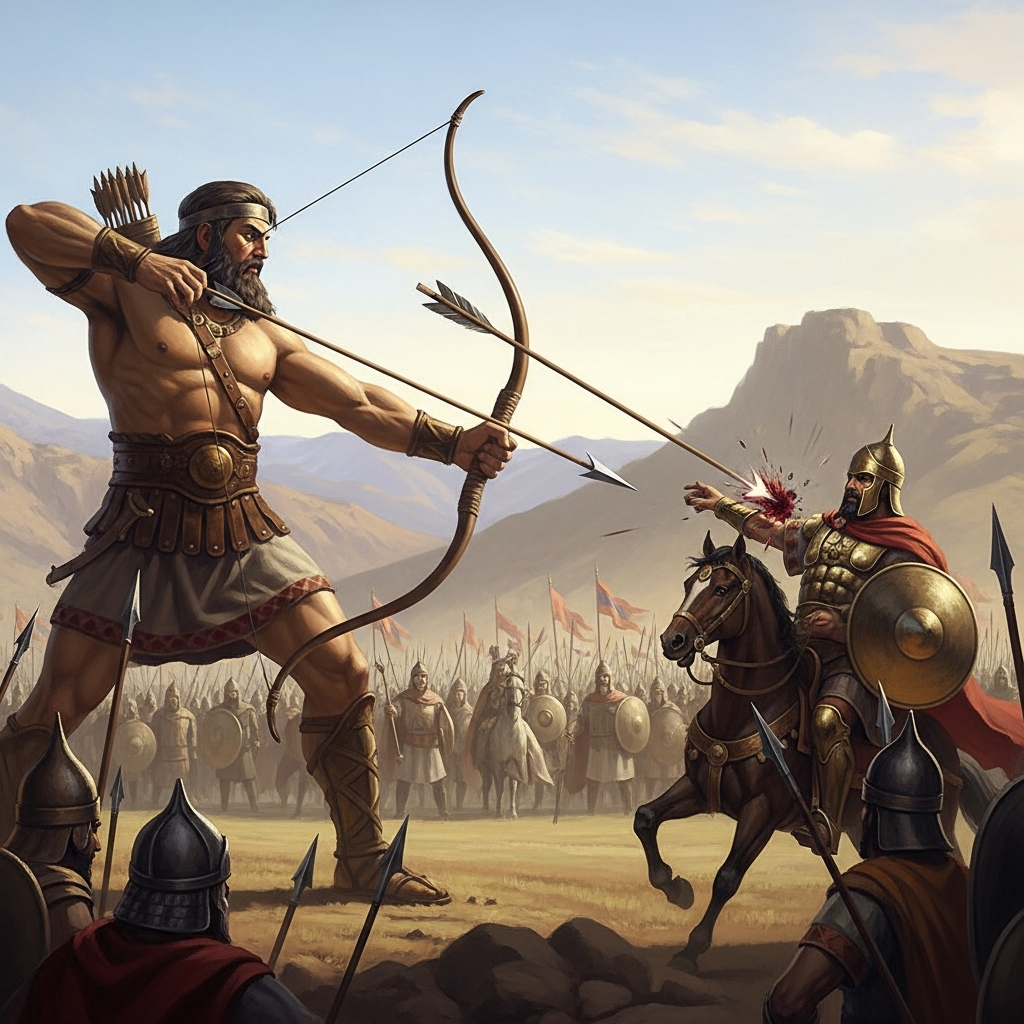
She mobilized her army.
The Armenian tradition is specific that she instructed her generals to capture Ara alive. She wanted him breathing; she wanted him standing in her court in the particular way that the person you have been imagining from a distance eventually stands before you in reality. She issued the order against killing him. She meant it.
The battle on the Armenian plain was not a contest. Assyria was an empire; Armenia was a highland kingdom. The mathematics were obvious. What was not obvious was that the specific chaos of a field battle does not always honor specific orders about specific people.
Ara was killed in the fighting.
Whether by accident or misidentification or the ordinary confusion of men in armor killing other men in armor — the sources do not agree. What they agree on is the outcome: when the battle was over and Semiramis’s forces controlled the field, Ara was among the dead.
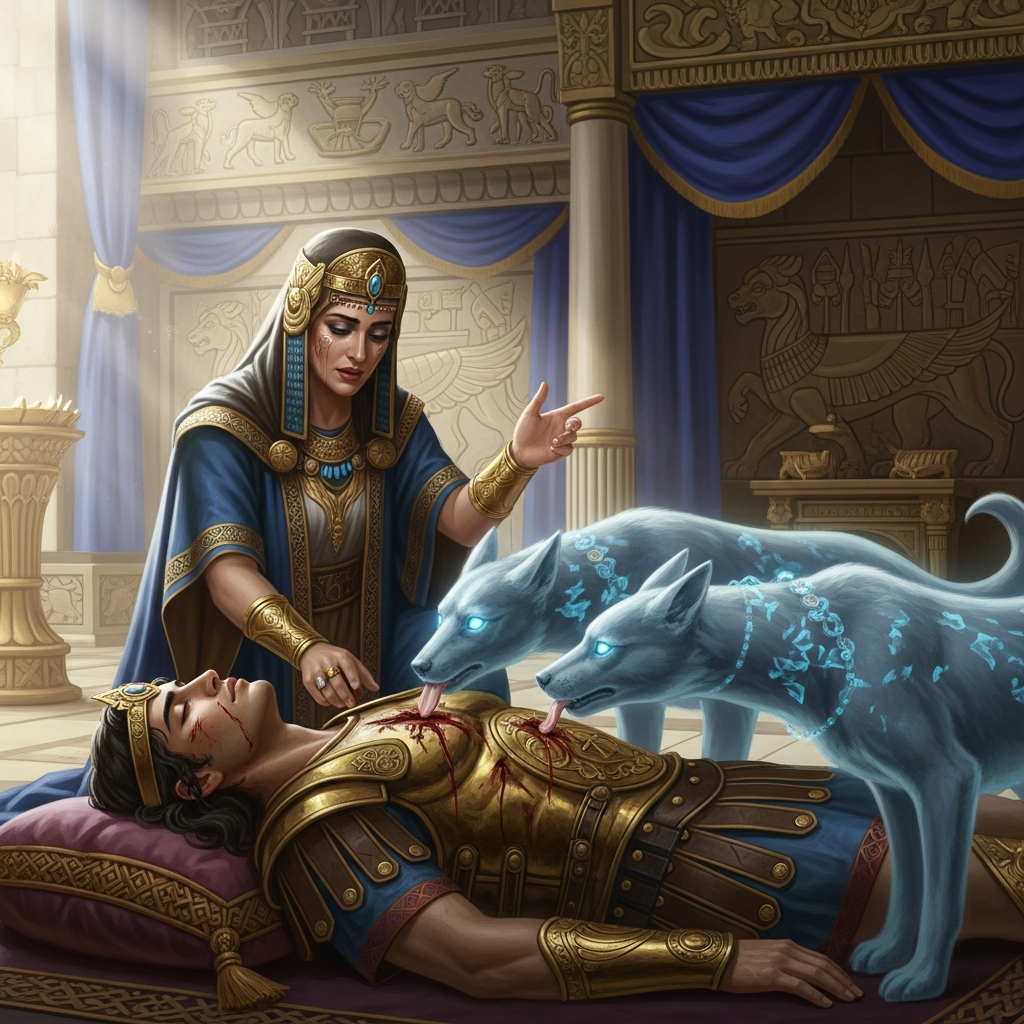
She ordered the body brought to her.
The Aralezner — the spirit-beings of the Armenian supernatural world, who take the form of dogs — have a particular power: they lick wounds and restore the dead to life. This belief is attested in pre-Christian Armenian sources and connected to similar traditions across the Iranian and Caucasian world. Dogs in many ancient traditions have this liminal quality, existing on the border between the living and the dead, capable of passage that humans cannot make.
Semiramis called on the Aralezner. She placed Ara’s body in a location where the spirit-dogs could find it and work. She waited.
The Aralezner came. They performed what they could perform.
The body did not rise. Whether they were too late, or whether Ara’s wound was beyond what the Aralezner’s power could address, or whether something in the situation itself had foreclosed the possibility — the myth does not give a reason. The gods she invoked were real gods in her tradition; they had the power she credited to them. But Ara remained dead.
Semiramis had a problem.
She had started a war to capture a man alive, and the man was dead, and the war had produced only a corpse where she had wanted a living person. She was queen of the world’s most powerful empire and she was standing next to a body she could not restore.
What she did next is the most psychologically penetrating detail in the myth.
She found a man who resembled Ara — a soldier, a hostage, someone of the right build and coloring — and dressed him in Ara’s clothes and placed him in Ara’s rooms and announced that the Aralezner had succeeded. That the gods had heard her prayer. That Ara had been restored.
She maintained this claim for as long as she could maintain it.
The tradition does not say she believed it. It says she claimed it. The distinction is important. She knew the man in Ara’s rooms was not Ara; she had dressed him there herself. What she was managing was not her own grief but the political consequences of having destroyed what she sought. The war required a justification that the death of Ara removed. The fake resurrection provided it: she had wanted him alive, she had asked the gods for his life, the gods had answered, everyone could stand down.
The story does not give Semiramis a redemption.
She built a city on the shores of Lake Van that the Armenian tradition calls Shamiramakert — Semiramis’s city. The ruins near Van, which Khorenatsi describes as extraordinary, were attributed to her for centuries. She built in Armenia the way powerful rulers build in places they have conquered: elaborately, as if construction could substitute for possession, as if the stone could hold what the living person refused to give.
She returned to her empire.
Nvard, Ara’s wife, remains in the story as the figure who is not asked and not consulted — the person whose existence makes everything Semiramis wanted impossible from the beginning. The myth does not follow Nvard after the battle. She is present in Ara’s refusal; she is present in his death; then the story moves past her without ceremony.
The Aralezner are still believed in, in some Armenian folk traditions, as the spirits who wait near bodies and try. They are the mercy that arrives after the violence and sometimes fails to be enough. They are the good intention that comes too late — which is, in the Armenian reading, not a failure of will but a failure of timing.
Every spring in the Armenian world, the story of Ara is present in the liturgical calendar, because the myth’s structure — desire, refusal, destruction, the failed resurrection — maps onto the agricultural cycle of death and renewal. The fields died. The spirit-dogs tried. The spring came anyway, but without the particular thing that was lost.
Ara the Beautiful does not return. The man in his rooms is someone else.
Echoes Across Traditions
Entities
- Ara the Beautiful (Ara Geghetsik)
- Semiramis (Shamiram)
- the Aralezner (spirit-dogs)
- Nvard (Ara's wife)
Sources
- Movses Khorenatsi, *History of Armenia* (*Patmut'iwn Hayots'*), Book 1, trans. Robert W. Thomson (Harvard University Press, 1978)
- Mardiros Ananikian, 'Armenian Mythology' in *Mythology of All Races*, vol. 7 (1925)
- Vahan Kurkjian, *A History of Armenia* (Armenian General Benevolent Union, 1958)
- Hratch Tamrazyan, studies on Armenian pre-Christian religion (Yerevan, 1990)
- Mary Boyce, *A History of Zoroastrianism*, vol. 1 (Brill, 1975) — on spirit-dogs in Iranian and related traditions