Vahagn Is Born from Fire
Ancient Armenian oral tradition; recorded in Movses Khorenatsi's *History*, c. 5th century CE · The primordial sea; the Armenian highlands; the sky
Contents
The birth song of Vahagn, the Armenian thunder god and dragon-slayer, is one of the oldest Armenian texts: he is born from the sea in a burst of fire and smoke, his hair is flame, his eyes are suns, and he rushes immediately to kill dragons. The ancient hymn preserved by the medieval historian Movses Khorenatsi is a window into the pre-Christian Armenian world.
- When
- Ancient Armenian oral tradition; recorded in Movses Khorenatsi's *History*, c. 5th century CE
- Where
- The primordial sea; the Armenian highlands; the sky
This is what the singers sang at the royal feasts of the ancient Armenian kings.
Movses Khorenatsi, who recorded it in his History of Armenia sometime in the fifth or eighth century (scholars disagree), called it a “fabulous song” — meaning a song about fabulous, mythological things, not fabulous in the modern sense of praise. He quoted it as an example of what was sung before his own time, when Armenia had not yet received the word of Christ, when the gods of the mountains and the sea were still understood to be awake and capable of being invoked.
The song is not complete in Khorenatsi’s version. What survives is a fragment — six or seven lines in the original Armenian, one of the oldest surviving examples of Armenian literature — that begins with the world before the birth and ends with the birth itself.
What the singers sang:
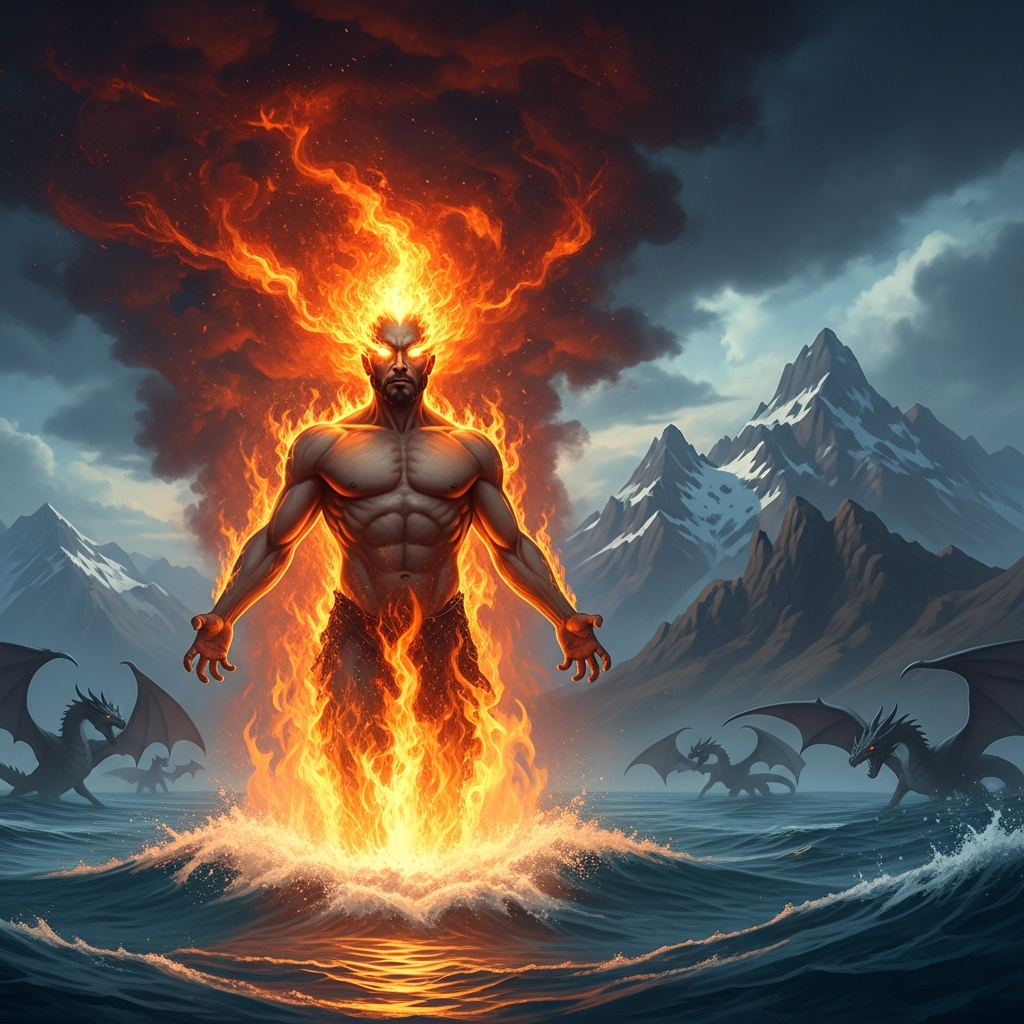
In travail were heaven and earth, in travail too the crimson sea; the travail held also in the sea the small red reed. Through the reed’s stem there came forth smoke, through the reed’s stem there came forth flame, and out of that flame a youth ran forth. Fiery were his locks, and he had a flaming beard; and his eyes, they were as suns.
The youth who runs from the sea-flame is Vahagn. His full cultic title is Vahagn Vishapakagh: Vahagn the Dragon-Reaper. The vishaps are the great serpentine monsters of the Armenian highlands — volcanic stones carved in serpentine form have been found across the Armenian plateau, near mountain lakes and springs, evidently set up as cult objects marking the homes of these creatures. The vishaps inhabit water: high mountain lakes, underground springs, the places where water comes from and returns to. They are not evil in the simple sense; they are the raw power of the natural world before it has been civilized.
Vahagn exists to kill them.
He does not grow into this purpose. He does not train for it. He does not receive a divine commission or a weapon or a mentor. He erupts from the sea in fire and he already is what he is: the Dragon-Reaper, the principle of organized force that meets and cancels the principle of unorganized chaos. The hair that flames and the eyes that are suns are not decorative; they are functional. He is made of the same fire he wields. He cannot be harmed by it. He cannot be extinguished by the water that produced him.
The birth is a cosmogony.
In the logic of the hymn, the world before Vahagn is a world in labor: heaven and earth, the sea, the small red reed that grows at the water’s edge — all of them are in travail, are pregnant with the thing that is about to happen. The smoke and the flame and the rush of the youth from the reed is not merely a birth; it is the world becoming something it was not before. Before this moment, the vishaps have the sky and the deep water and the high mountain lakes, and nothing opposes them with sufficient force. After this moment, they have an enemy who is their equal and will eventually be their end.
The red reed is the specific detail that draws scholars of comparative mythology. Calvert Watkins, in his landmark study How to Kill a Dragon, analyzed the Vahagn birth hymn alongside cognate Indo-European texts — the Old Irish dragon-slaying formulas, the Vedic hymns to Indra, the Hittite Illuyanka myth — and found that the reed-birth is archaic, older than the Armenian literary tradition that recorded it. The image of the divine hero born from a hollow natural object at the water’s edge is not Armenian invention. It is the common inheritance of an ancient linguistic and religious community that became, over millennia, Greeks and Armenians and Iranians and Indians.
The birth-song was already old when the Armenian kings feasted to it.
Vahagn’s dragon-slaying is not described in any surviving text at the length that the Vedic or Greek equivalents give to their equivalent battles. We have the birth; we have the title; we have the vishap stones standing in their lake-beds. The specific campaigns against specific vishaps — which presumably existed in the full oral tradition, which presumably filled an entire evening’s worth of royal feasting music — did not survive the Christianization of Armenia.
What survived is enough to reconstruct the shape: the thunder-god descends on the vishaps wherever they corrupt the waters or devour the people or steal the sun. He kills them. The world is renewed. The agricultural cycle continues. The springs run clean. This is the function of the thunder-deity in every Indo-European tradition that has one: to maintain the world by periodic violence against the principle that would uncreate it.
The Armenian church eventually identified Vahagn with Hercules. This was a consistent strategy of early Christian theology across the Caucasus and Anatolia: the divine heroes of the old religion were either demonized (assigned to the category of false gods whose worship was to be abandoned) or assimilated (reinterpreted as precursors or distant shadows of Christian truth). Vahagn as Hercules allowed the old stories to be told in a new vocabulary, the dragon-slaying now intelligible as a figure for the soul’s battle against sin.
The vishap stones remained. Farmers in the Armenian highlands, centuries after Christianity, still performed ritual acts at the lakeside stones — small offerings, specific gestures that the church periodically condemned and periodically gave up condemning. The bodies of the old religion persist in landscape and in practice long after the theology has been officially replaced.
In summer thunderstorms over Mount Aragats and the Ararat plain, the lightning still strikes the high ridges in the way that lightning has always struck in the highlands. Whether anything is slain in the process, the tradition no longer claims to know for certain.
But the smoke that precedes the flame, rising from the reed-bed at the edge of the mountain lake, is the birth-signal. When you see it, Vahagn is coming.
His eyes are suns. He is already running.
Echoes Across Traditions
Entities
- Vahagn (Vishapakagh, Dragon-Reaper)
- the vishaps (dragons)
- heaven and earth
- the sea
Sources
- Movses Khorenatsi, *History of Armenia*, Book 1, Chapter 31, trans. Robert W. Thomson (Harvard University Press, 1978)
- Mardiros Ananikian, 'Armenian Mythology' in *Mythology of All Races*, vol. 7 (1925)
- Calvert Watkins, *How to Kill a Dragon: Aspects of Indo-European Poetics* (Oxford University Press, 1995) — analysis of the Vahagn birth hymn in comparative context
- Hratch Tamrazyan, *The Armenian Pre-Christian Pantheon* (Yerevan, 1990)
- James Russell, *Zoroastrianism in Armenia* (Harvard Iranian Series, 1987)