How Fire Was Taken from the Crow
Dreaming time — before fire was available to all people · Southeastern Australia — Kulin Nation country, the fire-origin stories of the Wotjobaluk, Woiwurrung and neighboring peoples
Contents
In the Dreamtime, fire belongs to the Crow people alone, and they guard it jealously — until the Hawk, the Hawk's friends, and a plan involving the dried grass of the dry season finally steal it and give it to all the people.
- When
- Dreaming time — before fire was available to all people
- Where
- Southeastern Australia — Kulin Nation country, the fire-origin stories of the Wotjobaluk, Woiwurrung and neighboring peoples
Crow has fire and Crow will not share it.
In the Dreaming time, fire is Crow’s possession. He keeps it in his camp, where the warm coals are always burning, and he eats his food cooked while everyone else eats theirs raw. He is not cruel about it — he does not taunt the other beings with his warmth, does not offer it and withdraw. He simply does not share. The fire is his. It has always been his. He sees no reason to change this.
The other birds and people eat raw lizard and raw yam in the cold season and watch Crow’s fire from a distance.
Hawk is watching Crow’s fire from the distance one afternoon and thinking.
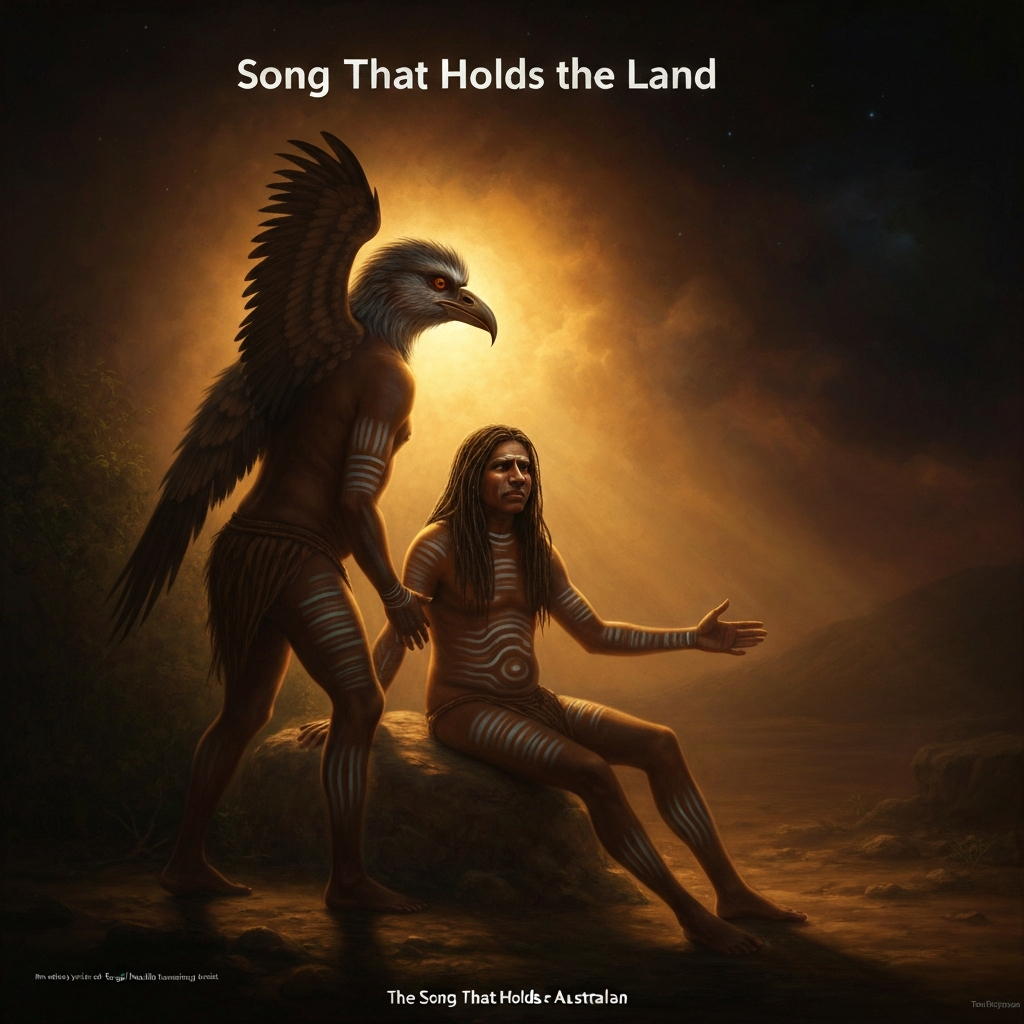
Hawk’s intelligence is not the trickster intelligence of certain other bird-beings — Hawk does not deceive or misdirect in the elaborate way that the great tricksters do. But Hawk is patient and observant, and what Hawk has noticed is that Crow’s fire has a property that Crow has not fully thought through: it spreads when it reaches dry grass.
The dry season in southeastern Australia is a time of extraordinary fire risk. The grass dries to the specific golden color that means it will carry a spark. The eucalyptus trees accumulate oils that make them explosive when they finally ignite. The whole landscape becomes a system waiting for the trigger.
Crow’s fire is the trigger. If Crow can be made to carry his fire into the dry grass —
The plan involves the whole community.
Hawk does not work alone. The plan requires multiple beings placed at intervals across the landscape, in the right configuration of wind and dry grass. The idea is simple: provoke Crow into chasing something, chase him through the dry grass with fire, and let the fire’s natural behavior do the rest.
The provocation is a snake.
Crow hates snakes. Hawk knows this. He arranges for a large goanna to put a snake in Crow’s path at the right moment, and when Crow sees the snake he does what Crow does — he goes for it, with fire. He picks up a burning branch to chase the snake with, because fire is his tool and the snake deserves the fire.
He chases the snake into the dry grass.
The dry grass catches.
The fire in the dry grass does what fire in dry grass does in the hot wind of the dry season: it explodes. Not slowly and controllably, the way Crow’s careful camp fire burns, but fast and spreading and impossible to hold. The fire jumps from grass to grass, carried by the wind that Hawk has carefully chosen this day for its direction and strength.
The fire spreads to the eucalyptus trees.
The eucalyptus trees, which have been building oil in their leaves through the whole dry season, ignite with an intensity that Crow has never seen. The fire is no longer his.
The fire is everywhere.
The other beings — the birds, the marsupials, the people, all the creatures who have been cold-eating and watching Crow’s warmth from the other side of the firebreak he maintained — now have access to fire. They gather it. They carry coals in the specific ways that each community will develop — in bark containers, in clay pots, in the specially selected firesticks. They make their own fires.
Crow, whose feathers are singed black in the explosion that he did not plan for, is now black. He will be black from this day forward, which is why crows are black. He did not die. He simply lost his monopoly.
Fire belongs to everyone now.
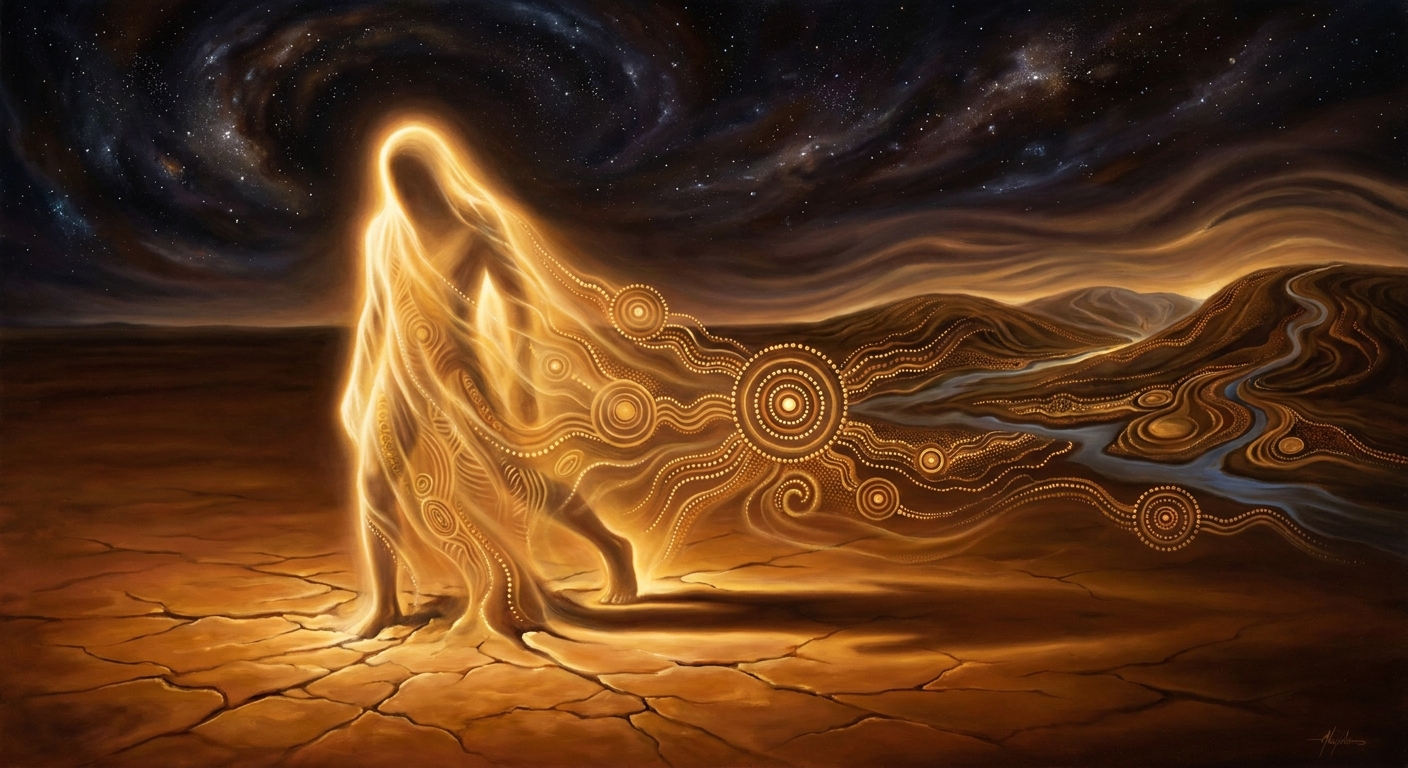
The ecological wisdom in this story is not accidental: the southeastern Australian landscape is fire-adapted, requiring periodic burning to maintain the grassland-forest mosaic that supports the animals and plants the people depend on. The “theft” of fire from Crow is also the arrival of controlled burning — the practice that the Aboriginal Australians developed over fifty thousand years that is now recognized by ecologists as among the most sophisticated land management systems in human history.
Fire is a tool.
Hawk understood this before Crow did.
Echoes Across Traditions
Entities
- Crow (Waa) the fire guardian
- Hawk and the other birds
- the first human beings without fire
- the dried grass and the wind
- fire as a gift to all living things
Sources
- Massola, Aldo, *Bunjil's Cave: Myths, Legends and Superstitions of the Aborigines of South-East Australia* (Lansdowne, 1968)
- Berndt, Ronald M. and Berndt, Catherine H., *The Speaking Land* (Penguin, 1989)
- Parker, K. Langloh, *Australian Legendary Tales* (Nutt, 1896) — early collection of southeastern fire myths