The Alcheringa: The Dream Time That Is Still Now
the Alcheringa — always-was, always-is, always-will-be · Central Australia — the Aranda homeland in the red sand country of the MacDonnell Ranges and the spinifex desert
Contents
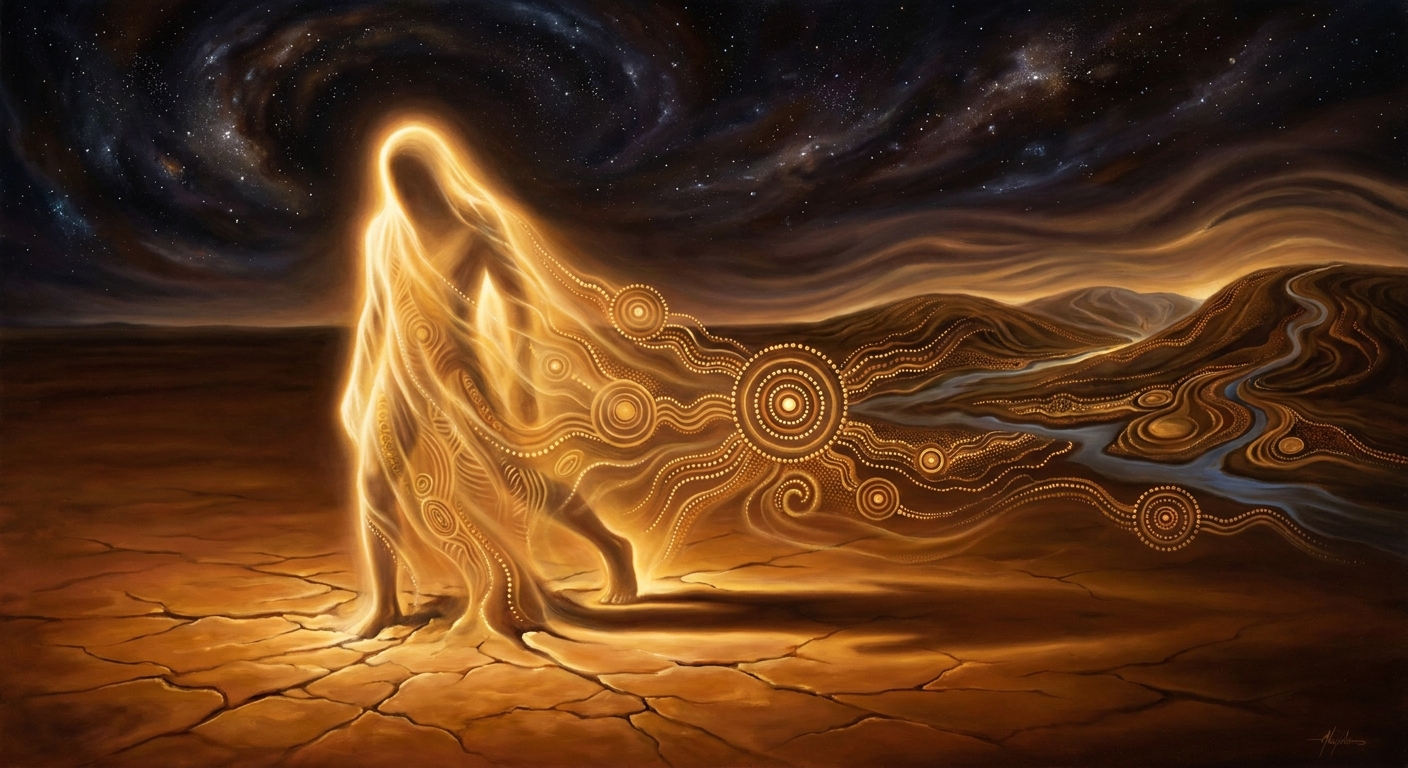
The Aranda people of the Central Australian desert describe the Alcheringa — often translated as 'Dream Time' — as a time that is not past but permanently present, the eternal dimension underlying the physical world, accessible through ceremony and sacred sites.
- When
- the Alcheringa — always-was, always-is, always-will-be
- Where
- Central Australia — the Aranda homeland in the red sand country of the MacDonnell Ranges and the spinifex desert
There is no word in English for what the Alcheringa is.
The anthropologist W.E.H. Stanner, who spent thirty years trying to explain the Aranda concept to Western readers, eventually concluded that the problem was not translation but ontology: English assumes that time moves in one direction, that the past is past and the present is now and the two cannot be simultaneously true. The Alcheringa requires a different model of time entirely.
Everywhen, he called it. Not a time but a dimension that is always present.
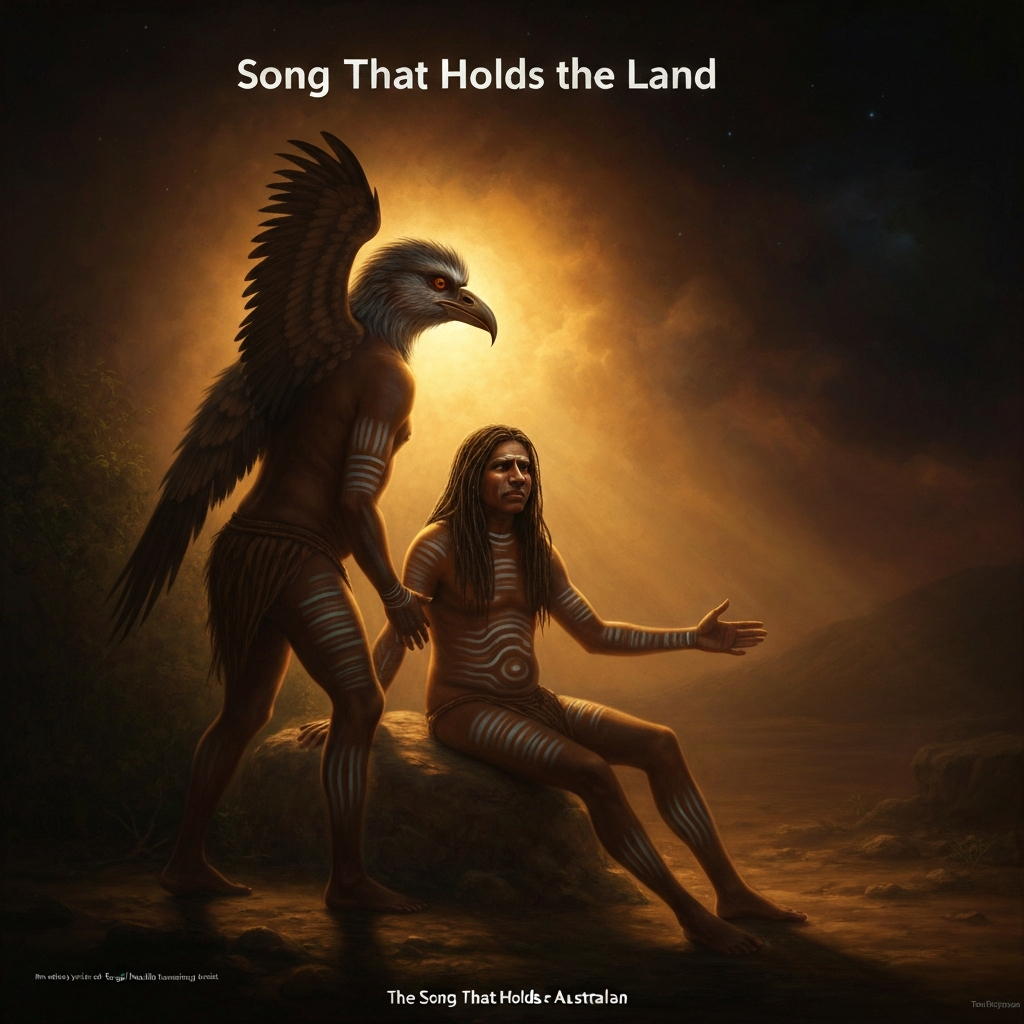
The Alcheringa ancestors — the great beings of the first time, the ones who created the landscape as they moved through it — are not historical figures who lived and died. They are beings who exist in the Alcheringa continuously. When the Aranda ceremony re-enacts the ancestor’s journey across the landscape, the ancestor is not being remembered or honored. The ancestor is present. The ceremony is a meeting.
The meeting point is the sacred site.
Every site in Aranda country is the location where an ancestor event occurred in the Alcheringa. The event is not over. The ancestor’s power — their specific creative energy, their particular form of the life-force — is concentrated at that place permanently. When an initiated man approaches the site with the correct ceremony, the correct songs, the correct state of mind, he encounters the ancestor directly.
The churinga holds the ancestor’s power.
These are the stone or wooden objects, incised with the geometric patterns of specific ancestors, that are among the most sacred objects in Aranda culture. They are stored in hidden rock shelters known only to the fully initiated. They are taken out for ceremonies and returned. They are the physical condensation of Alcheringa power — each one carries the specific life-force of the ancestor it represents.
Non-initiated people, including women and children, do not see the churinga. This is not a punishment or a restriction based on their unworthiness. It is a protection: the Alcheringa power in the churinga is too concentrated for someone without the spiritual preparation to encounter safely. The initiation ceremonies that young men go through are the preparation — years of teaching that give the young person the knowledge and spiritual formation to handle the encounter.
The boy being initiated this season is fifteen. He has been preparing for years — learning the preliminary levels of the sacred knowledge, learning the songs that belong to the lower levels of ceremony, learning the geography of the ancestral journeys across the landscape from the elders who hold that knowledge.
Tonight, for the first time, he will see a churinga.
The moment is described differently by every Aranda man who has gone through it, but the descriptions cluster around the same quality: it is not what he expected, and it is more than he expected, and afterward the landscape will never look the same.
The Alcheringa is present. Not as a vision or a feeling exactly — more like a shift in the perceptual register that makes previously invisible things visible. The red sand country, which is the landscape he has lived in all his life and knows thoroughly in its practical dimensions, reveals an additional dimension: the ancestor-paths crossing it, the sites where the Alcheringa power concentrates, the web of sacred relationships connecting every feature of the landscape to the ancestral network.
He is not entering a new world. He is entering the world more fully.
Stanner wrote about this:
The Dreaming is a poetic key to reality. By it, in its idiom, the Australian Aboriginal explains all. Or rather, he comprehends without explaining. The Dreaming is to him what a complete cosmology, a complete ontology, and a complete religious philosophy are to more systematized kinds of culture.
The boy holds the churinga.
He feels what has always been there.
Echoes Across Traditions
Entities
- the Alcheringa ancestors (altjiranga)
- the churinga (sacred objects containing ancestral power)
- the increase ceremonies
- the sacred sites on the plain
- the young man being initiated
Sources
- Spencer, Baldwin and Gillen, F.J., *The Native Tribes of Central Australia* (Macmillan, 1899) — the foundational documentation
- Strehlow, T.G.H., *Songs of Central Australia* (Angus & Robertson, 1971)
- Stanner, W.E.H., *White Man Got No Dreaming* (ANU Press, 1979) — the essential philosophical analysis