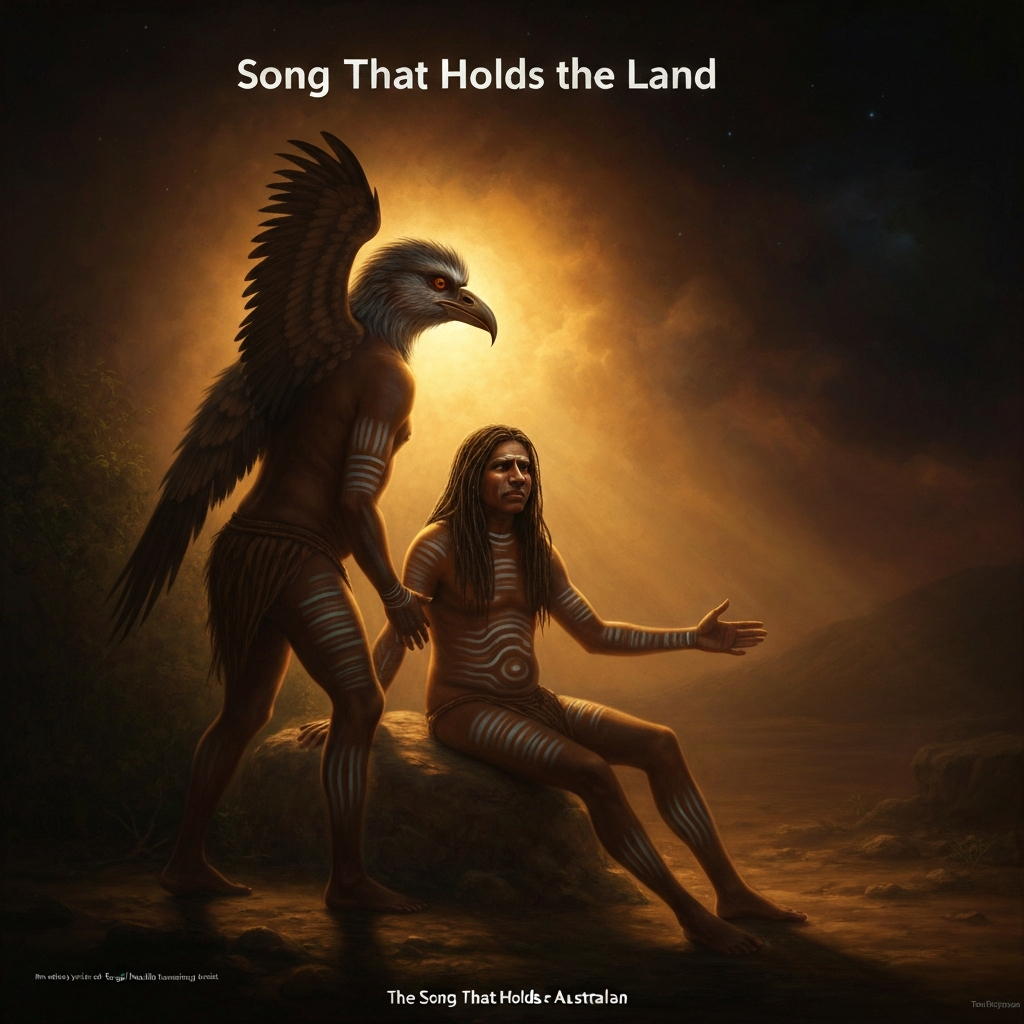
The Songlines: Every Feature of the Land Has a Song
Dreaming time and now — the songs are eternal present · The Australian continent — the songline networks that cross every landscape from coast to desert
Contents
The Australian Aboriginal songlines are not merely songs about the landscape but the mechanism by which the landscape exists — walking the songline while singing it is an act of creation and maintenance, and letting the songs go silent would unmake the world.
- When
- Dreaming time and now — the songs are eternal present
- Where
- The Australian continent — the songline networks that cross every landscape from coast to desert
The world was sung into existence.
This is the foundational proposition of the songline cosmology: in the Dreaming time, the ancestral beings moved across the surface of a world that was still unformed, and as they moved they sang, and the singing created the features of the landscape. The mountain was sung into being by an ancestor who rose up and named herself. The river was sung by an ancestor who flowed and named himself. The salt lake is a song. The desert pavement is a song. The red rock country of the central desert is a vast interlocking system of songs, still being sung.
The human custodians of the land walk the songs.
To walk a songline is to walk the path that the ancestor took in the Dreaming — the same path, over the same landscape, singing the same songs in the correct sequence that the ancestor sang. As you walk, each verse of the song corresponds to a specific feature of the landscape: this rock, this waterhole, this dry creek bed. The song describes the feature; the feature confirms the song. You know you are on the correct path because the landscape matches the words.
You know you are maintaining the world because the words and the landscape match.
The songs are also maps.
This is the most remarkable practical dimension of the songline system: the verse-by-verse descriptions of the landscape encode precise navigational information about terrain that is mostly featureless to the uninitiated eye. The central Australian desert, to someone who does not know the songs, is an apparently uniform red expanse. To the person who knows the songs, it is a detailed map with every waterhole, every shelter location, every food source, every dangerous place marked by its verse.
The songs also encode ecological knowledge. A verse that mentions a particular plant in a particular location may contain information about that plant’s seasonal behavior, its medicinal uses, the animals that rely on it. The knowledge is not stated discursively — it is embedded in the song’s narrative, accessible to the person who knows how to read it.
Different peoples hold different sections of the same songline. The Aranda people hold one section. The Luritja hold the next section. The Pitjantjatjara hold the section after that. Each group knows their own verses completely and has partial knowledge of their neighbors’. At the borders between custodian groups, ceremonies are held to share the overlapping sections and maintain the continuity.
The songline extends from the coast to the interior and back, woven through multiple peoples’ territories — a continental-scale system maintained by the cumulative knowledge of dozens of groups.
The danger is silence.
If a community loses its singers — through introduced disease, through forced displacement from traditional country, through the disruption of the intergenerational transmission that keeps the songs alive — the section of songline they hold becomes unsung. The landscape still exists physically. But in the Aboriginal cosmology, the landscape’s vitality — its participation in the ongoing Dreaming, its full existence as a living place rather than an inert geography — depends on the singing.
An unsung section of country is sick country. The waterholes diminish. The animals move. The ecological connections that the songs have maintained for tens of thousands of years begin to degrade.
This is not metaphor to the elders who carry the songs. It is observation.
The elder who is teaching the young people the songs says: I am teaching you because I will die. When I die, if you do not know these songs, the country I hold will be without its singer. The country knows it needs to be sung. You will feel it — the country asking you, the land making you uneasy until you have returned and done the walking.
The young people are learning.
The land is listening.
Echoes Across Traditions
Entities
- the ancestral beings who sang the world into existence
- the custodians who walk and maintain the songlines
- the country itself (as a living being)
- the interlocking song-networks of adjacent peoples
- the elders who carry the songs
Sources
- Chatwin, Bruce, *The Songlines* (Viking, 1987) — accessible introduction, but not the primary source
- Strehlow, T.G.H., *Songs of Central Australia* (Angus & Robertson, 1971) — the foundational scholarly study
- Rose, Deborah Bird, *Nourishing Terrains: Australian Aboriginal Views of Landscape and Wilderness* (Australian Heritage Commission, 1996)