The Dark Constellation: The Emu in the Milky Way
traditional time — the ongoing astronomical knowledge · The Australian continent — the Southern Hemisphere sky where the Milky Way is most brilliant
Contents
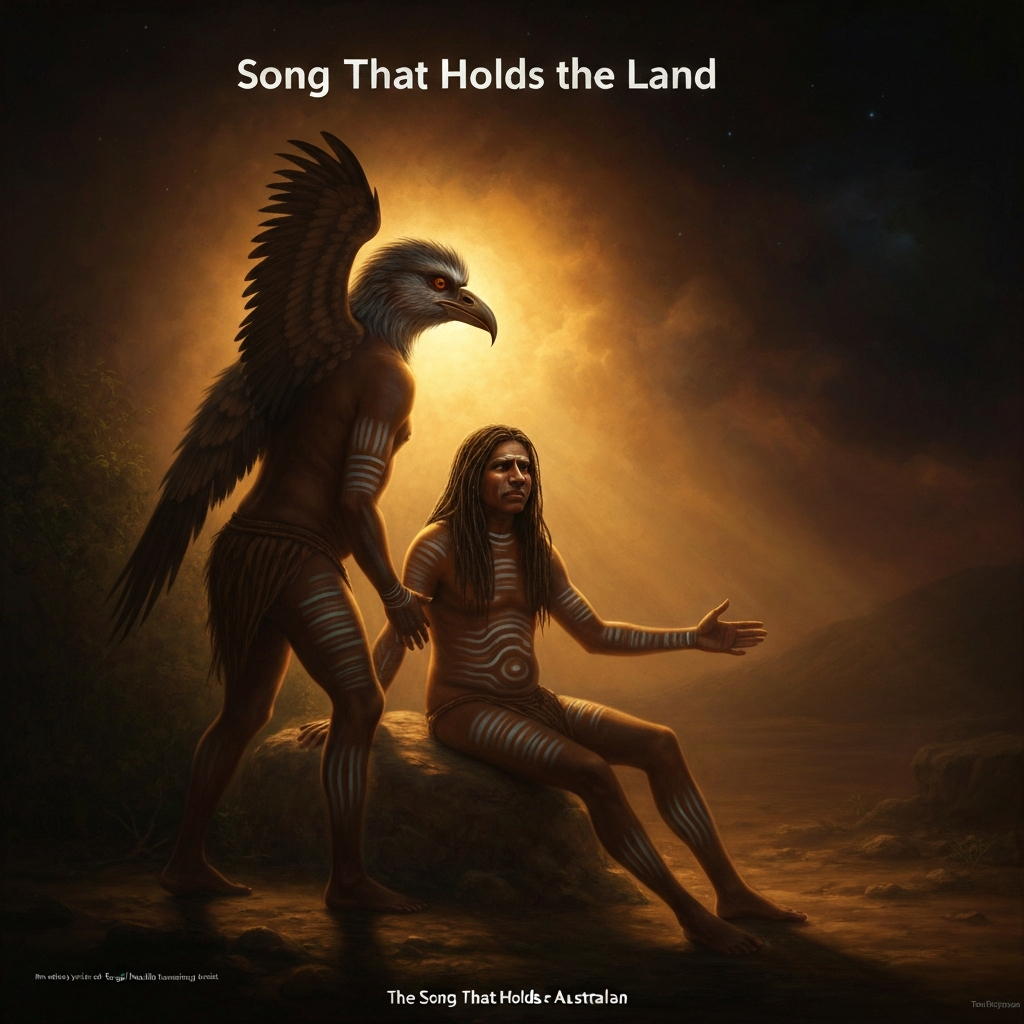
While European astronomers mapped the stars, Aboriginal Australians mapped the dark spaces between them — the emu in the sky is a shape made of cosmic dust clouds, and its position tells the community exactly when the emus on the ground are laying eggs.
- When
- traditional time — the ongoing astronomical knowledge
- Where
- The Australian continent — the Southern Hemisphere sky where the Milky Way is most brilliant
Look at the dark parts.
This is the instruction that shifts the way you see the Australian night sky. European astronomy — and the astronomical traditions of most civilizations — maps the stars: the bright points that can be connected into figures. The constellations are dot-to-dot pictures, made from the lights against the darkness.
The Aboriginal Australian tradition does something different. It reads the dark clouds of cosmic dust — the rifts in the Milky Way where star-forming gas absorbs the light behind it, creating shapes of darkness against the background glow. These dark shapes have names, stories, and seasonal meanings.
The emu is the most prominent.
Stretched along the Milky Way from the Coal Sack nebula near the Southern Cross, the dark emu’s head, neck, body, and legs are outlined by the cosmic dust lanes. It is enormous — spanning a substantial arc of the southern sky — and it is unmistakably emu-shaped to anyone who has spent time watching emus in the landscape: the long neck, the round body, the stubby vestigial wing visible as a dark break in the glow.
The emu’s position in the sky changes through the year, as the Earth moves around the sun.
When the emu in the sky is horizontal — lying flat, which happens in April and May — the emus on the ground are nesting, and the females have left the eggs for the males to incubate. The eggs are accessible. This is when the gathering season begins.
This is not coincidence. It is not even primarily a mnemonic — a way of remembering what season it is. It is a direct reading of the sky as an ecological calendar, developed over thousands of years of observation and confirmed as accurate by continuous practice.
The sky emu tells you when the ground emu is laying.
The Aboriginal astronomical traditions across Australia contain dozens of such correspondences: the appearance of specific star clusters marking the time of specific animal behaviors, specific plant flowerings, specific fishing conditions. The sky is not a metaphorical map of the seasons — it is a literal one, readable if you know the language.
The story of the sky emu is also a Dreaming story.
The emu in the sky is an ancestral emu — the great emu being who moved through the landscape in the Dreaming and whose passage shaped the emu country of the interior. When astronomers from different parts of the continent tell the sky emu’s story, the details of the Dreaming narrative vary, but the emu is always connected to the landscape emus, always a being whose presence in the sky is the record of a Dreaming journey.
The seasonal calendar and the Dreaming narrative are the same text.
When the elder shows the young person the sky emu for the first time, she is not showing them astronomy as separate from cosmology. She is showing them the sky as it actually is: a map of the world’s structure that is simultaneously a practical guide to when to gather eggs and a story about the ancestral beings who made the emu country.
Duane Hamacher, one of the researchers who has most thoroughly documented Aboriginal Australian astronomical knowledge, writes that the sophistication of the dark-constellation system demonstrates that Aboriginal Australians were engaged in careful, systematic sky observation for at least tens of thousands of years — developing a body of astronomical knowledge that is functionally precise and cosmologically integrated in ways that European astronomy achieved only much later.
The emu lies down in May.
Go look at the dark parts of the sky.
The eggs are ready.
Echoes Across Traditions
Entities
- the sky emu (the dark constellation)
- the Milky Way as the storytelling sky
- the ground emu whose laying season it predicts
- the Aboriginal astronomers who read the sky
- the seasonal calendar encoded in the sky
Sources
- Hamacher, Duane W. and Frew, David J., *An Aboriginal Australian Record of the Great Eruption of Eta Carinae* (Journal for the History of Astronomy, 2010)
- Norris, Ray P. and Hamacher, Duane W., *The Astronomy of Aboriginal Australia* (Proceedings of the IAU Symposium, 2009)
- Johnson, Dianne, *Night Skies of Aboriginal Australia: A Noctuary* (Sydney, 1998)