Väinämöinen's Last Voyage in the Copper Boat
Mythic time, the moment of transition between the pagan age and the Christian · Karelia where Marjatta gives birth, the shore where Väinämöinen builds his copper boat, the rim of the sea where the boat passes out of the world
Contents
After a virgin in Karelia gives birth to a child whose strange wisdom eclipses Väinämöinen's own, the old singer recognizes that his age is over. He builds a boat of copper, leaves the kantele on the shore for the people of Finland, and sails away over the rim of the sea — promising the country he is leaving behind that he will return when the world has need of him again.
- When
- Mythic time, the moment of transition between the pagan age and the Christian
- Where
- Karelia where Marjatta gives birth, the shore where Väinämöinen builds his copper boat, the rim of the sea where the boat passes out of the world
A virgin in Karelia eats a lingonberry.
This is how the runo begins. Marjatta — her name a Finnish form of Maria — is a young shepherdess living in the country east of the great lakes. She is herding her sheep one summer afternoon. She is hungry. She sees a single red lingonberry on a low bush. She bends down. She picks it. She eats it.
The runo says she becomes pregnant.
It does not say she is touched. It does not say she is visited by an angel. It says, simply, that after the lingonberry is in her belly the lingonberry begins to grow, and after a few weeks her belly is rounder than it should be, and after nine months she gives birth — alone, in a stable, because her family has thrown her out — to a son.
The son is unusual.
He is born already speaking. He is born already walking. He is born with the calm steady gaze of an old wise man, and he speaks in complete sentences from his first hour, and the first thing he says is a question that nobody can answer: who am I, and what is my name to be?
Marjatta does not know.
She wraps him in cloth. She walks with him through Karelia, asking the elders to name him. The elders cannot. They do not know what to make of a child born from a berry. The child is too strange. The child is too old. The child looks at them with the gaze of someone who already knows them, and they cannot meet it.
Finally Marjatta brings the child to the chief elder.
She brings the child to Väinämöinen.
Väinämöinen is in his old age.
He has been alive for a very long time. He has been alive since before the world; he has, in fact, been alive since before he was born — those seven hundred years in his mother’s womb count, in the runo’s reckoning. He has sung the song-duel with Joukahainen, and lost Aino to the sea, and forged with Ilmarinen, and traveled to Pohjola, and stolen back the Sampo, and rescued the sun and the moon, and gathered Lemminkäinen from the river. He is tired.
He sits on the bench in his cottage when Marjatta brings him the child. He looks at the child. The child looks at him.
There is a long silence.
The runo says Väinämöinen takes one look at the child’s eyes and knows. He does not need an explanation. He does not need a prophecy. He has lived long enough to recognize the gaze of a successor when he meets it, and he sees in the child’s face the calm authority that the next age of the world will need.
He says: This child should be drowned. He is the son of a strange birth, conceived from a berry, with no father. He should be killed before he can bring trouble.
This is the test. The runo wants us to understand that this is what Väinämöinen says first. It is the conservative answer. It is the answer of the old age refusing to let the new age in. It is the answer Joukahainen gave the world when he lost the song-duel; it is the answer Untamo gave Kullervo when the slave-child was born; it is the answer the older systems give to the younger systems before they yield.
The child speaks.
The child looks up at Väinämöinen from his mother’s arms. The child is two weeks old. The child says — clearly, in the formal meter the Kalevala uses for important speech — Old man, you are wrong. You once gave the same advice about a different child, and the child grew up to be the great singer of Kalevala. You are advising your own death by advising mine. The world will not always be the world it was.
Väinämöinen looks at the child for a long time.
He does not argue. He does not reply with another song. He sits on the bench and looks at the child, and the child looks at him, and the old singer — who has won every previous song-duel of his life, who has out-sung Joukahainen and out-witted Louhi and out-lived almost everyone he has ever known — recognizes that he has lost this one.
He stands up.
He says: You are right. The age is changing. I have stayed too long.
He walks out of the cottage.
He does not go home.
He walks down to the shore. He walks with the slow gait of an old man who has decided something. He passes the smithy of Ilmarinen, but he does not go in. He passes the hall where Lemminkäinen and his mother are sitting at supper, but he does not stop. He walks down the path to the harbor where his boats are kept.
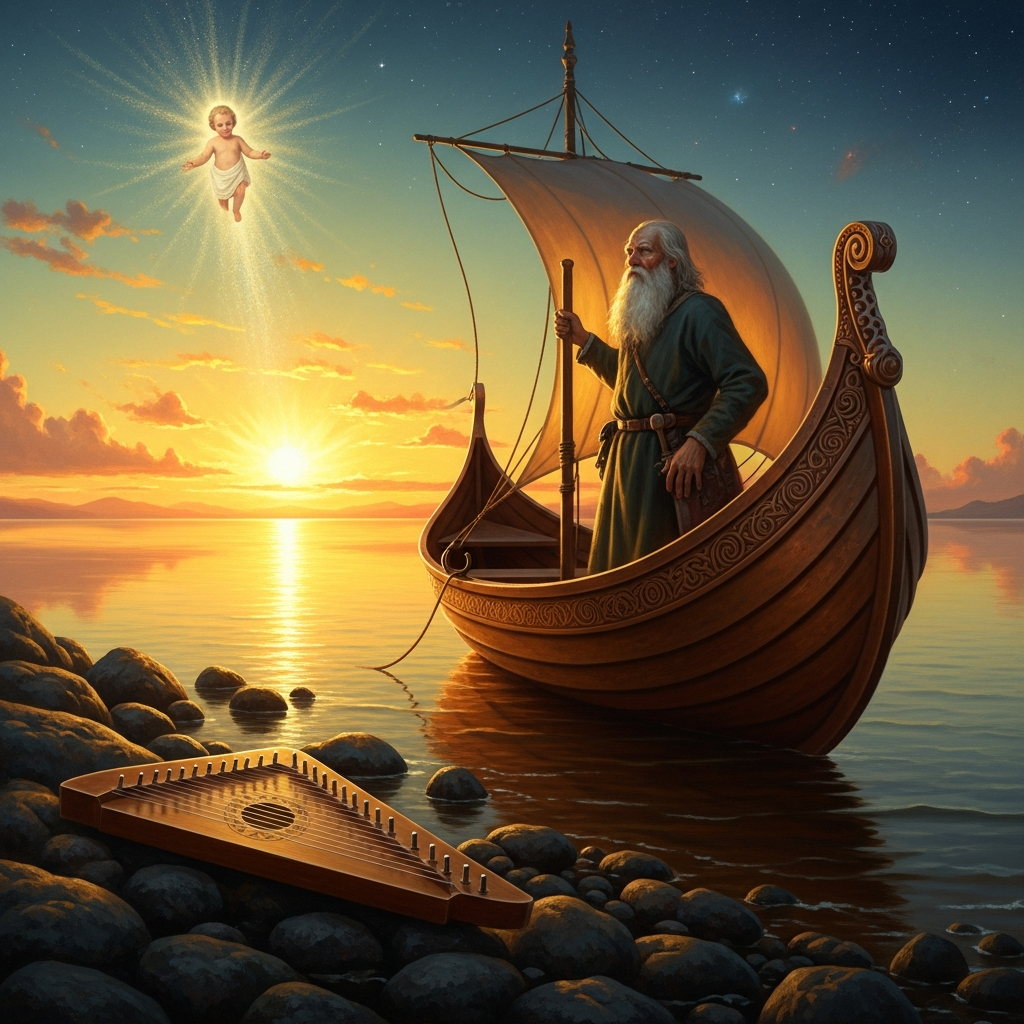
He has many boats. He chooses one he has not used before — a boat he made years ago with copper sheathing on the hull, a boat for a long voyage on a cold sea, a boat he had been keeping in case it was ever needed.
It is needed.
He pushes it into the water. He raises the single mast. He raises the single sail. He stows a small bag of provisions, and his fishing tackle, and the old fur cloak he has worn since his birth.
He pauses on the shore.
He has the kantele in his hand. The second kantele — not the pike-bone one, which sank at the Sampo battle, but the birchwood one with the maiden’s hair for strings — and he stands looking at it for a long moment. The kantele is the one possession he loves. He has played it through the long years; it has been on his lap through every important runo of the second half of his life.
He sets it down on a flat rock at the edge of the shore.
He leaves it there.
This is one of the great moments in any epic.
The runo lingers on it. The kantele sits on the rock at the edge of the shore. The sun is just rising over the trees on the eastern hills. The water is still. The boat is rocking gently in the harbor, ready. Väinämöinen stands looking at the kantele.
The kantele, the runo says, was made for him. It was made by him. It is the instrument that has been the voice of his magic for centuries, and he has played it longer than any other person has played any other instrument in the history of the world. To leave it behind is to leave behind half of what he is.
But the kantele also belongs to Finland.
The runo is precise about this. The kantele is not Väinämöinen’s possession; it is the country’s possession that has been in Väinämöinen’s hands. He has been the player but not the owner. The proper end for the kantele is to remain in Finland, where the people can find it, where new singers can learn its strings, where the music can keep going after the singer is gone.
He puts the kantele down.
He says — to no one in particular, to the rock and the shore and the future — the songs will continue. The kantele will be played. Finland will not lose the music when it loses me.
He turns. He walks down to the boat. He steps into it. He casts off.
He sails.
The wind is from the north — a gentle steady wind that fills the single sail and pushes the boat south, then east, then south again, on a course Väinämöinen does not steer. He does not need to steer. The boat knows where it is going. The copper hull catches the morning light and reflects it back at the water. The water gives back the same light, doubled. The boat moves through a line of brightness that the runo describes as a path the eye can follow even after the boat is small in the distance.
The villagers begin to notice.
A child sees the boat first — a girl on the headland, gathering kindling — and runs back to her cottage to tell her mother. The mother comes out and stands on the headland with the child and watches the boat. Other villagers come down to the shore. Word spreads up the coast. By midday, half of Karelia is on the beach watching the copper boat sail away.
Ilmarinen is among them.
He has come down from his smithy. He is in his leather apron, with soot on his hands, with the hammer still in his belt. He stands on the shore with the others. He does not call out. He does not run after the boat. He understands, the way Väinämöinen understood the child’s eyes. He stands and watches.
Lemminkäinen is there too.
The reckless one, who would in any earlier runo have leapt into a boat and chased Väinämöinen down — Lemminkäinen, who has been in this story since he was a baby, who has been killed and resurrected, who has been every kind of impulsive there is — is silent. He stands beside Ilmarinen. He does not move.
Marjatta is there with the child in her arms.
The child is looking at the boat. The child is the only person on the shore who is not surprised. The child is looking at the boat with the same calm gaze he turned on Väinämöinen in the cottage, the gaze that says: yes, this is how it goes, this is how the ages change, and this is the proper way to do it.
The boat reaches the rim of the sea.
The Kalevala believes — the way many old cosmologies believed — that the sea has a rim, an edge, a place where the water turns over the curve of the earth and goes to wherever it goes underneath. The runo describes the rim as a long, low line of cloud at the southern horizon, a line that the boat is moving steadily toward, a line that the boat eventually reaches and crosses.
When the boat crosses the rim, the runo says, it does not sink.
It does not vanish. It does not stop being. It simply passes out of view — the way a bird passes over a hill and is no longer visible from the valley side, but is still flying — and Väinämöinen is now somewhere the people on the beach cannot see, but somewhere he still is.
This is the precise theological point the runo wants to make. He is not dead. He has not died. He has gone to the place beyond the rim, where the old singers go when their age is over, and he is alive there, with his copper boat tied to whatever shore the rim has on its other side, and he is waiting.
He has left the kantele.
He has left it specifically so that the people on this side of the rim will know, every time they hear the kantele played, that the music is still working, the magic is still working, the runo is still in the world even though the singer has gone.
Before the boat passes out of sight, he speaks.
The runo gives him a final song. It is a short song. It is the last song of the Kalevala. He sings it from the deck of the copper boat as it nears the rim, and the wind carries the song back across the water to the shore, where the villagers are still standing.
He sings: I am going. I will not be gone forever. I leave the kantele on the shore for whoever wishes to learn its strings. I leave the runos in the air for whoever wishes to remember them. I leave my songs to Finland.
He sings: I will return when there is need.
He sings: I will return when the kantele is forgotten and the runos are forgotten and the language itself begins to be forgotten. I will return when the country has lost its songs. I will return at that hour, with this same boat, on this same wind, from over the rim, and I will bring the songs back.
He sings: Until then, sing them yourselves.
The boat passes the rim. The sail goes over the line. The hull goes over the line. The mast tip goes over the line. He is gone.
The villagers stand on the beach for a long time.
The kantele is still on the rock at the edge of the water. The sun is now overhead. Ilmarinen, after a long pause, walks down to the rock. He picks up the kantele. He looks at it. He hands it to a young woman who is standing nearby — a young woman whose name the runo does not give, but who is, in the runo’s logic, the first new singer of the new age.
She takes the kantele.
She does not know how to play it yet. She is holding it the way a child holds an instrument she has never touched. But she will learn. She will learn from the older singers, who learned from Väinämöinen, who learned from his own mother. The line is not broken. The kantele is still being played. The runo is still being sung. The Kalevala has reached its last page, and the last page is — explicitly — also the first page of the next book.
The Christ-child is named that afternoon.
He is named King of Karelia. He grows up to be the new singer, in a Christian idiom now, with new hymns and new psalms, and the old runos are not lost — the old women keep singing them in the cottages, the way old women have always done — but the public, official, court-supported singing belongs now to the new child and his new tradition.
Väinämöinen, in his copper boat, beyond the rim, waits.
The Finns who sang this runo understood what the myth was telling them.
They sang it last. It was always the last runo of the night, the last runo of the cycle, the last runo of the song. The singer would let the silence after the final line hang in the cottage for a long time, and the listeners would not speak, and the kantele — if a kantele was being played that night — would be set down very gently on the bench beside the singer.
The runo was a promise.
The promise was simple. The age you are in is not the only age. The age you are in will end. The wise old singer who taught the songs will leave. The new child who comes is not the betrayal of the old age but its proper successor. The kantele will remain on the shore, and a new singer will pick it up, and the music will not stop.
And in the unimaginable hour when even the new music has been forgotten — when the language itself begins to be lost, when the country has reached the bottom of its long forgetting — the copper boat will appear again on the southern horizon. The old singer will come back over the rim. He will pull the boat up onto the beach. He will pick up the kantele from wherever it is. He will sit down on a rock. He will begin to sing.
The runo says he will return.
The Finns who sang the runo — for a thousand years, in their cottages, in their boats, in their fields — believed the runo. Some of them still do.
The boat is out there, somewhere, beyond the rim.
He is still waiting.
He is, the runo insists, still alive.
Echoes Across Traditions
Entities
- Väinämöinen
- Marjatta
- The Christ-Child
- Ilmarinen
- Lemminkäinen


Sources
- Kalevala, runo 50 (compiled by Elias Lönnrot, 1849)
- Keith Bosley translation, *The Kalevala* (Oxford World's Classics, 1989)
- Eino Friberg translation, *The Kalevala: Epic of the Finnish People* (1988)
- Juha Pentikäinen, *Kalevala Mythology* (1999)
- Lauri Honko, *Religion, Myth, and Folklore in the World's Epics* (1990)
- Anna-Leena Siikala, *Mythic Images and Shamanism* (2002)