Louhi Hides the Sun and Moon
Mythic time, the years immediately following the loss of the Sampo · The mountain of copper where the sun is hidden, the cliff of stone where the moon is sealed, the sky-vault where Ukko strikes the flint, the lake into which the fire-fish swallows the spark
Contents
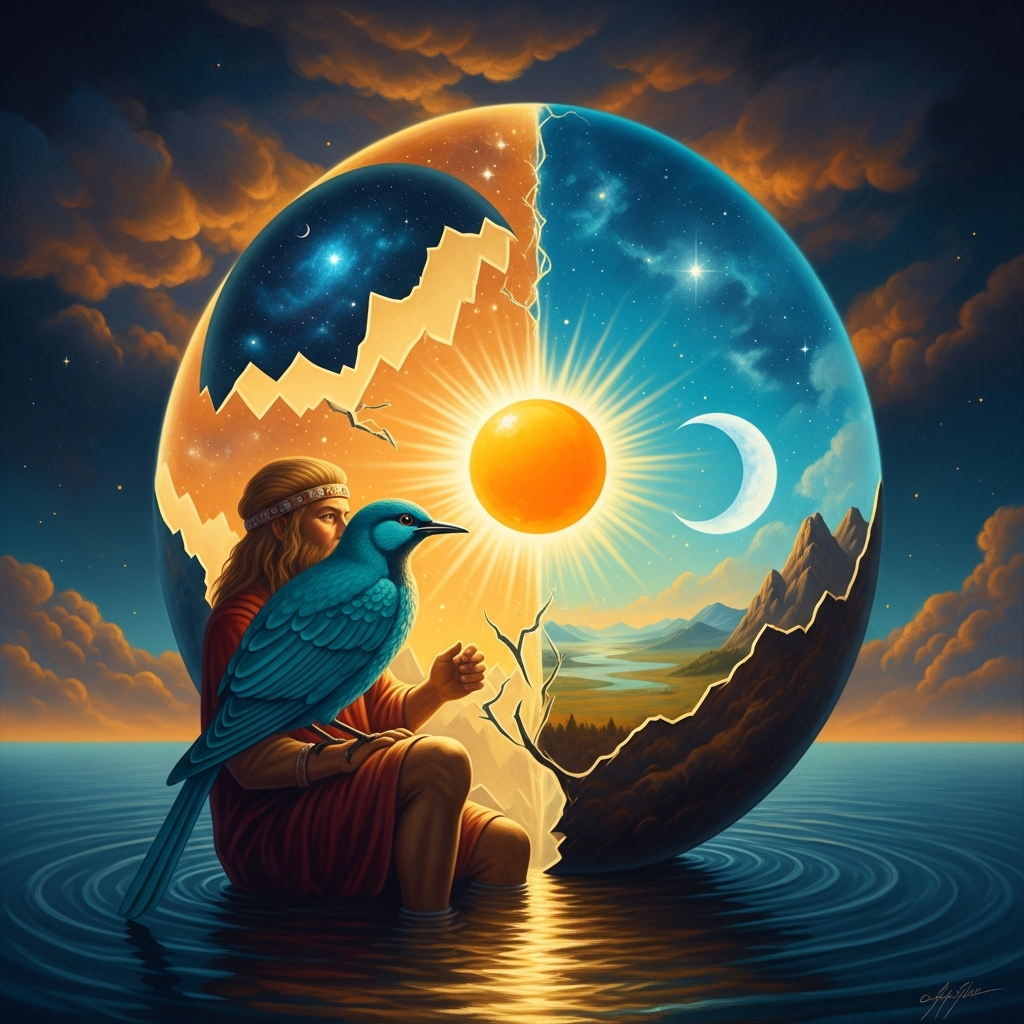
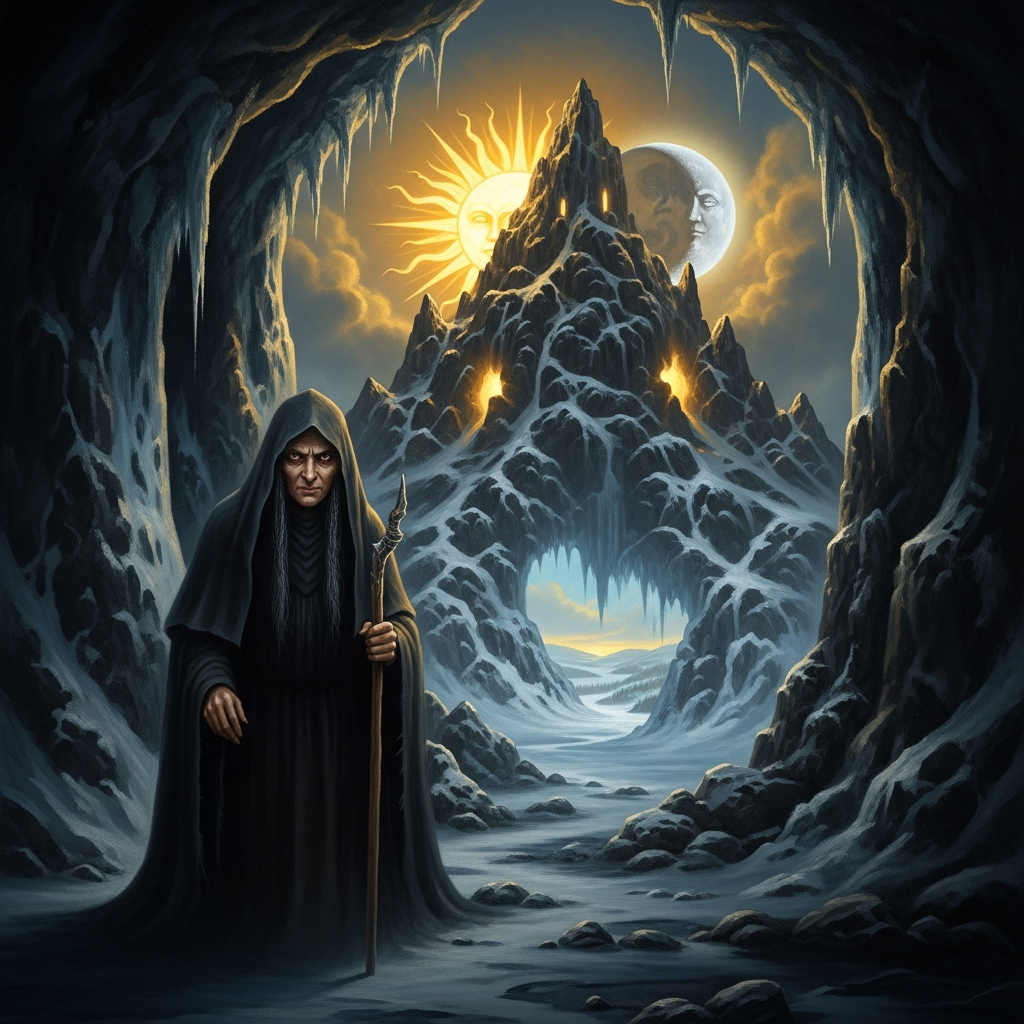
Furious at the loss of the Sampo, the witch-queen Louhi takes revenge on all of Kalevala: she imprisons the sun in a copper mountain and seals the moon inside a cliff of variegated stone. The world is plunged into permanent darkness, the cattle freeze, the crops die — and Väinämöinen and Ilmarinen must climb to the sky for fire from Ukko's flint and at last force Louhi to release her captives.
- When
- Mythic time, the years immediately following the loss of the Sampo
- Where
- The mountain of copper where the sun is hidden, the cliff of stone where the moon is sealed, the sky-vault where Ukko strikes the flint, the lake into which the fire-fish swallows the spark
She does it in a single night.
Louhi has been planning her revenge for years. The Sampo is gone — broken on the seabed of the Baltic, its fragments salting the sea, its body forever beyond her reach — and she has spent the years since the sea-battle thinking about what to take. She cannot reach into the Baltic. She cannot raise the Sampo. But she can take something from the people who took her Sampo. She can take, from the sky over Kalevala, the two largest things the sky has.
She climbs the mountain at midwinter.
She climbs the highest mountain in Pohjola — the Vuoriskallio, the copper-mountain, which has a hollow heart and a single iron door — and she carries with her two of her oldest spells. The first is a song that calls; the second is a song that closes. She gets to the door at moonrise. She opens the door. She steps inside the hollow mountain. She sings the calling song.
The sun is overhead.
The sun has been about to set, the way the sun sets in Finland in winter, after only a few hours of low pale light. Louhi’s song catches her at her lowest point — when she is touching the horizon, when she is most tired, when she has just spent the day crossing a sky too short to satisfy her — and the song pulls her out of her track.
The sun comes down.
She does not come down willingly. The runo describes her struggling — the sun, with her gold disc and her flame-hair, pulled out of her own sky against her will, pulled by a song she cannot resist, pulled toward a mountain in the far north that has been waiting for her. She comes down through the cold air. She lands in front of Louhi at the door of the hollow mountain, and Louhi grabs her by the hair, and pulls her inside, and slams the door, and sings the closing song.
The closing song is the one that seals.
The mountain closes around the sun the way a fist closes around a coin.
Louhi does the same to the moon.
She crosses the snow to the next valley. There is a cliff there — the cliff of variegated stone, kirjokallio, with veins of red and blue and yellow running through grey granite — and the cliff also has a door, smaller than the door of the mountain, that opens to her hand. The moon is rising as Louhi arrives. The moon is full that night; she is heavy in the sky; she is moving slowly along her track.
Louhi calls.
The moon comes down.
She comes down more easily than the sun. The moon has always been the more obedient of the two; the moon is the one who answers when called, while the sun has to be ordered. The moon descends in her silver disc, with her pale face, and she lands in front of the cliff, and Louhi takes her by the wrist and leads her — almost gently, almost the way you lead a tired old woman into a house — through the small door, and into the chamber inside the cliff, and Louhi closes the door behind her, and sings the seal.
The moon does not protest. The moon is so tired she does not protest.
The cliff closes.
The world goes dark.
The next morning, in Kalevala, dawn does not come.
The runo describes the slow understanding of this. The cocks crow at the right hour, but the sky stays black. The shepherds wake, but they cannot see their sheep. The fishermen rise to launch their boats, but the water and the sky and the shore are all the same color. The stars are still there — the stars are not part of Louhi’s spell; she did not bother with them — but stars do not light a forest, and stars do not melt the snow off a roof.
The first day, people assume the storm is bad and the sun will appear at noon. It does not.
The second day, people begin to be afraid.
The third day, the cattle begin to die. The cattle die of cold first, in barns that were not insulated for permanent winter, and then they die of starvation, because the haylofts cannot last forever, and the herders cannot find new fodder in fields they cannot see.
The fourth day, the trees begin to die. The needles of the spruces fall off in dark drifts. The birches go dormant and do not wake up. The forest, which had been ready for spring, has no spring to wake to.
The fifth day, people begin to die.
This is the part the runo is unflinching about. The children die first — the small children, who cannot keep warm — and then the old, and then the sick, and the runo does not soften this. It says: in the dark winter that Louhi made, three out of every ten children in Kalevala died, and four out of every ten of the very old, and the cottages were full of small bodies, and the cattle-yards were full of large ones, and the smell of the cottages was the smell of grief without firewood.
The fires were going out.
This is the second part of Louhi’s spell. She has not only taken the sun and the moon; she has taken — by extension, through the same closing song — the fires of Kalevala. The hearths flicker and die. The kindling will not catch. The flint sparks but the spark refuses to flame. Without sun, without fire, without warmth, the country is freezing.
Väinämöinen and Ilmarinen meet on the road.
They have been searching, separately, for five days. Now they meet at a crossroads, both with torches that will not burn, both with their cloaks frozen stiff. They sit down at the crossroads to talk.
Väinämöinen says: We have to go up.
Ilmarinen does not understand at first. Väinämöinen explains. He explains that the only place fire can be obtained — without the sun, without the moon, without flint that works — is from Ukko, the sky-god, who keeps in his hall a piece of flint that has never failed. They have to go to Ukko’s hall. They have to ask for fire.
Ilmarinen says: How?
Väinämöinen says: We climb.
They climb.
The runo is shamanic about this section. It uses the imagery of the seita — the world-pillar, the sky-pole, the climbable axis-mundi that runs from the earth up through the layers of the cosmos to the topmost sky. The two old men do not climb literally. They climb in the way the shaman climbs: through trance, through song, through the steady ascent of the spirit-body up the layers of the world.
They pass through the first sky-layer.
They pass through the second.
They pass through the third, the fourth, the fifth, the sixth.
At the seventh sky-layer they come to Ukko’s hall. Ukko is at home. Ukko is sitting on his bench beside the hearth — Ukko’s hearth is the only hearth in the cosmos that is currently burning, because the spell could not reach this high — and he is making a flint.
He is making a flint of fish-skin.
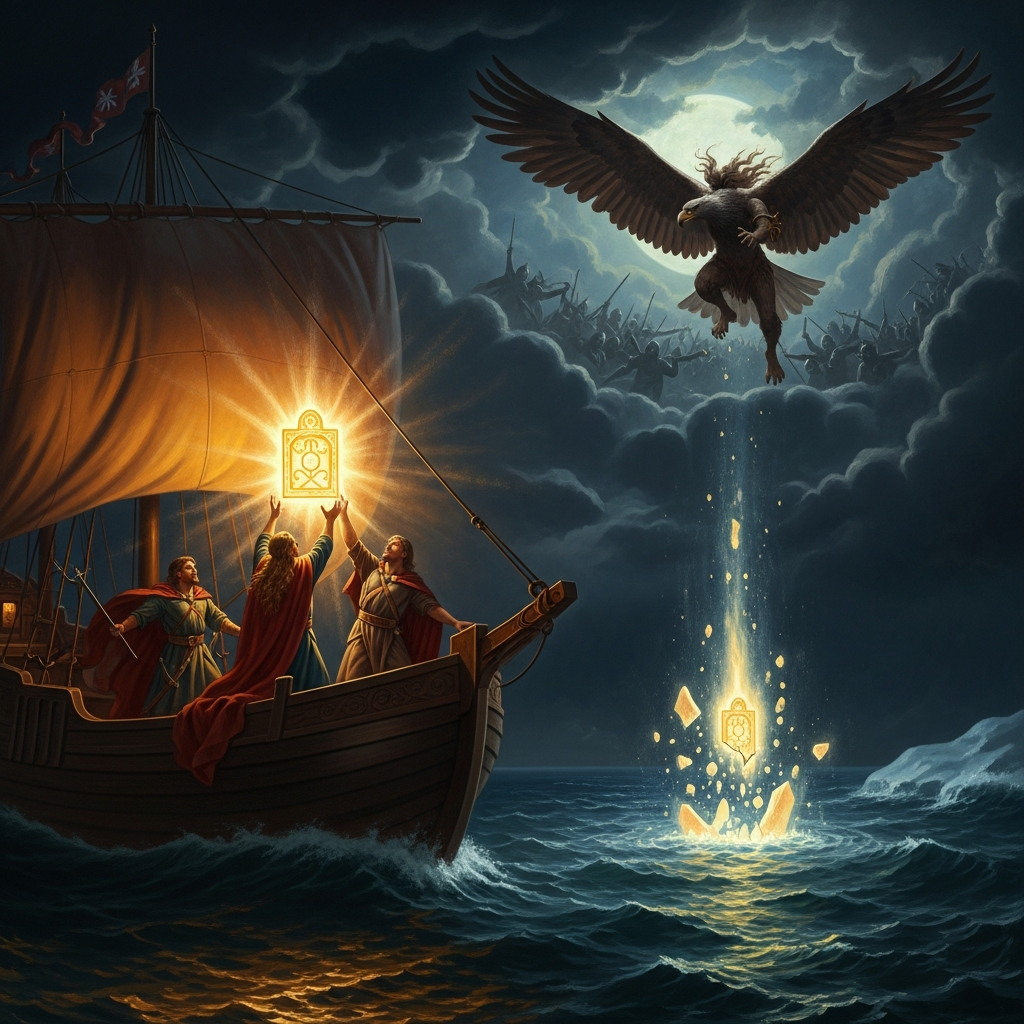
This is the strange detail the runo wants. Ukko, the sky-god, is striking together two pieces of dried fish-skin to make a spark. The spark, when it comes, is small — a single bright bead of fire — and it falls from his hands. It falls from the seventh sky-layer downward.
It falls through the sky.
It falls past the moon’s empty track. It falls past the stars. It falls through the cold air. It falls through the cloud-layer and into the lower atmosphere of Kalevala, and Väinämöinen and Ilmarinen — who are already descending, who have already climbed back down through the first six sky-layers — see it falling toward them like a small bright comet.
They reach for it.
They miss.
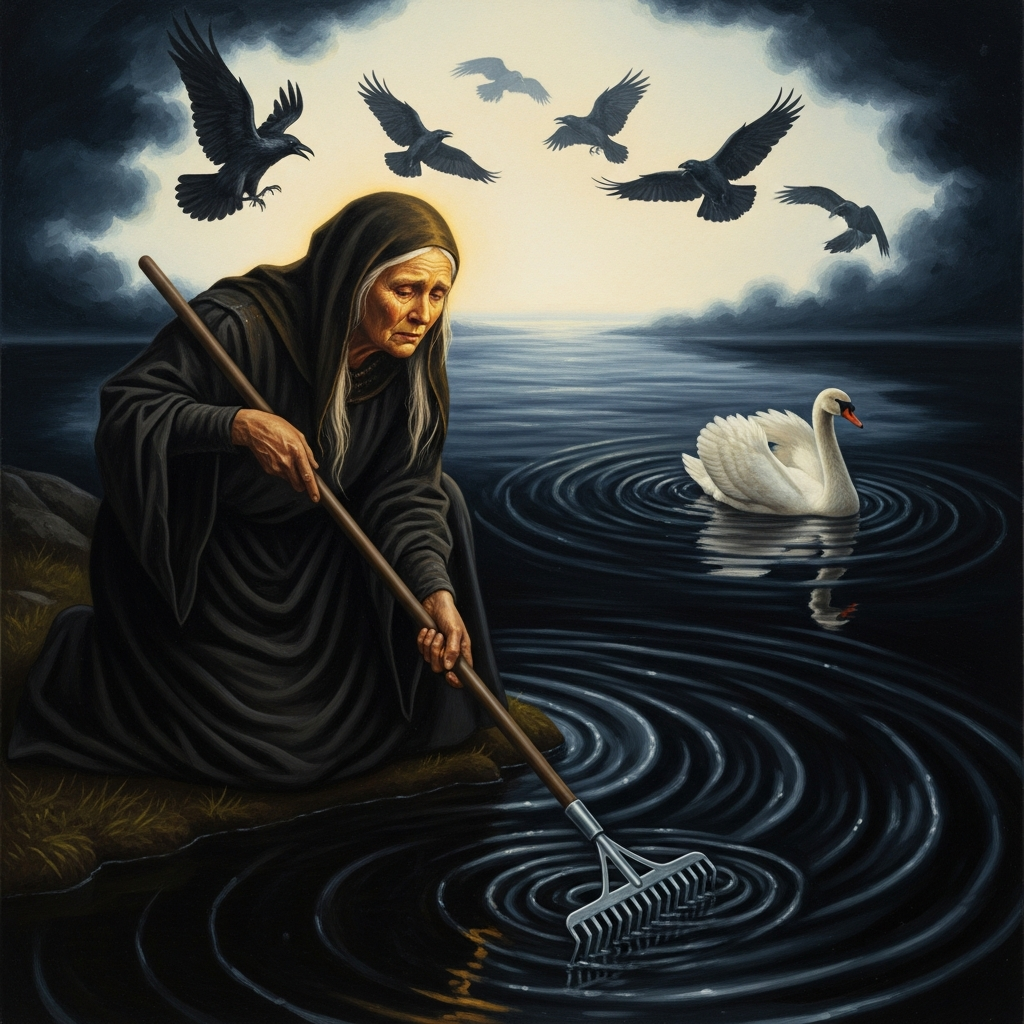
The spark falls into a lake.
The lake is Lake Alue. It is a deep lake. The spark falls into the water, and instead of going out — sparks fall into water and go out, ordinarily — the spark continues to glow. It sinks. It sinks to a depth of thirty fathoms. It sinks past the cold layer. It sinks down to where the largest fish swim.
A whitefish swallows the spark.
The whitefish — a large adult, who has been in this lake for years — eats the bright object the way she eats anything that flashes in front of her, and the spark goes into her belly. The spark, in the belly of the fish, begins to burn. It does not burn the fish; it burns inside her, gently, the way a candle burns inside a lantern. The fish becomes uncomfortable. The fish begins to swim erratically.
A pike eats the whitefish.
This is the next detail. A great pike — perhaps even the same kind of pike whose jawbone became the kantele, though the runo does not say so — comes through the deep water and swallows the smaller fish whole. The whitefish, with the spark still in her belly, is now in the pike’s belly. The pike continues to swim, but the pike is also now uncomfortable; the pike is also burning gently inside; the pike begins to swim near the surface looking for relief.
Väinämöinen is on the lake.
He has come to the lake because he has seen the spark fall into it. He has been searching the surface for hours. He is in a small boat. He has nets. He has hooks. He has been catching fish all morning, and gutting them, looking for the spark. He has gutted dozens of fish without finding it. He is tired.
He catches the pike.
The pike comes up on his line. He pulls it into the boat. He gutters it on the floor of the boat. He cuts open its belly. Inside the pike’s belly is the whitefish. He cuts open the whitefish. Inside the whitefish’s belly is the spark — small, still bright, still gently burning — and Väinämöinen reaches in with two fingers and lifts it out.
It burns his fingertips.
He cries out. He drops it onto the deck. The deck begins to smolder. He stamps on it. He cups his hands around it. He gets it under control. He places it in a small clay jar that he has brought for this purpose, and he closes the lid, and he carries the jar back to shore in trembling hands.
He kindles the first fire from it that night.
The hearths of Kalevala come back to life one by one. A fire from Väinämöinen’s first fire is carried to Ilmarinen’s smithy. A fire from Ilmarinen’s smithy is carried to the next farmstead. A fire from the next farmstead is carried to the one after. By the third night all the hearths in Kalevala are burning again, and the people who have not died of cold are being warmed for the first time in nearly two weeks.
But the sun and the moon are still in the mountains of Pohjola.
Ilmarinen forges the keys.
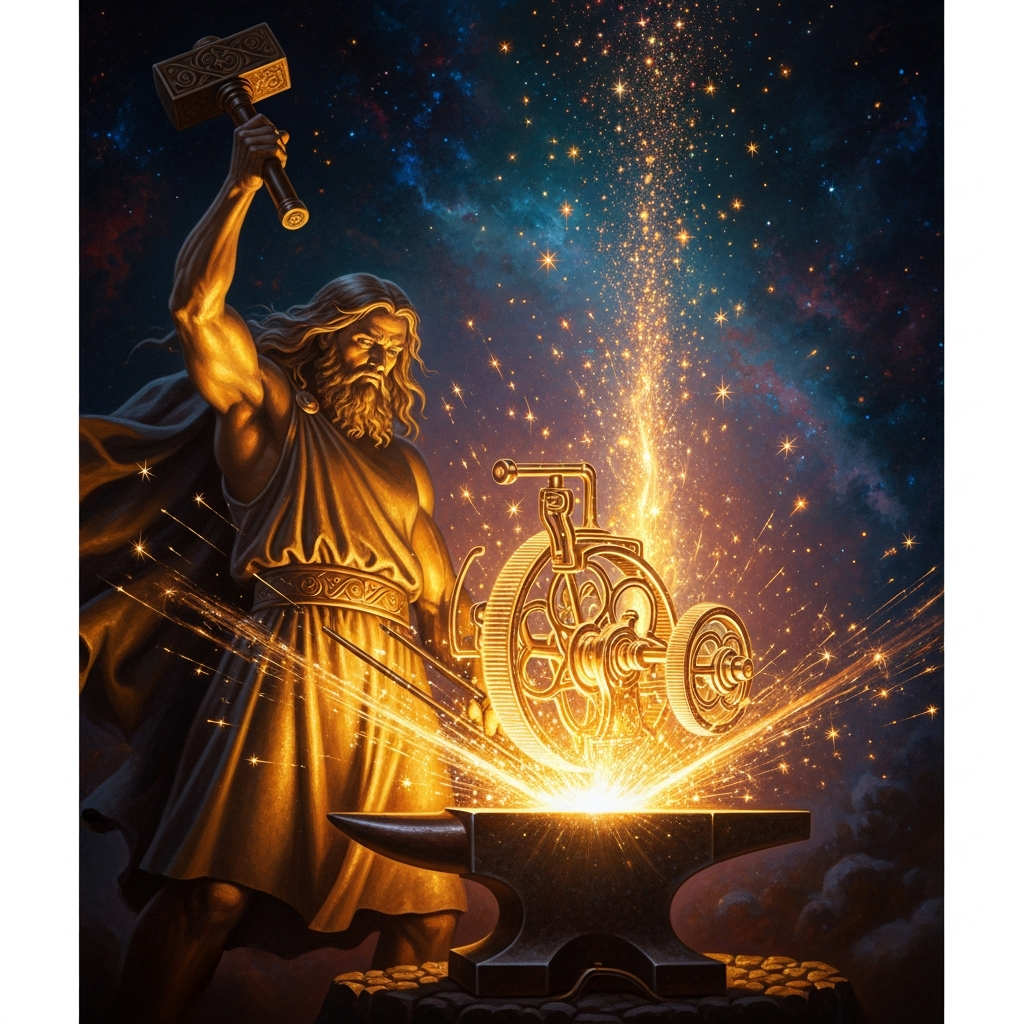
He goes to his smithy. He builds his fire to a great heat with the four winds in his bellows. He forges three keys: one for the iron door of the copper-mountain, one for the small door of the variegated cliff, and one for the closing-song itself, the third key being not iron but a sung-key, a key made of a particular note. He is not sure if the keys will work. He does not know what locks Louhi has used.
Väinämöinen and Ilmarinen ride north together.
They ride to Pohjola. They arrive at the dark farm. They walk past the hall where Louhi is sitting at her loom. She does not come out. She knows why they have come. She watches them through the window. She does not speak.
They go to the copper-mountain. They stand at the iron door. Ilmarinen tries the first key. The key does not fit; the lock has been changed. They walk to the variegated cliff. They stand at the small door. Ilmarinen tries the second key. The key does not fit; the lock has been changed.
They go back to Pohjola’s hall.
They confront Louhi.
She is at the loom. She is weaving a length of black wool. She does not look up when they come in. Väinämöinen sits down at the table. He is too old for this kind of journey; he is breathing hard from the ride. He says, calmly, Louhi, give us back the sun and the moon.
She does not look up. She says, I will not.
He sings.
He does not sing a war-song. He does not sing a curse-song. He sings the song he sang to put the household of Pohjola to sleep when they stole the Sampo — and he sings it, this time, only to Louhi. He sings it to her hands at the loom. He sings it to her eyes. He sings it slowly, the way he sang it that night, but more focused, with no other listeners to absorb the song’s force, and Louhi feels the song coming for her and she fights it and she fights it and at last she puts down the shuttle and puts her head on the warp and falls asleep.
While she is asleep, Ilmarinen takes the keys from her belt.
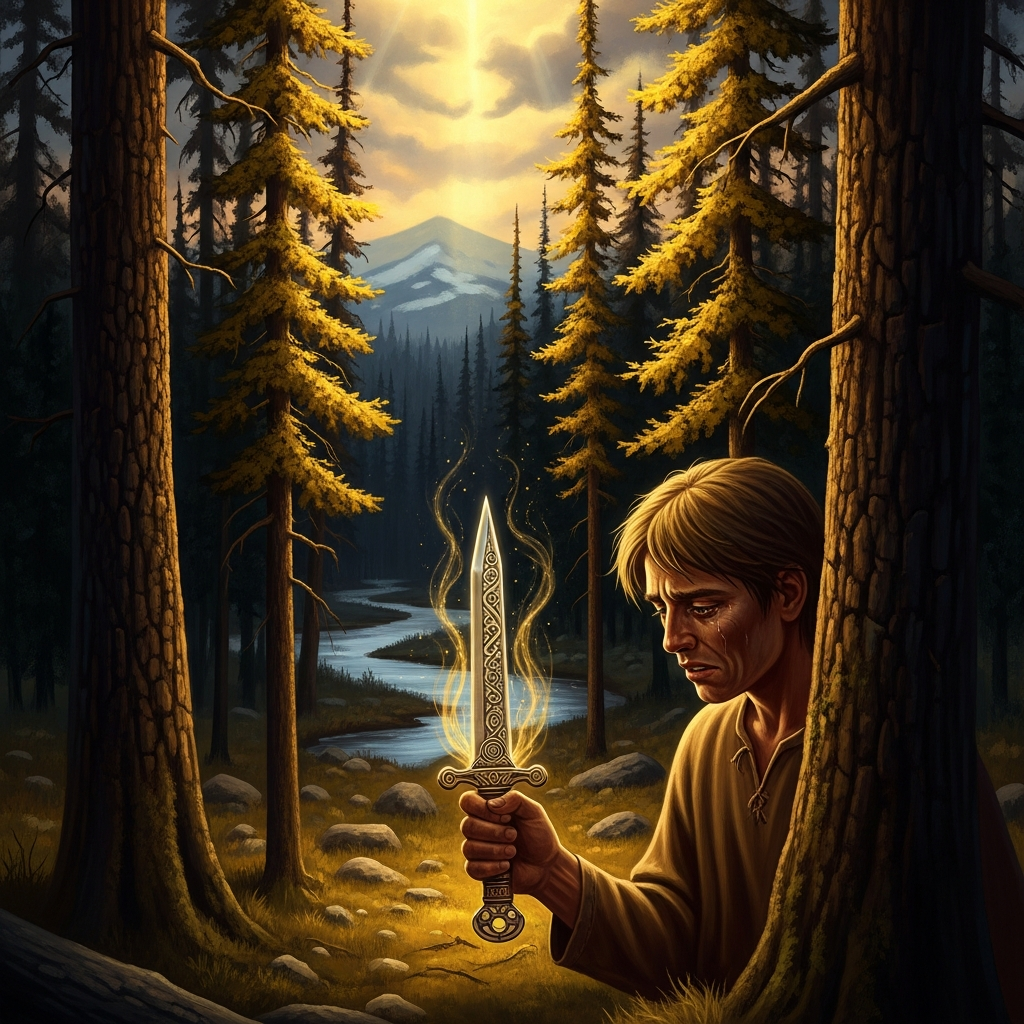
The keys he wants are real keys, not the iron ones he forged. They are small bone keys. He takes them. He does not wake her. He and Väinämöinen leave the hall, and ride back to the copper-mountain, and try the first bone key, and the key fits, and the iron door opens.
The sun is inside.
She is sitting on the floor of the hollow mountain. She is dim. She is exhausted. She is paler than the sun should be. She looks up when the door opens. She does not say anything. She does not know if she is being released or moved to another prison. Väinämöinen says — gently, as you would say to a frightened animal — Come out. The sky is empty. Go back.
She rises slowly. She walks past them out of the mountain. She lifts off the snow. She rises into the air. She rises higher. She finds her track. She begins to move along it. She is shy at first; she is half-bright at first; but with each minute of moving she gets her old brightness back, and within an hour the sun in the sky over Kalevala is the sun the Finns remember, and the snow is melting on the south sides of trees, and the chickens in the yards are coming out for the first time in two weeks.
They go to the variegated cliff. They use the second bone key. They open the small door. The moon is inside, half-shrouded in the dark, even paler than the sun was, almost translucent. She rises silently and goes back to her track.
Ilmarinen and Väinämöinen ride south.
Behind them, in the hall of Pohjola, Louhi wakes up and finds her keys gone, and the doors open, and the sun and moon back in the sky. She does not pursue. She has been beaten. She has, the runo says, lost the will. She sits at her loom and weaves the black wool into the cloth she will eventually be buried in, and the runo does not give her another speaking line in the rest of the epic.
The sun returns to her track.
The moon returns to hers.
The crops, by the next year, are growing again. The cattle are recovering. The children who survived are being born of women who, a year before, had been wondering whether to have children at all. Kalevala is alive again. The light is back. The fires — the small kindling-fires that Väinämöinen lit from the spark in the fish’s belly — are still burning in every hearth.
The Finns who sang this runo understood what the myth was telling them.
The dark winter is a real thing. It is not metaphor. It is sixty days of true darkness in the northern parts of the country, and it kills people, and it has always killed people, and the only response to it is — the runo argues — to climb. To climb in song to Ukko’s hall and ask for fire. To search the lake for the fish that swallowed the spark. To gut the fish on the deck of the boat with frozen fingers. To carry the small clay jar of fire home through the dark. To kindle the first hearth from it. To carry the fire from house to house. To survive together until the spell breaks and the sun comes back.
This is the work of winter, the runo says. This is what the runos are for.
The sun and moon will be hidden every year. Louhi is, in some sense, doing it again every December. The spell will be broken every year. Väinämöinen and Ilmarinen — who are, after all, just the figures of every old man in every farmstead who knows how to keep a fire going through January — will go up to the sky and bring the fire down, and the fire will be lost, and a fish will swallow it, and the fish will be caught, and the spark will be found, and the hearths will be lit, and the country will not die.
It has not died yet.
It is still doing this.
Echoes Across Traditions
Entities
- Louhi
- Väinämöinen
- Ilmarinen
- Ukko (Sky-God)
- The Sun
- The Moon
- The Fire-Fish


Sources
- Kalevala, runos 47–49 (compiled by Elias Lönnrot, 1849)
- Keith Bosley translation, *The Kalevala* (Oxford World's Classics, 1989)
- Eino Friberg translation, *The Kalevala: Epic of the Finnish People* (1988)
- Mihály Hoppál, *Shamans and Traditions* (Akadémiai Kiadó, 2007)
- Anna-Leena Siikala, *Mythic Images and Shamanism* (2002)