Contents
Sold into slavery before his birth, cursed before his name, Kullervo grows into a young man who breaks every boundary the world holds against him: he kills his master's wife by magic, unknowingly seduces and destroys his own sister, and at the end of his life kneels in a meadow and asks his sword whether it would consent to take his life. The sword answers yes.
- When
- Mythic time, ancient Karelian-Finnish oral tradition
- Where
- The household of Untamo where the cursed boy is raised, the smithy of Ilmarinen where he serves as cattle-herd, the meadow where the sword answers
He is born in slavery.
This is where the runo begins. Kullervo is born in his uncle Untamo’s house, into the household that was built on the destruction of his own. The story before the story: Untamo, his father’s brother, raided the family’s farm before Kullervo was born — burned it, killed everyone, took the pregnant women back to his own household as slaves. Kullervo’s mother gave birth to twins in the slave-quarters: a boy, Kullervo, and a girl, the sister whose name the runo never quite settles on.
Untamo tries to kill the boy three times.
He tries to drown him in the sea. The boy floats. He tries to burn him on a pyre of birchwood. The boy walks out of the fire unharmed, scratching pictures in the ashes with a stick. He tries to hang him on a tree. The next morning the boy is sitting on the branch carving runic figures into the bark with a knife.
Untamo gives up trying to kill him.
He decides instead to use him.
The boy grows.
He grows fast. He grows strong. He grows in the way cursed children grow in folk tales: too quickly, with too much in his hands, with the kind of strength that breaks tools. By the time he is three he can lift a barrel of water; by the time he is seven he can lift a horse. Untamo, who is shrewd, decides to put the strength to work. He gives Kullervo jobs.
Each job is sabotaged.
The runo is grimly funny about this stretch of Kullervo’s childhood. Untamo sends him to rock the cradle of the baby — the new heir, Untamo’s own son. Kullervo rocks the cradle so hard he kills the baby. Untamo sends him to clear a forest. Kullervo clears the forest, every tree, every root, every stump, and salts the earth so nothing will grow there for a generation. Untamo sends him to build a fence. Kullervo builds a fence with no gate, on every side, encircling the whole field, so the cattle cannot get in or out. Untamo sends him to thresh barley. Kullervo threshes the barley into chaff so fine it blows away in the next wind.
Each task is the wrong shape because the boy is the wrong shape.
He is too strong, and he is too literal, and he is — though no one in the household says it aloud — under a curse. The curse is the one his mother put on the slaver’s house when she gave birth in the corner of the slave-quarters. Let my children be the ruin of yours. It is working, the way curses worked in old Finland: not as magic exactly, but as a kind of slow inevitability, where every action of the cursed person turns slightly wrong, the way a poorly-fired clay pot turns slightly out of round.
Untamo finally sells him.
He is sold to Ilmarinen.
The smith — yes, the same Ilmarinen who forged the Sampo — has paid two old kettles and three rusted scythe-blades for the slave. He brings him home. He sets him to herding cattle. The Maid of Pohjola — Ilmarinen’s wife, who is famously beautiful and famously cruel — does not like the new slave. She gives him bread for his lunch, but bakes a stone into the loaf.
Kullervo takes the bread out into the pasture.
At noon he sits down to eat. He cuts the loaf with the knife his mother gave him before he was sold — the only thing he owns, the only thing he carries that came from his real family. The knife is a fine knife. It has a horn handle. It has been in his pocket for years. He cuts the bread, and the knife strikes the stone the Maid has baked into it, and the blade snaps.
The blade snaps in two.
Kullervo sits on the rock for a long time looking at the broken knife.
This is the moment, the runo says, that Kullervo’s grief turns into rage. He has been beaten, mocked, sold, denied his family, denied his name — and he has borne it. He has borne it because the knife was his connection to his mother, who he believed was dead, and as long as he had the knife he had something. The knife is now broken because his master’s wife thought it would be funny to bake a stone into his bread.
He stands up.
He gathers the cattle. He drives them to the edge of the forest. He sings a song over them — a slow, terrible song, the curse-runo, the worst song he knows — and as he sings, the cattle change. They become wolves. They become bears. They become the wild predators of the deep forest. He drives the herd of wolves and bears back to Ilmarinen’s farm. He drives them into the yard. He calls into the house, Mistress, the cattle are home, come milk them.
The Maid of Pohjola comes out into the yard.
The wolves and bears tear her apart in front of the smithy.
Kullervo runs.
He runs into the forest. He runs north. He runs for many days. He runs because Ilmarinen will be home soon and Ilmarinen — the smith, the hammer-wielder, the friend of Väinämöinen — will not pursue with mercy. Kullervo runs into the trackless north of Finland, where there are no farms, where the lakes have no names, where the only language is the language of birds.
He stops at a stream.
He drinks. He looks at his reflection. He has been running for a week; he is thinner now, harder, and the face in the water is not quite the face he remembers.
He hears singing.
It is a young woman’s voice. She is somewhere on the other side of the stream — picking berries, or gathering reeds, or doing whatever a young woman does alone in the deep forest. He follows the singing. He pushes through the alder thicket. He comes out into a small clearing where a young woman is sitting on a fallen log eating cloudberries from a wooden bowl.
She looks up.
She is beautiful in the way only solitary forest-women in folk tales are beautiful — barefoot, brown-armed, her hair unbraided. She does not seem afraid of him. She offers him a cloudberry. He sits down beside her on the log. They begin to talk.
He does not know who she is.
She does not know who he is.
This is the part of the runo that is hardest to read.
They sit on the log for a long time. They talk about where they are from. He says he is a slave who has run from his master. She says she is a girl who got lost in the forest as a child and has been wandering for years. They do not exchange names. He has not used his name in so long he barely remembers it; she has, perhaps, never had one she knows.
He gives her cloth.
He has cloth in his pack — fine cloth, embroidered cloth, cloth he stole from Ilmarinen’s house on the way out. He offers it to her. He offers her a brooch. He offers her a length of red wool. She accepts. They speak for the rest of the afternoon. They — the runo is direct about this, in a way modern translators have to soften — they sleep together that evening in the clearing.
They speak again afterward.
This is when she says, who is your mother?
And he says her mother’s name.
And she says, who is your father?
And he says her father’s name.
And there is a long silence in the clearing, and the cloudberries are still in the wooden bowl on the log, and the cloth he gave her is still under her hand, and she stands up — slowly, the way you stand up when the world has changed — and she walks past him, out of the clearing, through the alder thicket, down to the stream.
She walks into the stream. She walks deeper. She walks until the water closes over her head.
She does not come back up.
He sits in the clearing.
The runo lingers on this, too. He sits in the clearing with the cloudberries and the cloth and the wooden bowl, and he understands. He understands what he has done. He understands who his mother put the curse on, and how the curse has worked through him. He understands that the slave-boy who was sold by his uncle and herded cattle for a smith has, on the day he ran away, found and seduced and destroyed his own sister.
He gets up.
He picks up his belongings. He walks home.
This is the strange thing he does. He walks home — to his mother. His mother, who he believed was dead, who in fact has been alive all this time on the family farm that was rebuilt after Untamo’s raid, and who has been waiting for him.
He walks for two weeks.
When he arrives, his mother — who has been told he was killed three times in childhood, who has been told he died in the fire and the sea and the noose, who has assumed for years that her boy is gone — sees him at the gate and recognizes him and runs to him and embraces him.
He tells her what he has done.
He tells her about Untamo. He tells her about Ilmarinen’s wife. He tells her about the sister in the clearing. He tells her about the cloth and the brooch and the bowl of cloudberries.
His mother does not curse him. She does not strike him. She does not turn him out. She sits with him at the kitchen table and she weeps, and he weeps, and they hold each other for a long time, and at the end of the weeping she says — quietly, in the voice mothers use to make terrible suggestions — go and burn down Untamo’s farm. Take the war back to where it began.
He goes.
He gathers a small band — his father’s old companions, the men who survived Untamo’s raid years ago — and he rides north and he burns Untamo’s farm. He kills Untamo. He kills Untamo’s surviving sons. He kills the herders, the slaves, the women, the dogs. He burns the granaries. He salts the fields. The runo does not flinch from this. Kullervo, the cursed boy, the unloved one, ends his uncle’s bloodline in a single afternoon.
He rides home.
He arrives at his mother’s farm at dusk.
The farm is empty.
His mother has died while he was gone. His father has died while he was gone. His brothers — the ones he did not know he had — have died while he was gone. The runo says the family has been carried off by a fever, all of them in the same week, and the house is dark and the cattle are wandering loose in the yard, and Kullervo is alone in the world.
He goes into the house. He sits at the table. He sits at the table for a day, and a night, and another day. He does not eat. He does not light the fire. He sits at the table.
Then he stands up. He walks out of the house. He walks down through the yard, past the wandering cattle, onto the path that leads into the forest. He walks. He walks until he comes to the meadow.
The meadow is the meadow where his sister drowned in the stream. He has come back to it.
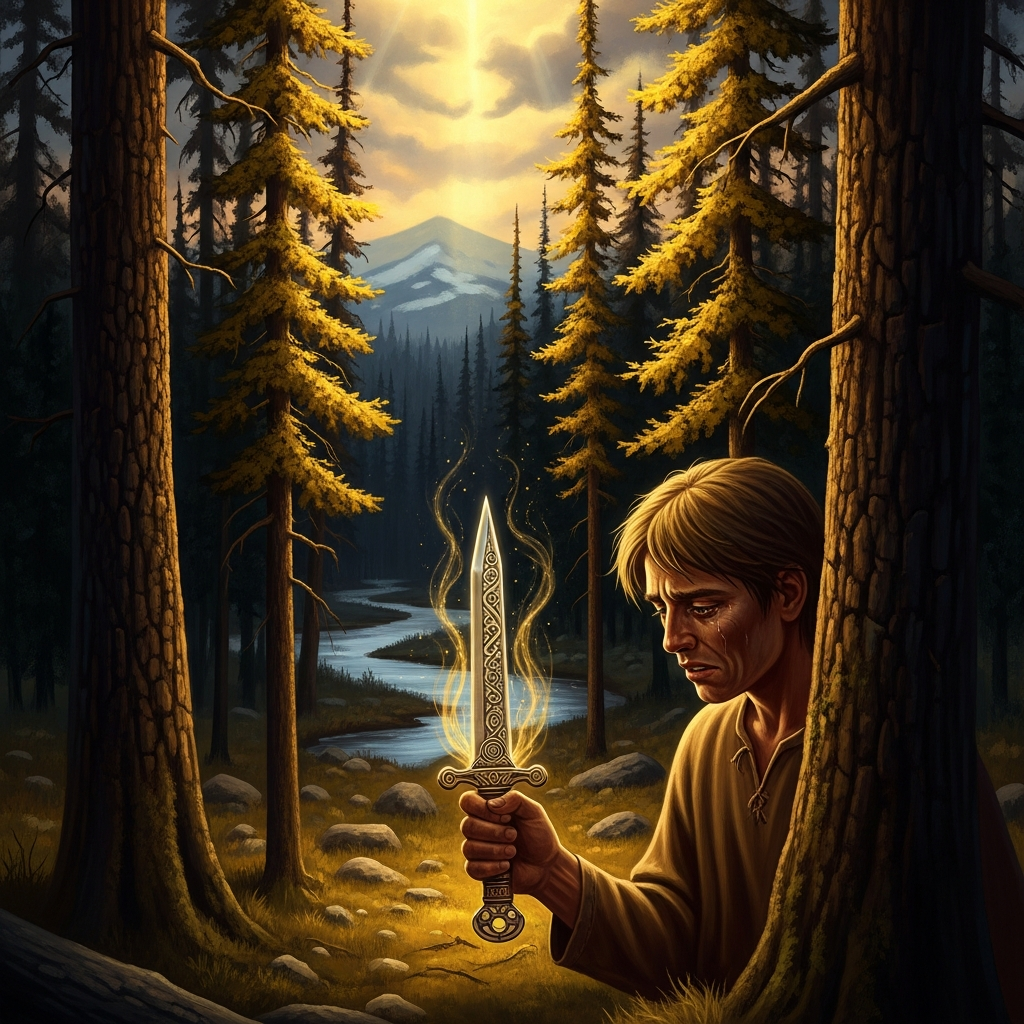
He draws his sword.
The sword is a fine sword, a heavy sword, with a long blade and a worn handle. It is the sword he used at Untamo’s farm. It is the sword that has killed many men. It is sticky still, in places, with old blood.
He plants the hilt in the ground.
He plants it carefully, point upward, in a soft patch of earth in the middle of the meadow. He kneels in front of it. He looks at the blade.
He speaks to the sword.
This is the moment the runo has been waiting for. Kullervo, kneeling in the meadow, his hands on his knees, asks the sword a question. He asks it courteously, the way a man asks a friend for a serious favor. Sword, he says, would you be willing to take my life? Would you find it acceptable to drink the blood of a guilty man? Or would you refuse, the way an honest sword should refuse to kill an innocent?
The sword answers.
The sword speaks. The runo gives it a voice. The voice is metallic, and sharp, and clear, and what it says is: Why would I not? I have killed many men in my time. I have drunk the blood of innocents. I have taken the lives of guilty men and the lives of harmless ones. I do not refuse on grounds of innocence. I will certainly not refuse on grounds of guilt. Lean forward.
Kullervo leans forward.
The point of the sword goes through his throat.
He falls onto the blade. The blade goes the rest of the way through him. He dies in the meadow where his sister drowned, on the soft earth, beside the stream, with the cloudberries still ripening in the bushes around him.
The sword stands in the ground for a while. Then the wind tips it over. Then the rain washes the blood off. Then the meadow grows over both the sword and the body, and by the next summer there is no sign of either, and the cloudberries are picked by other women who do not know what happened in the meadow.
The Finns who sang this runo understood what the myth was telling them.
They sang it last, or near-last, in long winter performances of the Kalevala. They sang it when the listeners were ready for it — usually after midnight, after the children had gone to sleep, when the older listeners were grim and tired and able to bear it. The singer would slow down for the meadow. The singer would slow down even more for the conversation with the sword. The singer would let the silence after the sword’s answer hang in the smoky air of the cottage for a long time, and no one would speak, and no one would ask for another runo immediately.
The myth is about what the world owes the cursed.
The Finnish answer is unsentimental. The world owes them nothing. They are owed no salvation, no afterlife, no reunion in heaven. They are not vindicated. They are not redeemed. They are not made into examples. They are simply recorded — exactly, mercilessly, with the names of the people they hurt — and the recording itself is the only memorial.
This is what the runo offers Kullervo, and what the runo offers anyone who finds themselves in his position. Not forgiveness. Not transcendence. Just the song. Just the singer in the smoky cottage saying his name in the meter the language wants, telling the story exactly the way it happened, refusing to lie, refusing to look away.
The sword agreed.
The runo agrees with the sword.
The runo says: yes, this is what happened. This is what happens. This is one of the things the world contains.
Echoes Across Traditions
Entities
- Kullervo
- Untamo
- Ilmarinen
- Ilmarinen's Wife (the Maid of Pohjola)
- Kullervo's Sister
- Kullervo's Mother
- The Sword

Sources
- Kalevala, runos 31–36 (compiled by Elias Lönnrot, 1849)
- Keith Bosley translation, *The Kalevala* (Oxford World's Classics, 1989)
- Eino Friberg translation, *The Kalevala: Epic of the Finnish People* (1988)
- J.R.R. Tolkien, *The Story of Kullervo* (written 1914, published 2015) — the direct inspiration for *The Children of Húrin*
- Verna Aho, *Kullervo: tarinasta sankarihenkilöksi* (1995)
- Sibelius, *Kullervo Symphony* (1892), Op. 7