Ixion on the Wheel
Mythic age — generations before the Trojan War; Ixion was king of the Lapiths in Thessaly · Thessaly (Ixion's kingdom and the pit of fire he prepared for his father-in-law); Mount Olympus (the banquet); Tartarus (the eternal wheel)
Contents
Ixion was the first murderer — he killed his own father-in-law to avoid paying the bride-price. Zeus, alone among the gods, agreed to purify him, an unheard-of mercy. Ixion's response to that mercy was to attempt to seduce Hera. Zeus shaped a cloud into Hera's likeness; Ixion lay with the cloud and fathered the Centaurs. Then Zeus bound him to a wheel of fire and set it spinning forever in Tartarus.
- When
- Mythic age — generations before the Trojan War; Ixion was king of the Lapiths in Thessaly
- Where
- Thessaly (Ixion's kingdom and the pit of fire he prepared for his father-in-law); Mount Olympus (the banquet); Tartarus (the eternal wheel)
Ixion is king of the Lapiths in Thessaly.
He has agreed to marry Dia, the daughter of Eioneus, and Eioneus — a careful father, perhaps not entirely trusting his future son-in-law — has set the bride-price high. Ixion has not paid it. The wedding has happened; Dia is in Ixion’s house; Eioneus is still waiting for the gold and the cattle that were promised at the betrothal.
Eioneus comes to collect.
He arrives at Ixion’s hall expecting hospitality, expecting payment, expecting at least a meal and a respectful conversation. Ixion welcomes him with smiles. Ixion has, in fact, prepared something for him.
Outside the hall, in the courtyard, Ixion has dug a pit. He has filled the bottom of the pit with burning coals. He has covered the pit with a thin layer of leaves and earth so that the floor of the courtyard looks unbroken. He walks Eioneus across the yard, talking pleasantly about the bride-price, and Eioneus walks onto the leaves and falls through them into the fire.
This is the first murder in Greek myth.
Greeks did not lack for myths of killing. Heracles will kill his children in madness; Cronus will eat his; the gods will kill each other across generations. But this is the first deliberate, premeditated murder of a kinsman by a man — a son-in-law killing his father-in-law, host killing guest, the xenia bond annihilated, the philia bond annihilated, all at once, for money.
The crime is so unprecedented that no purification ritual exists for it.
This is what Pindar emphasizes in the Pythian ode where the story is told most fully. The Greek world had elaborate rituals for cleansing the blood of homicide — Apollo himself was the god of such purifications, the priest-figure who could wash a man back into the community of the living. But those rituals had been developed for the kinds of killings the world had so far seen. They could clean a man who had killed in war, in a feud, in self-defense, in a quarrel.
There was no ritual for what Ixion had done.
The neighbouring kings refuse him. The local priests refuse him. The river-gods refuse to take his blood. He is agos — sacrilegious, contagious, a walking pollution — and no human community will let him in. He wanders Thessaly going mad with the smell of his father-in-law’s burning still on his hands.
Then Zeus invites him up.
This is the part of the story that is, frankly, strange.
Zeus has no obligation to Ixion. Zeus is the guardian of xenia, the protector of the host-guest bond — Zeus Xenios, the god most directly offended by what Ixion has done — and the natural Olympian response to such a crime should be a thunderbolt. Pindar is at pains to point out the strangeness of what Zeus does instead.
Zeus takes pity on him.
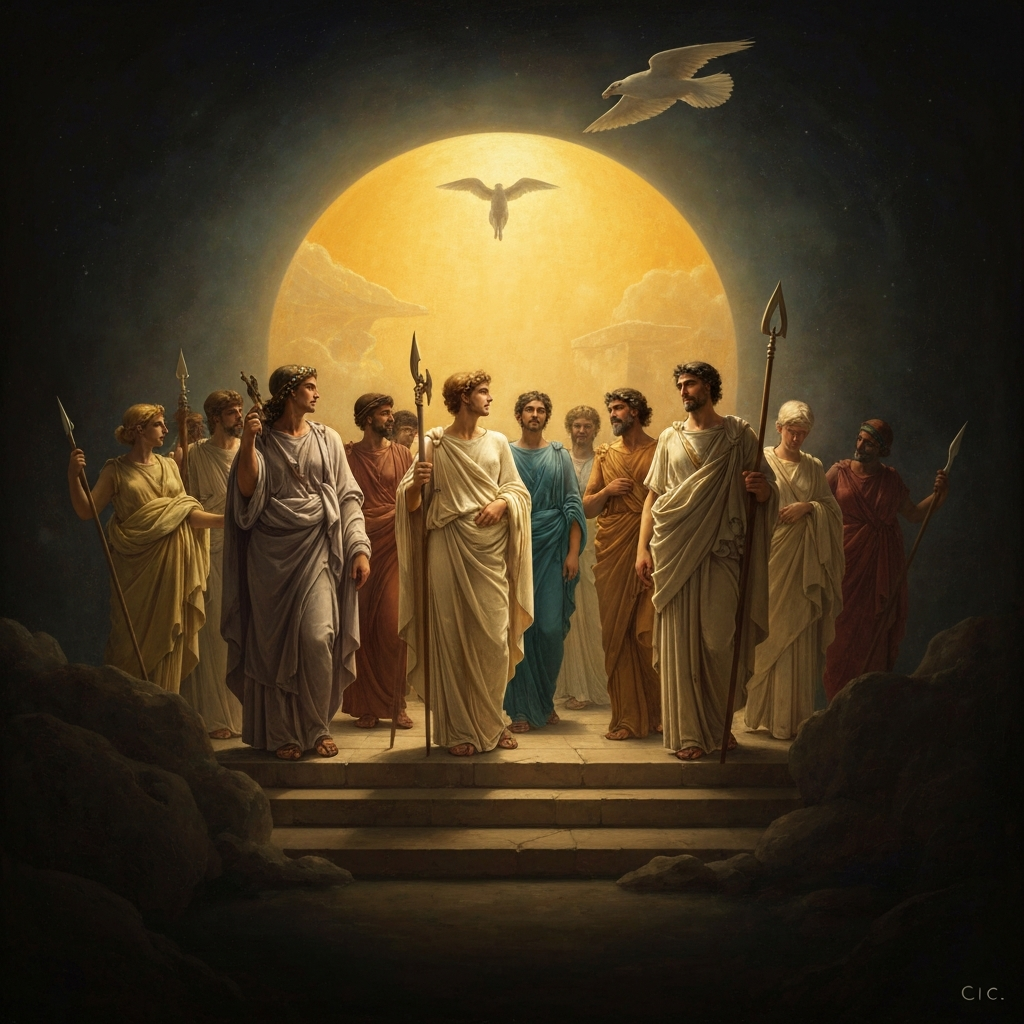
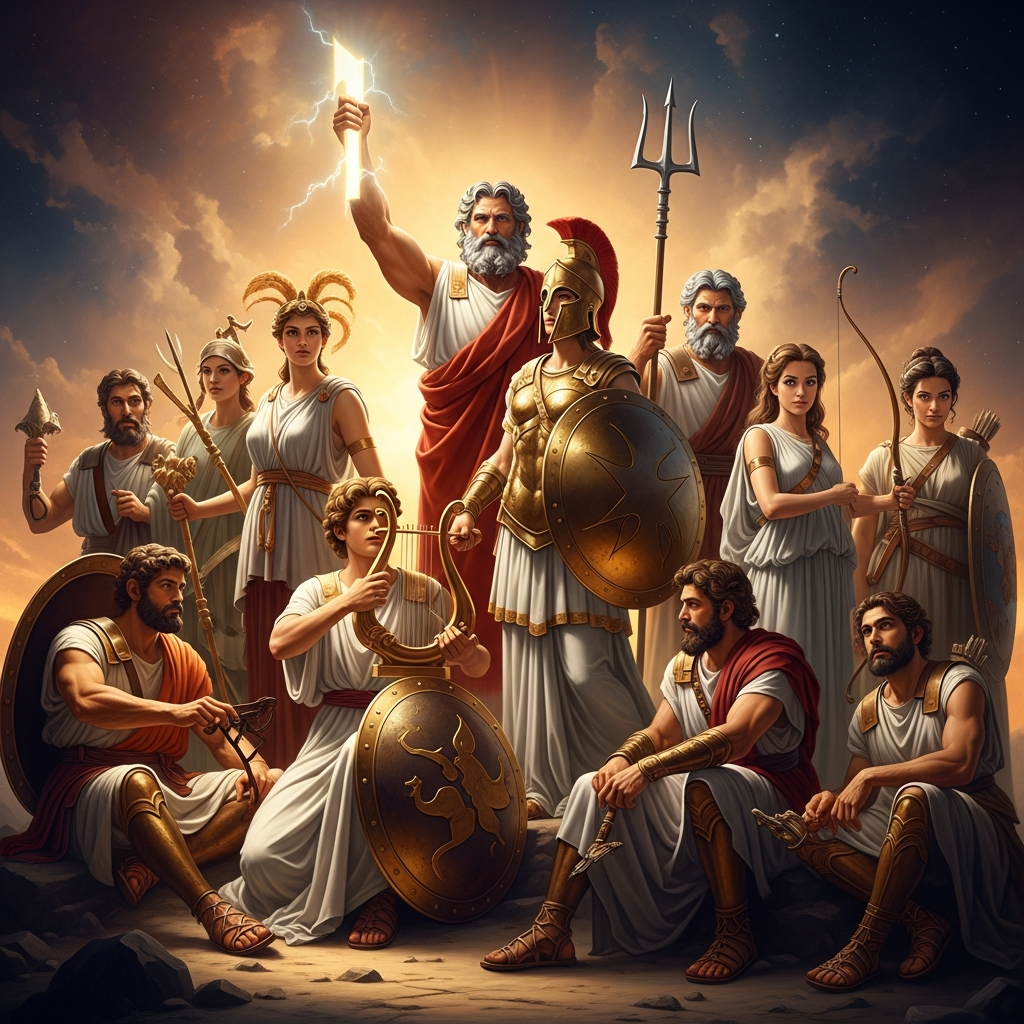
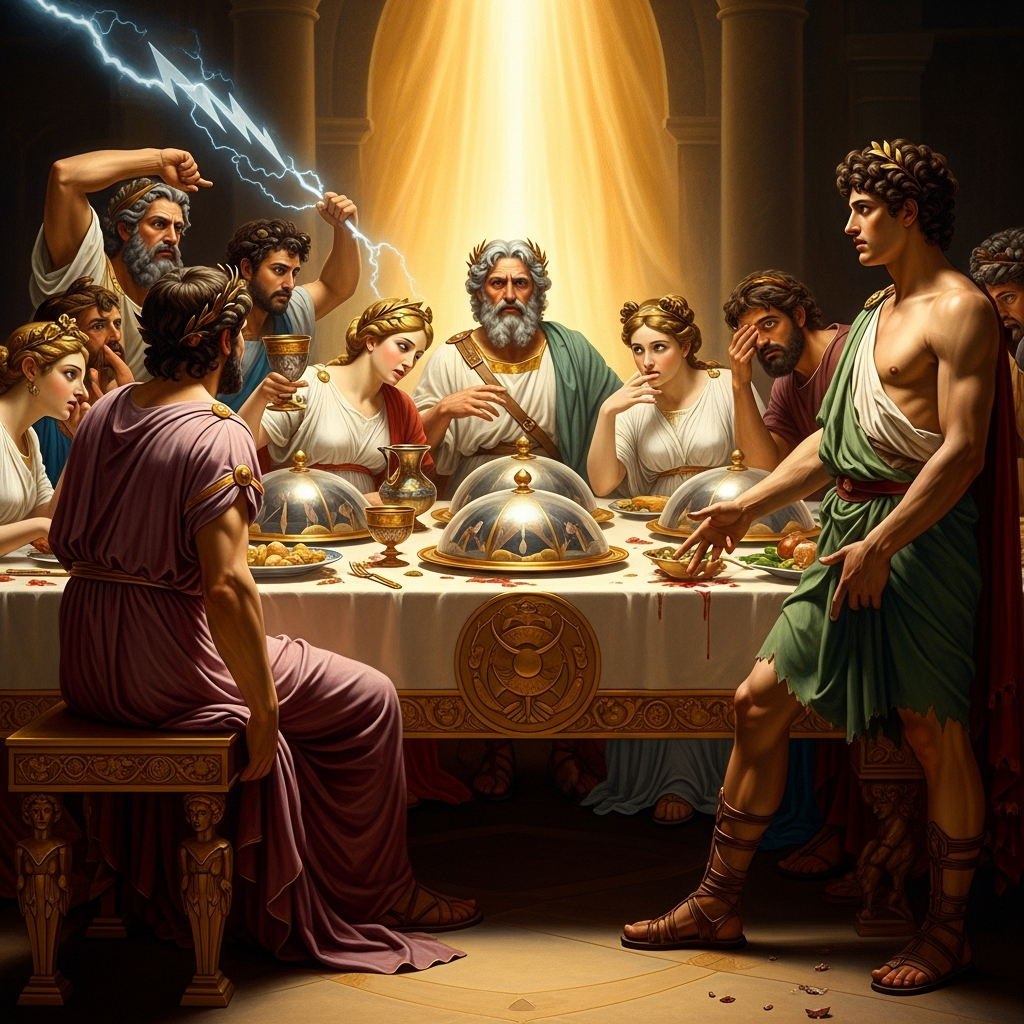
Zeus brings Ixion up to Olympus. Zeus performs the purification himself — the only time in Greek myth that a god performs the ritual cleansing of a mortal’s blood-guilt without delegating it to Apollo or to a priestly intermediary. Zeus washes him. Zeus seats him at the table of the gods. Zeus gives him ambrosia.
It is, by any measure, the most extraordinary mercy in the corpus of Olympian myth. Tantalus had been invited to the divine table for unspecified reasons (and we know how that ended). Ixion is invited for one specific reason: because he had committed a crime no one else would touch, and Zeus alone would touch it.
It is a gift unprecedented in the order of the world.
Ixion sees Hera across the table.
He looks at Hera and he wants her.
This is the moment Pindar holds at length. Ixion has been seated at the table of the gods, given the food of the gods, washed of the worst crime any man has yet committed — and the reaction this produces in him is not gratitude. The reaction is appetite. He looks at Zeus’s wife, and he forms a plan.
Pindar’s line is direct: to be aware of one’s good fortune is the first sign of the well-bred soul; Ixion was not aware. The whole punishment, in the Pythian version, hinges on this — the failure to recognize the gift as a gift. Ixion treats Olympus the way a guest at a feast treats a free buffet: as something he has earned, as something he can take more of, as something that licenses further taking.
He approaches Hera.
What exactly happens between them is described differently across sources. He propositions her; he attempts to assault her; he seduces her; the versions vary. What is consistent is that Hera goes immediately to Zeus and tells him, and Zeus does not believe her — or does not want to — until he sets up a test.
He shapes a cloud.
This is one of the most peculiar images in Greek myth. Zeus takes a cloud — a piece of weather, formless mist — and shapes it into the exact likeness of Hera. The cloud is called Nephele, Cloud; she is given Hera’s face, her body, her hair, her voice. Then Zeus places her where Ixion can find her.
Ixion finds her. Ixion does not realize. Ixion, believing he is in bed with the queen of the gods, lies with the cloud.
The cloud conceives.
This is the impossible part. From the union of a mortal man and a sculpted piece of weather, a child is born — and not just one child, but a whole race. The being that comes from Nephele is named Centaurus, and Centaurus, mating with the mares of Mount Pelion, fathers the Centaurs — half-human, half-horse, the wild race that will live in the Thessalian mountains and eventually war with the Lapiths (Ixion’s own people) at the wedding of Pirithous.
So the Centaurs are born. From a man’s appetite for a goddess he could not have, mediated through a cloud he did not realize was a cloud, comes the entire half-human race that the Greek tradition will use, for centuries afterward, as the visible figure for the human form crossed with something the human form was not supposed to mate with. The Centaurs will be the visible offspring of Ixion’s misrecognition — beings whose very existence is the running consequence of the misrecognition, the human in the upper half always at war with the animal in the lower.
That is one consequence of Ixion’s act. The other is the wheel.
Zeus comes for him.
Ixion has, by now, returned to earth bragging — Pindar reports it — about having had Hera. The bragging is the second offense; the first was the act, but the bragging is what makes the offense unconcealable. Zeus arrives with Hermes, and they take Ixion down.
The punishment is specific.
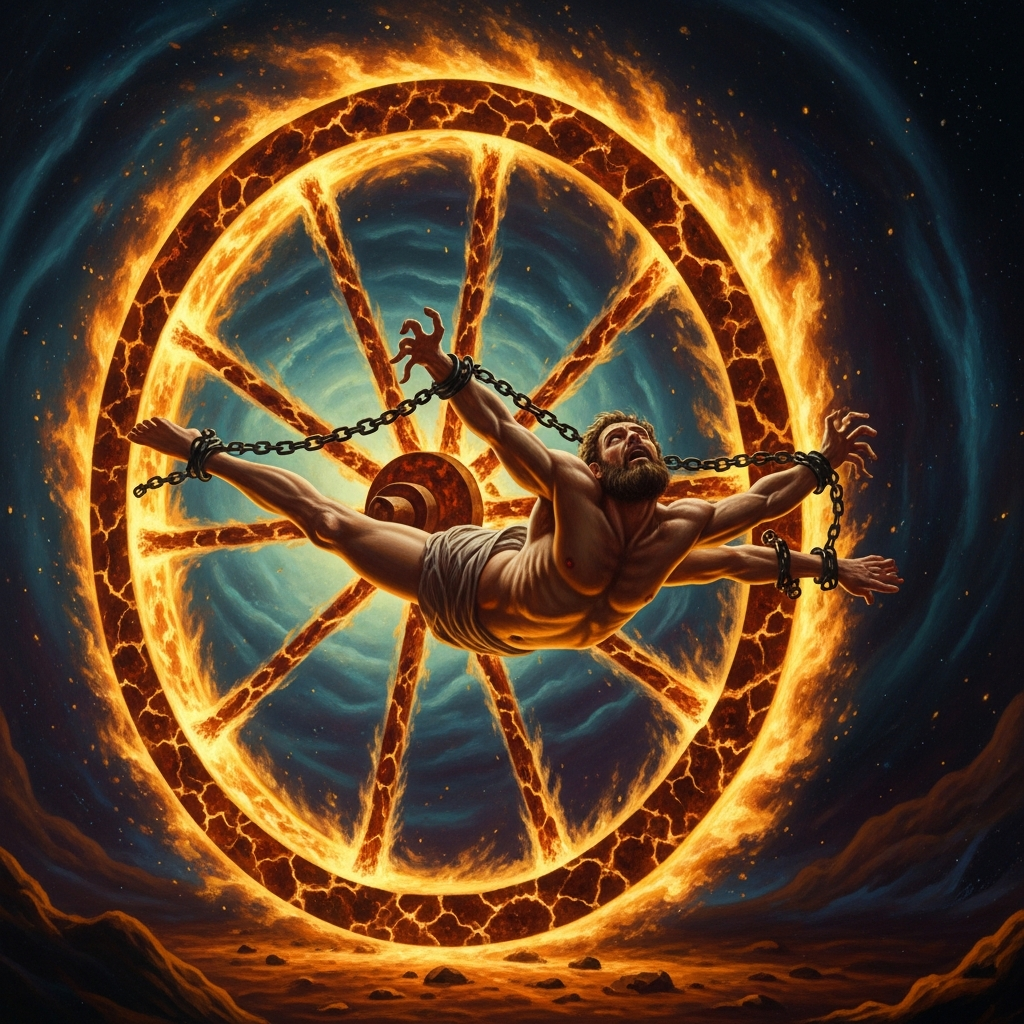
There is a wheel. Some accounts make it a wheel of fire; some make it a wheel of brass with serpents wrapped around it; some make it a wheel of iron studded with hooks. Hermes binds Ixion to the wheel — wrists and ankles spread to the rim, body stretched across the spokes — and then sets the wheel spinning. The wheel turns forever.
It does not turn slowly. It is described as turning with great velocity — Ixion is whipped through the air with a rushing sound, the wheel rotating in the wind, fire trailing behind it. He cannot look in any one direction long enough to see it. He cannot rest. He cannot sleep. The motion of the wheel is the motion of his eternity.
In some versions the wheel is suspended in mid-air in the upper world; Pindar has it down in Tartarus. The geography matters less than the mechanism. Ixion is the spinning man. Ixion is the figure on the rotating wheel of fire. He is, in the Greek tradition, the inventor of the iconography that will become the medieval Wheel of Fortune — the soul bound to a turning shape it did not build and cannot stop.
He is required to recite a phrase as he turns.
The phrase is preserved in Pindar: one ought to repay one’s benefactor with kindly favour. Ixion says it every revolution. He says it forever. He is teaching, by the rotation of his own punished body, the lesson he himself failed to learn at the table where the king of the gods washed his hands of his father-in-law’s blood.
The wheel is in Tartarus next to Tantalus’s lake and Sisyphus’s stone.
The three are the great image-cluster of Greek punitive theology — the three eternal punishments most often paired in art and literature, the three souls Odysseus or Aeneas sees when he descends into the underworld. Tantalus reaches for water that recedes; Sisyphus pushes a stone that always rolls back; Ixion turns on a wheel that never stops. The three figures together encode three different visions of the appetite that consumed itself: hunger that cannot be satisfied, labour that cannot be completed, and motion that cannot be stilled.
Each is also a parable about a specific crime.
Tantalus violated the table — host and guest, the xenia bond.
Sisyphus violated death — he tricked his way out of Hades twice, refusing the order of mortality.
Ixion violated mercy — he was given the rarest gift in Greek myth and used it to attempt the rarest crime.
The wheel turns. The man on the wheel turns with it. Around him in the dark of Tartarus the other punishments grind on at their own pace. Above him, on Olympus, the king of the gods sits at his table and remembers, perhaps, the time he tried to wash a murderer’s hands and was repaid with an attempt on his wife.
Mercy, the story says, is not protection. Mercy is given. What you do with it is what you become.
Pindar’s Second Pythian is the great surviving treatment, and Pindar uses Ixion as a moral exemplar in the most explicit way possible. The poem is addressed to Hieron of Syracuse, a tyrant who had been benefactor to Pindar and the Sicilian city. Pindar tells the Ixion story to Hieron as an extended caution: when you are given good fortune, recognize that it is given. Do not treat it as earned. Do not multiply the gift into license. The line to be aware of one’s good fortune is the first sign of the well-bred soul is, in the Greek, almost a prayer.
The story also bears, in passing, the genealogy of the Centaurs — and that genealogy matters. The Centaurs are not just a fantastic race. They are the embodiment of a specific anxiety in Greek thought: the human form mating across categories with the not-quite-human. They will appear, again and again, as the figures of disorder at the wedding feast — most famously at Pirithous’s wedding, where they get drunk and try to abduct the bride and have to be fought off by the Lapiths. Their crime is always the crime of the wedding-feast violated, the xenia and the gamos together broken. They are repeating, in their own existence, the broken-table crime of their grandfather Tantalus and the broken-marriage crime of their father Ixion. The whole genealogy of trans-categorical disorder in the Thessalian mythic landscape runs back to one cloud and one wheel.
Aeschylus wrote a tragedy called Ixion — lost. Sophocles wrote one — also lost. Euripides wrote one — also lost. The fifth-century Athenian tragedians clearly considered the Ixion story one of the most theatrically rich myths in their inheritance, but none of their treatments survive. What we have are the lyric treatment of Pindar and the prose summaries of the mythographers. The wheel itself — the visual image — survives in Greek vase painting, in Roman wall painting at Pompeii, and in the medieval iconography of the Wheel of Fortune that descends from it. The figure on the rim, going around forever, is one of the longest-lived images in Western art.
The deepest line in the myth is the smallest. Zeus did not have to take him up. Zeus did not have to wash his hands. Ixion was unwashable by every other authority; only Zeus extended the mercy. The wheel exists because the mercy was extended. The whole punishment is the result, not of the original murder, but of what Ixion did with the mercy that was offered for it.
Mercy is what you can refuse. What turns on the wheel is the soul that refused.
Echoes Across Traditions
Entities
- Ixion
- Zeus
- Hera
- Nephele
- Eioneus
Sources
- Pindar, *Pythian Ode* 2.21-48 (470s BCE)
- Diodorus Siculus, *Library of History* 4.69
- Apollodorus, *Bibliotheca* Epitome 1.20
- Hyginus, *Fabulae* 33, 62
- Aeschylus, *Ixion* (lost play)